
Mechanical Engineering Building Self-Guided Tour
 Thank you for visiting the Mechanical Engineering Building at Purdue University! This is the headquarters of the largest ME school in the country, with more than 3,000 undergraduate students, 1,000 graduate students, and 95 full-time faculty.
While most Purdue ME students get their start in this building, Mechanical Engineering research can be found in more than 20 buildings on- and off-campus, including all the way in Indianapolis. But right here is the best place to start, to learn about the world-changing influence of Purdue Mechanical Engineering.
Start on the ground floor, in the big open space with flags...
 1. Atrium
This open space is the focal point of the ME Building, and a gathering place for all sorts of events. During the school year, companies will come and set up informational booths in the atrium, offering students the chance to share their resumé and discuss job opportunities. We even have student bands play music here in the ten minutes between classes! (We call it Ten Minutes of Talent!)
The flags on the wall represent which countries our students came from to attend Purdue Mechanical Engineering. Currently we have students from 85 different nations.
NEXT: Look to your right, and find the display cases that make up...
 2. Toy Museum and 3D Printing Lab
Every toy in the Toy Museum was designed and built by students in ME444, Computer-Aided Design. This is one of the most popular classes at Purdue, and it teaches concept generation, CAD design, rapid prototyping, and finite element analysis. The final project is to design and build a toy — some of them purely mechanical, while others include electronic elements.
To the left of the display cases, you can see through the window into our 3D Printing Lab. Any student is welcome to use these 3D printers to create prototypes, class assignments, or personal projects.
NEXT: Follow along that wall, until you find...
 3. Trains!
Why trains? Because Purdue Mechanical Engineering became well-known in the 1890s as the first ever laboratory for locomotives. That’s why Purdue students are called “Boilermakers,” and why you often see a locomotive called the Boilermaker Special driving around campus! We have two models to celebrate this: a 1902 display with a crank you can turn, and an 1893 display that was shown at the Chicago World’s Fair, portraying what our locomotive laboratory looked like. And, if you look closely, you can see “train tracks” embedded in the floor of the Atrium!
NEXT: Look to the right of the 1893 train display to see the double doors to a...
 4. Classroom
This is ME1130, one of the larger classrooms in the ME Building. Feel free to take a peek inside (but don’t barge in if class is going on!) This is a typical size of most core classes that ME students take; generally, the farther you advance in your degree, the smaller the class sizes get. Most Purdue classrooms also feature recording capabilities, which allow you to go back and review lectures and notes to prepare for your homework and exams.
NEXT: Turn to the left and head toward the grid of glass windows that say “Mechanical Engineering,” which is our...
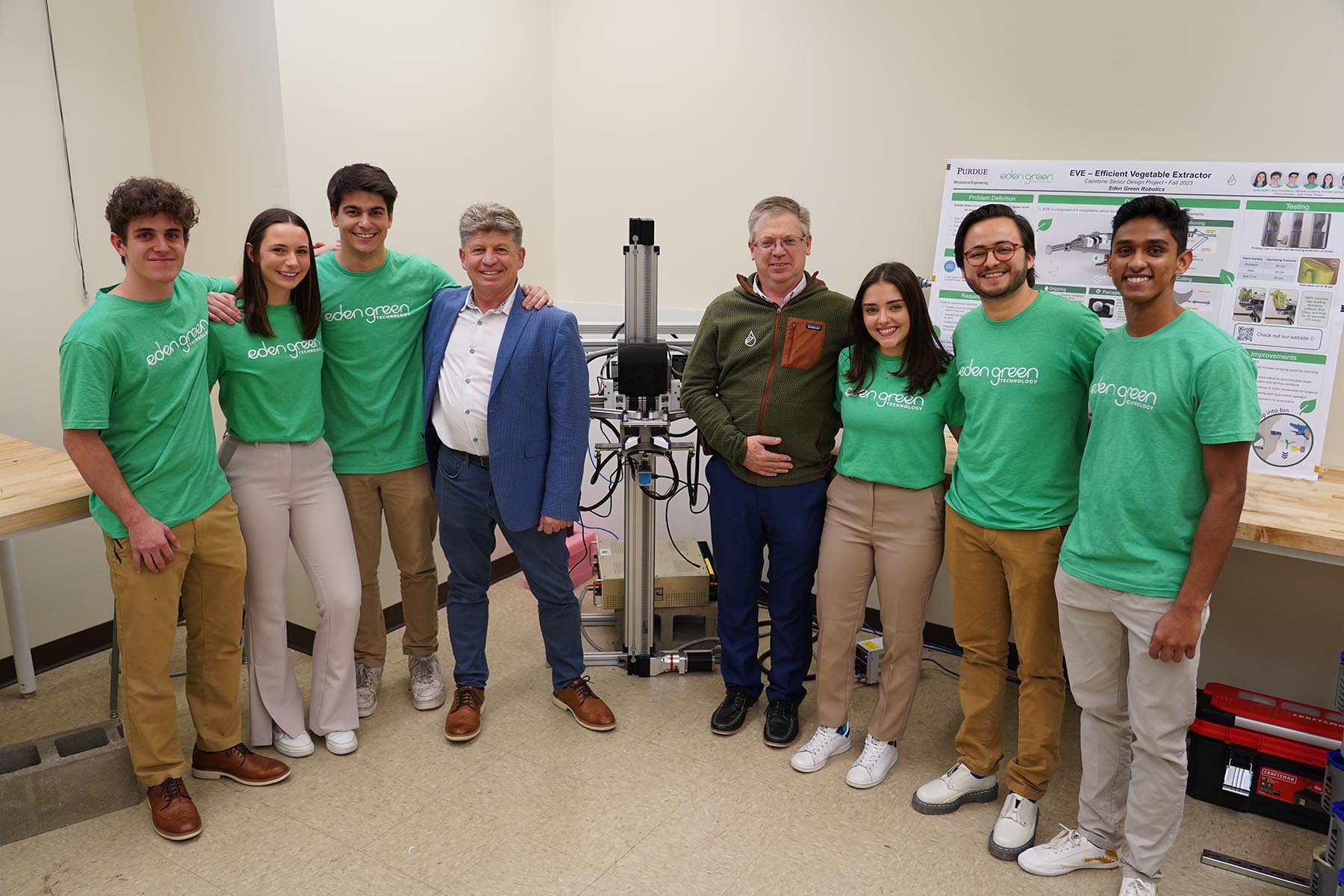 5. Capstone Design Workshop
These areas (and several others nearby) are exclusively for our seniors, taking their final class: ME463 Capstone Design. In this capstone class, teams of students work closely with faculty members and industry partners to create prototype products, continually refining and improving them using the knowledge from their engineering courses over the last four years. At the end of the semester, the students present their final prototypes to a panel of industry judges, ala Shark Tank. The best prototypes win cash prizes!
NEXT: To your left, there is an elevator. Go up to the 2nd floor, then turn right to walk to...
 6. Clock
This purely mechanical clock from 1895 symbolizes the deep roots of mechanical engineering at Purdue. It first rang out in Heavilon Hall, the earliest building that hosted mechanical engineering studies at Purdue. After decades in storage, the clock was rebuilt and refurbished by our staff and faculty in the 2010s. Its 11-foot pendulum keeps time, while the 200-pound counterweight must be manually cranked every four days.
NEXT: Turn left, to the hallway with the curved pillars...
 7. Advisors’ Offices
These offices belong to our Undergraduate Advisors. Students meet with their respective advisor once per semester to plan their academic journey together, and make sure they stay on track to graduate on time. They also assist with co-ops & internships, study abroad, academic and campus resources, career planning, and much more.
NEXT: Keep following the curved pillars to...
 8. Commons
This is one of several study areas in the ME Building, open to all students. It’s also the occasional home to events (both planned and unplanned), from office hours consultations to birthday parties and research showcases. Nearby is the Main Office and several conference rooms, if you need more formal space.
NEXT: go through the double doors to the white hallway, and take the first staircase on your right (an elevator is also available at the end of the hallway). Go down one floor, and you will see...
 9. Classrooms and Computer Labs
This floor has several classrooms and computer labs for core classes. In addition to calculus and other math classes, ME students also take Statics and Dynamics, Design and Manufacturing, Thermodynamics, Controls, and Fluid Mechanics. But they have a lot of freedom to choose Technical Electives from other schools that are focused on what they what to pursue.
NEXT: keep walking down the hallway, and look for a turn off to the right with a picture of the rising sun. This leads to the...
 10. Instructional Labs
ME students don’t just do classroom work; they also get hands-on. This hallway hosts our Instructional Labs. This first one is Heat Transfer, where they use thermocouples to track how heat moves through conduction, convection, and radiation. The next one is Fluid Mechanics, which teaches about turbulence and friction and airflow. They use a wind tunnel to plot out different objects and learn how air moves. And at the end is Controls, where students build microcontroller-powered devices and learn how to use feedback to do what they want.
NEXT: double-back to the main hallway, and to the right is a stairway (or elevator) to the ground floor. After reaching the ground floor, veer to the right and look for signs to the...
 11. Manufacturing Studio
This is our Manufacturing Studio, featuring welding, woodwork, and machining (please just peek in the doors; for safety reasons, only students have access to the shop). This fully-staffed facility enables students to use drills, lathes, CNC machines, and more to machine and manufacture both class assignments and their own personal projects.
Never been in a machine shop before? Don’t worry. As part of the sophomore-level design class ME264, each student has the opportunity to learn about the machines by making their own aluminum hammer. The hammer becomes your own personal keepsake at the end of the class!
NEXT: double-back onto the main ground floor hallway by the bricks. There you’ll find...
 12. History Wall
This brick wall is the last bit of the original ME building that is still visible (at least from the inside!) And so this is our History Wall. If you have time, you can come back and read through all these placards, which go through 150 years of our history.
Take note of the placards about halfway through, which describe the amazing research facilities Purdue has outside this building. Zucrow Labs is the largest academic propulsion lab in the world. Herrick Labs is the largest academic HVAC lab in the world. Maha Labs is the largest academic hydraulics lab in the world. People come from all over the world to conduct research here.
NEXT: keep going to the end of the hallway and you’ll learn about...
 13. Motorsports
This is a Formula SAE car. It’s one of numerous SAE design organizations that enable Purdue students to design, build, and test their own car. Every year, students start in the fall and design this car from scratch, and they manufacture it right here on campus. They test it on track in the spring, and then in the summer, they travel to compete against other schools. We have teams that build dune buggies, electric cars, go karts, and even solar-powered cars. This Formula car finished 6th out of a hundred schools this summer, and Purdue is the only Formula student team in the country to finish top 10 every year since the pandemic.
Motorsports is a big deal here at Purdue. We have alumni throughout NASCAR, IndyCar, and Formula 1. And down in Indy, we have the only accredited Motorsports Engineering program in the country, which is just down the street from the Indianapolis Motor Speedway.
Motorsports is a great way to apply what we learn in the classroom onto a real-world thing; but it's also a great way to exercise those super-important soft skills, like teamwork, project management, and supervising people.
NEXT: Pop up the steps, and you’re back in the Atrium where you started.
Thank you for taking our self-guided tour of the Mechanical Engineering Building at Purdue University! We hope you got a glimpse into the amazing work that our students and faculty undertake every day.
If you have questions, the best place to get answers is our website: https://purdue.edu/ME
You can also follow us on X, Instagram, Facebook, LinkedIn, and YouTube!
More interested in graduate-level research? Take a look at:
- Herrick Labs, the largest academic HVAC lab in the world
- Zucrow Labs, the largest academic propulsion lab in the world
- Maha Labs, the largest academic hydraulics lab in the country
- YouTube playlist of all our Purdue ME faculty research