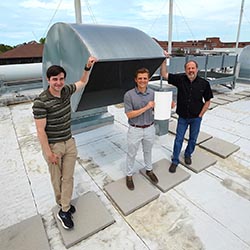
With today’s “smart” homes, you can activate lights and air-conditioning with a simple verbal request. But are these systems really “smart” enough to know which room you’re in? Can they save energy by cooling just one specific corner of the room? That’s the idea behind the Human Building Interactions Laboratory (HBIL), a first-of-its-kind interactive facility at Purdue University that will enable HVAC systems to become truly reconfigurable, right down to the specific wall panels.
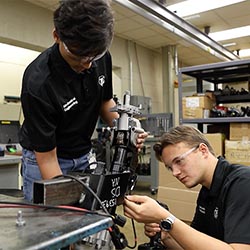
During the school year, Jennifer Short is a typical mechanical engineering student at Purdue. But when the racing calendar begins, her true passion for motorsports takes over. She discusses her recent internship with 14-time INDYCAR champions, Chip Ganassi Racing.
Purdue University hosted a four-day conference, led by Luciano Castillo, packed with content aimed at building a diverse STEM workforce, promoting sustainability and climate change, and collaborating with the best and brightest minds worldwide to solve critical problems around the globe.
Pancreatic cancer is the third leading cause of cancer deaths in the U.S., with approximately 60,000 new cases a year, resulting in a projected $3.2 billion burden to the healthcare system. Now, thanks to a grant from the National Cancer Institute, Purdue University's Bumsoo Han will be fighting the disease by building micro-environments to test new therapies.
Purdue ME has moved up two spots as the #6 undergraduate mechanical engineering program in the country, according to the 2023 US News and World Report rankings.
Precisely targeted drug delivery is the dream of biomedical engineers, and Purdue researchers will soon be using microrobots to deliver the goods. The National Institutes of Health (NIH) have awarded Purdue a $1.11 million grant to investigate targeted drug delivery in a live colon using tumbling magnetic microrobots.
Andres Arrieta's team created a giant-sized interactive wall of bistable dots for Boiler Gold Rush, the orientation event for incoming freshmen. It's one of several interactive exhibits that used art to introduce students to engineering.
A tiny bubble popping within a liquid seems more fanciful than traumatic. But millions of popping vapor bubbles can cause significant damage to rigid structures like boat propellers or bridge supports. Can you imagine the damage such bubbles could do to soft human tissues like the brain? During head impacts and concussions, vapor bubbles form and violently collapse, creating damage to human tissue. Purdue University fluid mechanics researchers are now one step closer to understanding these phenomena.