
Soft sensors help to map prosthetic pressure points
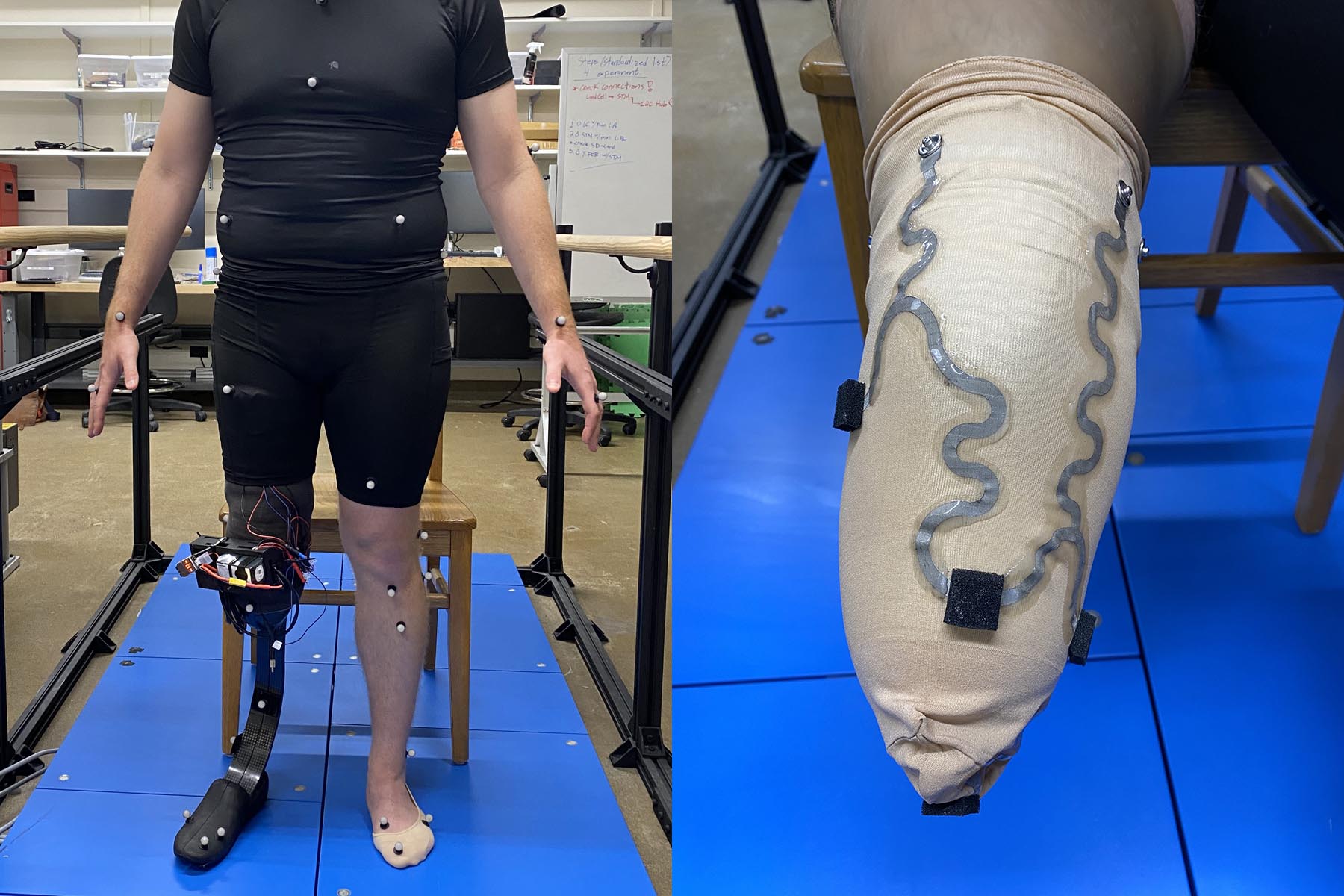
“There are more than 2 million people living with limb amputation in the United States, and 50 million worldwide,” said Tianhao Yu, graduate student in mechanical engineering and co-lead author of the paper. “For those who wear prosthetics, a great amount of pressure can be applied to the residual limb, which causes pain and discomfort. If doctors had more accurate data about this pressure, they could help to prevent these secondary injuries.”
Doctors and prosthetists have attempted to quantify this pressure, but it’s been a difficult task. Most measurements rely on rigid sensors and circuit boards, which actually introduce more discomfort. Those sensors also have a narrow range of pressures they can measure — usually less than 100 kilopascals.
Yu turned to his advisor, Chi Hwan Lee, Professor of Biomedical Engineering and Mechanical Engineering. As a Purdue faculty member since 2015, Lee has developed a broad range of wearable medical devices, from smart bandages to smart contact lenses — and even Bluetooth health sensors for horses. The challenge: create a textile-based soft pressure sensor that can conform to a residual limb, but also accurately measure the high pressures experienced in a prosthetic.
Their approach involves a 1.5-centimeter square of polyurethane foam, soaked in a solution of adhesion promoter and then carbon nanotubes. When the foam compresses, its electrical resistance changes, which can then be correlated to an accurate pressure reading of the affected area. This can be worn comfortably by the patient, while the sensor can monitor pressures up to 4,000 kilopascals.
Their research has been published in ACS Nano.
“We started with optimizing the foam,” Yu said. “We tested different materials of varying size, thickness, and porosity, until we found a sweet spot that gave us the data we needed.”
The team then coated the foam inside-and-out with functional materials, iterating until they discovered the right density and concentration. “As the porous structures of the foam become compressed, the carbon nanotubes come into contact with each other,” Yu said. “That decreases the overall electrical resistance of the sensor, and that is something we can measure and calculate to derive the pressure applied to the foam square.”
They then integrated the sensor into something an amputee could easily wear. They collaborated with Edgar Bolívar-Nieto, Assistant Professor of Aerospace and Mechanical Engineering at the University of Notre Dame, to attach these sensors to a textile sock worn by amputees at the interface of the prosthetic limb. They could even rotate and move the sensors to gather dimensional data at multiple pressure points on the limb.
Next step? A human trial.
Yu teamed up with Axel González Cornejo, a graduate student in Bolivar-Nieto’s lab, to enlist the help of a Notre Dame student with a lower-leg prosthesis. While wearing the biosensor sock, the student engaged in a series of sitting, standing, and walking exercises. “Our subject said it felt natural, like the sensors weren’t even there,” Yu said. “And what’s more important — the data we gathered was an exact match for the ground truth we tested beforehand, so we knew the sensors were delivering accurate data.”
The team also developed a smartphone app, so this pressure information could be both displayed live for the patient, and saved for future analysis by doctors and prosthetists.
“This is the culmination of three years of work,” Yu said. “But we’re not finished. Our goal is to build more advanced sensors, because the pressure of this prosthetic limb interface is still very complex. We want to be able to deliver the most customizable data for our patients, to give them the best possible experience with their prosthetic.”
The research reported in this publication was supported by the National Institute of Biomedical Imaging and Bioengineering of the National Institutes of Health under Award Number R21EB034879. Patents are being applied for by Purdue Research Foundation's Office of Technology Commercialization. If you are interested in licesning this technology, contact Clayton Houck at CJHouck@prf.org and reference number 2025-LEE-71204.
Source: Chi Hwan Lee, lee2270@purdue.edu
Writer: Jared Pike, jaredpike@purdue.edu, 765-496-0374
Ultrawide-Range Wearable Pressure Sensors for High-Load Prosthetic Interfaces
Tianhao Yu, Axel González Cornejo, Ziheng Wang, Junsang Lee, Taewoong Park, Sbeydi Ponce Duarte, Seokkyoon Hong, Edgar Bolívar-Nieto, and Chi Hwan Lee
https://doi.org/10.1021/acsnano.5c18106
ABSTRACT: Wide-range pressure sensing is essential for wearable biomedical systems operating under diverse mechanical conditions, such as prosthetic interfaces, surgical tools, and rehabilitation devices. However, current wearable pressure sensors remain limited to narrow pressure ranges (typically ≤100 kPa), restricting their use in high-pressure settings, such as prosthetic sockets. Here, we report a wearable pressure sensor with an ultrabroad detection range — from 70 Pa to 4 MPa — representing one of the widest ranges reported to date for wearable systems. The key enabling strategy is the use of poly(diallyldimethylammonium chloride) (PDDA) as a molecular binder to electrostatically anchor multiwalled carbon nanotubes within a polyurethane foam scaffold. This PDDA-assisted layer-by-layer assembly produces a stable, homogeneous, and highly compressible conductive network that preserves sensitivity across both subtle and extreme pressures. We integrated the sensor into a smart sheath for lower-limb prosthetics and demonstrated real-time pressure mapping during sitting, standing, and walking. This system provides a practical route toward continuous, high-pressure monitoring in prosthetic and other demanding wearable applications.