
Seawater desalination project receives $250,000 as XPRIZE semifinalists
In parts of the world where fresh water is scarce, many people rely on a process called “reverse osmosis” to desalinate seawater — flowing it over a membrane at high pressure to remove the minerals. Purdue University engineers have developed a variant of the process called “batch reverse osmosis,” which promises better energy efficiency, longer-lasting equipment, and the ability to process water of much higher salinity. Their team has been awarded $250,000 as semifinalists in the worldwide XPRIZE Water Scarcity competition, where their prototype will compete for a potential prize pool of $119 million.
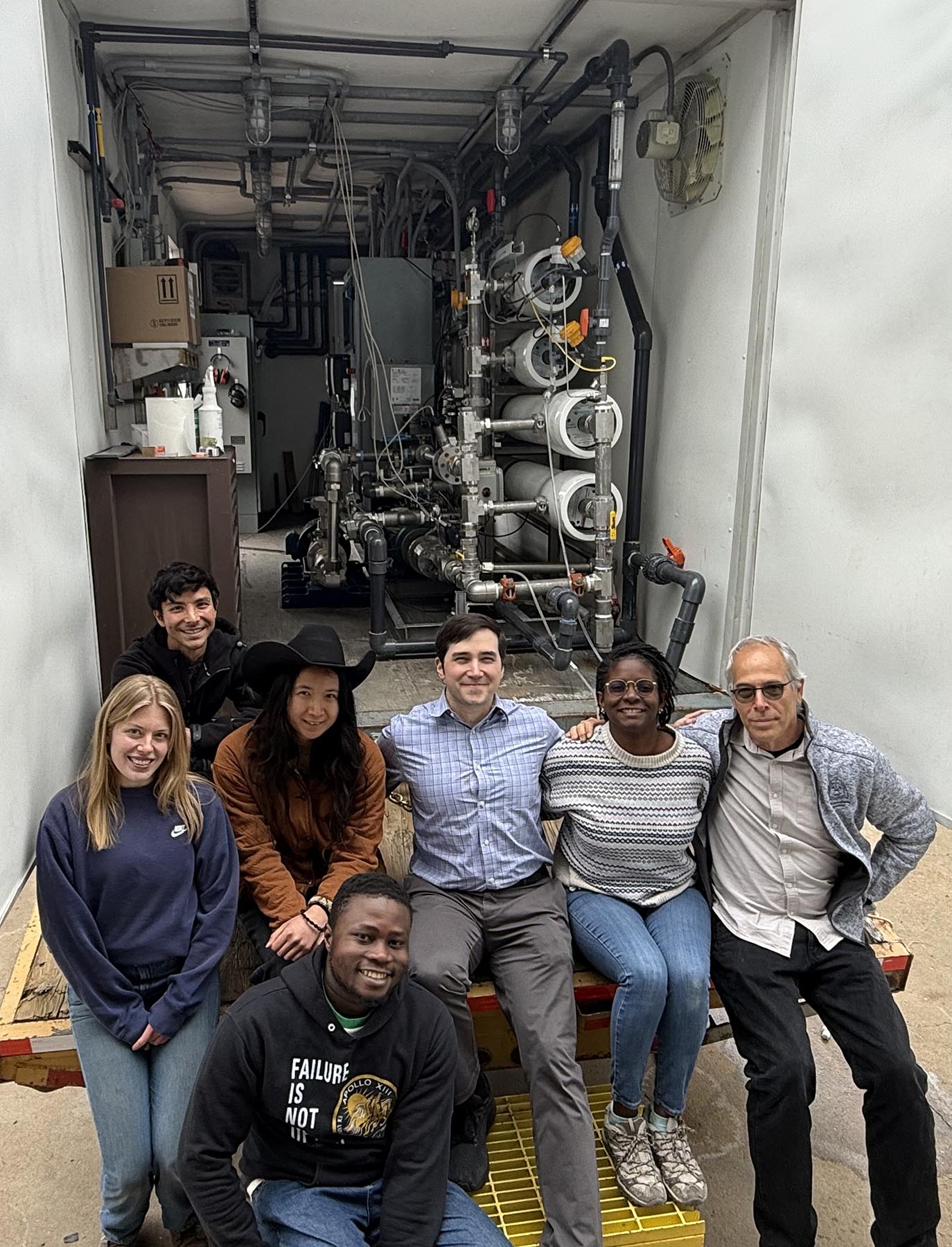
David Warsinger, associate professor of mechanical engineering, has been developing the concepts of “batch reverse osmosis” since his doctoral work at MIT in 2015, and holds several patents on the technology. Rather than keeping a constant flow of seawater at high pressure levels, a batch process takes in a set quantity of water at one time; processes it; discharges it; and then repeats the process with the next batch. This approach saves substantial energy, as the pressure can ramp up over time to barely exceed the increasing osmotic pressure, reducing pumping energy.
Warsinger’s lab has received several grants to study aspects of batch reverse osmosis. In 2023, the team received a $1.67 million grant from the U.S. Department of Energy to develop the largest pilot yet for batch reverse osmosis, collaborating with Tzahi Cath at Colorado School of Mines. This system allows Warsinger and his team to compare multiple configurations head-to-head — comparing the energy efficiency, salt rejection, and water recovery to verify which desalination processes should be pursued in the future.
That’s when XPRIZE came calling. “XPRIZE funds competitions to tackle the world’s grand challenges,” Warsinger said. “Last year they teamed up with The Mohamed bin Zayed Water Initiative to fund a competition that addresses water scarcity around the world. Our system is perfectly positioned for this.”
Warsinger’s team, Renaissance Water, consists of the for-profit company his colleagues spun up at MIT, Harmony Desalting, along with a coalition of academic and industry partners. In December 2025, they conducted a two-week test of their system on seawater in Massachusetts, desalinating 4 tons per day with 48% water recovery and 98% uptime.
An independent judging panel of desalination experts reviewed the test, and in May 2026, XPRIZE announced Renaissance Water as one of the twenty semifinalists in their system-level innovation track. Each semifinalist receives $250,000, and the opportunity to demonstrate their system in a robust real-world setting.
“They want to see four weeks of real-world operation,” Warsinger said. “We are using the semifinal prize money to construct a higher-pressure system, capable of desalinating 20 gallons of seawater per minute. We will test this at end of this year at a desalination plant in Cyprus.”
From these tests, XPRIZE will downselect to just five finalist teams, who will each receive $2 million. They will then conduct final tests in 2027 and 2028, constructing systems that are capable of desalinating 200 gallons per minute. From this, one team will be selected for the $40 million grand prize. Additional prizes are also available for exceptional performance in key environmental and system-level metrics. The total prize pool of $119 million makes this the largest competition XPRIZE has ever conducted.
Warsinger says his team is up for the challenge. “Our technology is very scalable,” he said. “The challenge lies in building a system that is both robust and portable. We have pumps, tanks, high voltage power lines, structural supports. It already takes up most of a shipping container now; if we qualify for the finals, the next prototype will be even larger.”
This technology was disclosed to the Purdue Innovates Office of Technology Commercialization, which applied for a patent through the U.S. Patent and Trademark Office.
Despite the challenges, the stakes of water scarcity around the world are even bigger. “We have a triple whammy of growing population, shrinking fresh water sources, and environmental sustainability concerns,” Warsinger said. “Our system helps with all of that. It can desalinate seawater efficiently. It requires less energy to run. It can be used in high-salinity areas to remediate water. It has lower fouling, and thus lower maintenance costs. There are many advantages.”
“I think we have the best technology in the competition,” he continued. “I look forward to showing the judges what we can do.”
Source: David Warsinger, dwarsing@purdue.edu
Writer: Jared Pike, jaredpike@purdue.edu, 765-496-0374