
Acoustic "virtual walls" create microchannels that never clog

Microfluidics have transformed many scientific fields by miniaturizing fluidic processes down to micro- and nano-scales. Researchers have used microfluidic devices to cool semiconductors and electronics, or create biological tools to diagnose diseases like cancer.
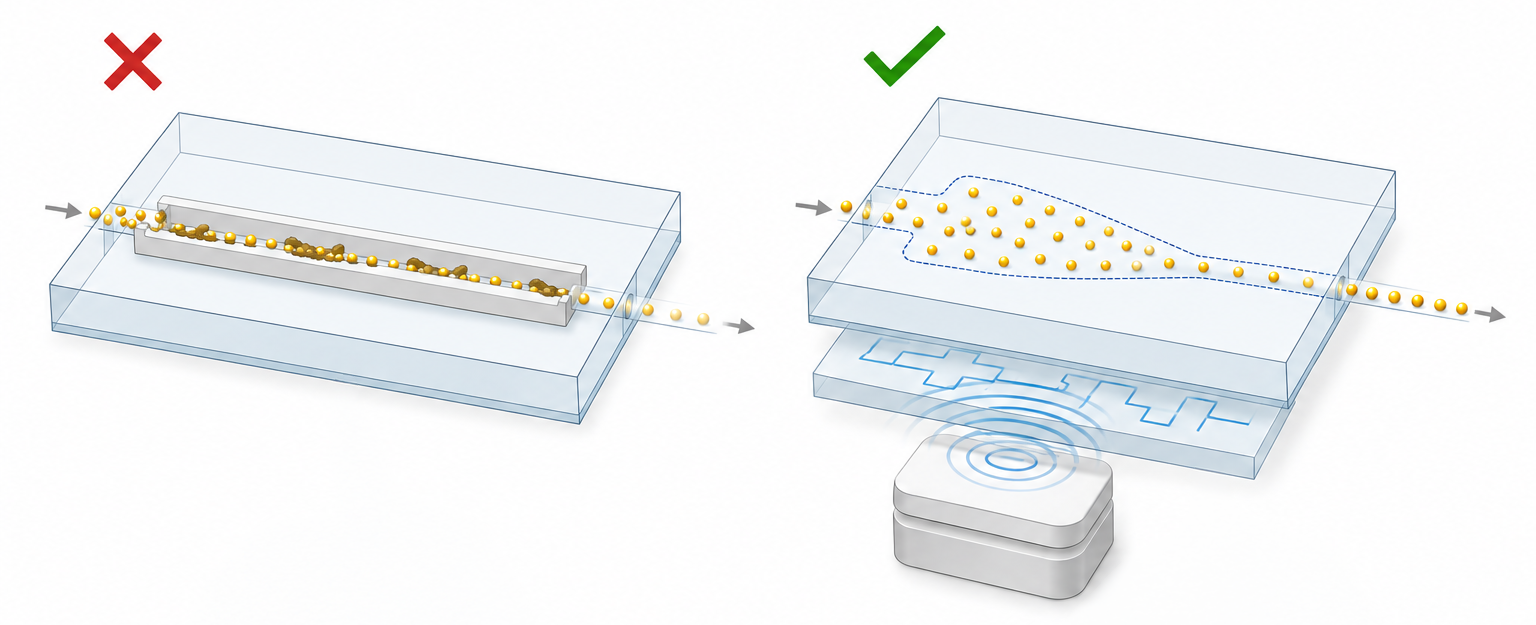
But there’s a problem. “Many of my colleagues have encountered frustration using these devices,” said Junfei Li, assistant professor of mechanical engineering. “They spend hours in a cleanroom fabricating these specialty devices with tiny microchannels. Then they run their experiments for a day, and the device is already clogged, contaminated, and unusable. Then they have to start over again fabricating a whole new device. These microchannels have limited throughput because of the size and drag force of the physical walls, which negate their effectiveness for quickly sensing cells or other biological processes.”
Li, an acoustics researcher, saw a solution from his work with ultrasonic tweezers. “We’ve demonstrated that we can use ultrasonic energy to move physical particles. What if we combine acoustics with microfluidics, and create microchannels that never clog?”
The result is a two-inch block of glass, with an unrestricted chamber inside and ultrasonic transducer underneath. In between is a custom-designed polymer sheet that reshapes the ultrasonic waves into a specific pattern. When the transducer is activated, particles flowing through the chamber immediately conform to a predetermined virtual channel. This enables flow rates that are orders-of-magnitude higher than conventional microfluidic systems.
Their research has been published in Science Advances.
They began their experiments by choosing a sample polystyrene particle that would mimic the size of cells being sorted by a typical biomedical microfluidic device. They then calculated the proper wavelengths of acoustic energy that would cause those particles to move. They used an ultrasonic transducer, which generates acoustic waves beyond the range of human hearing.
Then came the secret sauce: the polymer sheet. It’s made of polydimethylsiloxane (PDMS), an elastic silicone polymer that reshapes acoustic energy through geometry. By designing a custom polymer sheet, they can create a waveguide that allows some acoustic energy to be blocked, and others to be transmitted straight through to the channel without scattering.
“This allows us to create a very clean acoustic field inside the chamber,” said Hajin Oh, Ph.D. student in Li’s lab and first author of the paper. “By just changing the design of the polymer sheet, we can essentially control where the acoustic energy is directed.”
After many iterations, they developed a prototype that successfully channeled the particles within their predetermined “virtual walls.” Then they began experimenting with other virtual microchannel structures, mimicking how actual biological microfluidic devices would be used.
“Sometimes a researcher needs a minimum number of cells to enable a successful test,” Oh said. “So we created a virtual ‘corral,’ collecting particles in one place until we had a sufficient number to test. Then we turned off the ultrasound, which released the clump of particles to be tested.”
They also experimented with two different density particles, mimicking how various size or density cells would flow differently through a biological sensing device. The ultrasonic waves moved just one kind of particle into the channel, leaving the other untouched. This allowed them to successfully sort the two kinds of particles using just acoustic energy.
Using touch-free acoustic microchannels has multiple advantages. The first is customization. Many microchannels are not just straight lines; they can be complex paths, which require specialized equipment to fabricate. With acoustic microchannels, all you’d need to replace is the thin polymer waveguide sheet, which can be customized for each individual task.
The second advantage is scale. “Typical microfluidic devices can flow microliters per minute, which may work in a lab but is not suitable for scaling up,” Li said. “This process enables the same microfluidic channels, but we can flow milliliters per minute — orders of magnitude more flow in the same amount of time, without clogging or affecting the particles.”
Li’s team is currently researching other options for this technology, including dynamically switching the steering of particles, or moving them through 3D space. “We’re just starting to think about the possibilities,” Li said. “In addition to biological testing, we can imagine manufacturing — say, pharmaceuticals being able to filter this ingredient from that ingredient at a factory scale. We’re excited to collaborate in the future.”
Source: Junfei Li, junfeili@purdue.edu
Writer: Jared Pike, jaredpike@purdue.edu, 765-496-0374
Acoustic Virtual Walls Enable Open, Scalable, and Programmable Microfluidics
Hajin Oh, Mingyuan Liu, Tony Jun Huang, Junfei Li
https://doi.org/10.1126/sciadv.aec0104
ABSTRACT: Microfluidic platforms are widely used across biomedical research, chemical synthesis, diagnostics, environmental monitoring, and materials science for precisely manipulating small volumes of fluids and suspended particles. However, conventional systems rely on narrow physical channels that are prone to clogging, limited volumetric throughput due to high hydraulic resistance, and excessive shear stress that can damage sensitive cells and fragile materials. To overcome these constraints, we introduce acoustic channeling within a wide, open fluid chamber by replacing solid boundaries with Acoustic Virtual Walls. These walls are formed by evanescent acoustic pressure fields generated from an engineered two-dimensional waveguide that suppresses internal wave propagation and produces highly localized subwavelength fields. This architecture minimizes shear stress while guiding particles along precisely defined trajectories. The electronically tunable acoustic field enables programmable, remote, and real-time particle control. Supported by simulations, we demonstrate diverse channeling designs, efficient particle collection, and material-specific separation. Operating at milliliter-per-minute flow rates, two orders of magnitude higher than conventional microfluidic systems, this platform enables scalable, clog-free microfluidics for high-throughput and robust applications.