
Aaed Musa's robots launch him to YouTube success
Aaed Musa was like any other mechanical engineering student at Purdue University, using 3D printers to build projects... except his projects were robot dogs, CD slingshooters, infinitely spinning tops, and most importantly, a YouTube audience of millions.
Growing up in Jacksonville, Florida, Aaed displayed all the hallmarks of a budding engineer. “My mom would take me to the dollar store and we’d buy cardboard and scissors and popsicle sticks and glue, and just build whatever we imagined,” he said.
He soon progressed from cardboard, to LEGO, to robotics — thanks in part to the phenomenon of YouTube science creators. “I watched a lot of engineering videos,” he said. “The Hacksmith, Colin Furze, The King of Random, Mark Rober — those guys were huge inspirations. I’d watch their videos and try to recreate some of the things that they did.”
He taught himself robotics and 3D printing, and before long he was building projects of his own — and filming them. “My first YouTube video was a wrist-mounted Nerf gun, so you could wear it like a watch,” he said. “People liked my videos, so I kept making them!”
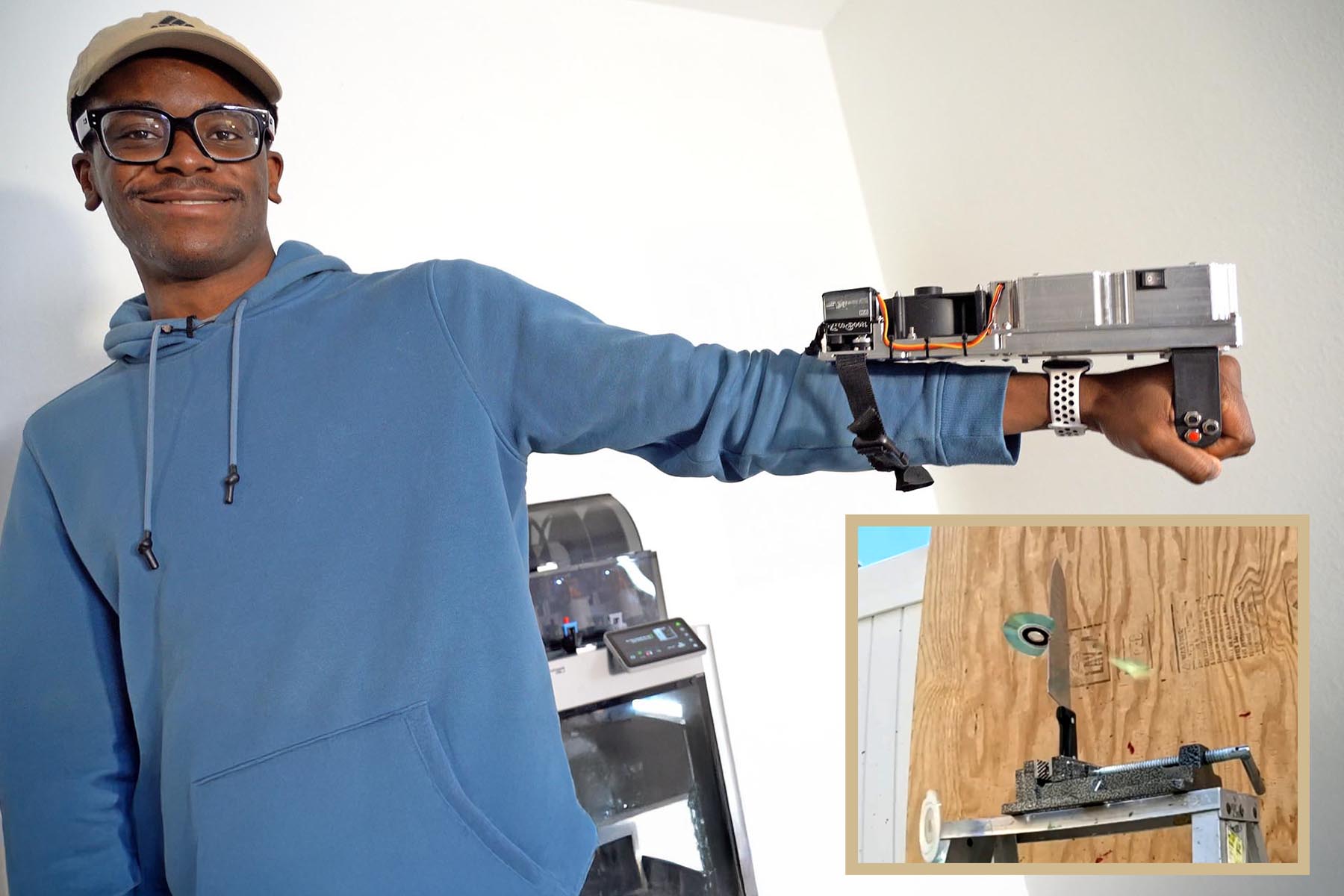
A handful of YouTube subscribers turned into thousands... then tens of thousands... and then hundreds of thousands. Aaed began designing and building more advanced projects, like a two-wheel gyroscopically balancing robot; or a top that can spin for more than two hours; or a wrist-mounted slingshot mechanism for launching mini CDs at a target. He built a floating platform that senses the location of a ball bearing, and automatically adjusts itself to keep the ball from rolling off the edge (further iterations heighten this talent by intentionally causing the ball to dance in abstract patterns).
These videos showcase another of Aaed’s strengths: explaining the underlying physics and engineering principles involved. As he walks the audience through his build, Aaed scribbles equations on an iPad to explain inverse kinematics, or gear ratios. “Viewers want to understand this stuff; that’s why they watch videos like this,” he said. “You have this entertaining video, but you can also teach people things. I think it’s so cool that you can do both.”
Boiler Bots
While pursuing his YouTube career, Aaed chose to enroll at Purdue University to study mechanical engineering. “Purdue is one of the top engineering schools in the country,” Aaed said. “But more than just academics, I wanted a school that had a good engineering culture. Being surrounded by people that have the same passion as you is very important.”
He found that Purdue’s classes supercharged his robot-building abilities. “Statics and Dynamics were a game changer,” he said. “Understanding how to draw a free body diagram, and analyzing the load on a joint or a bar, is super important. Sometimes I’ll design something and it will break, and I’m curious about, ‘how do I design this so it doesn’t break?’ Using Statics and Dynamics, I can figure that out.”
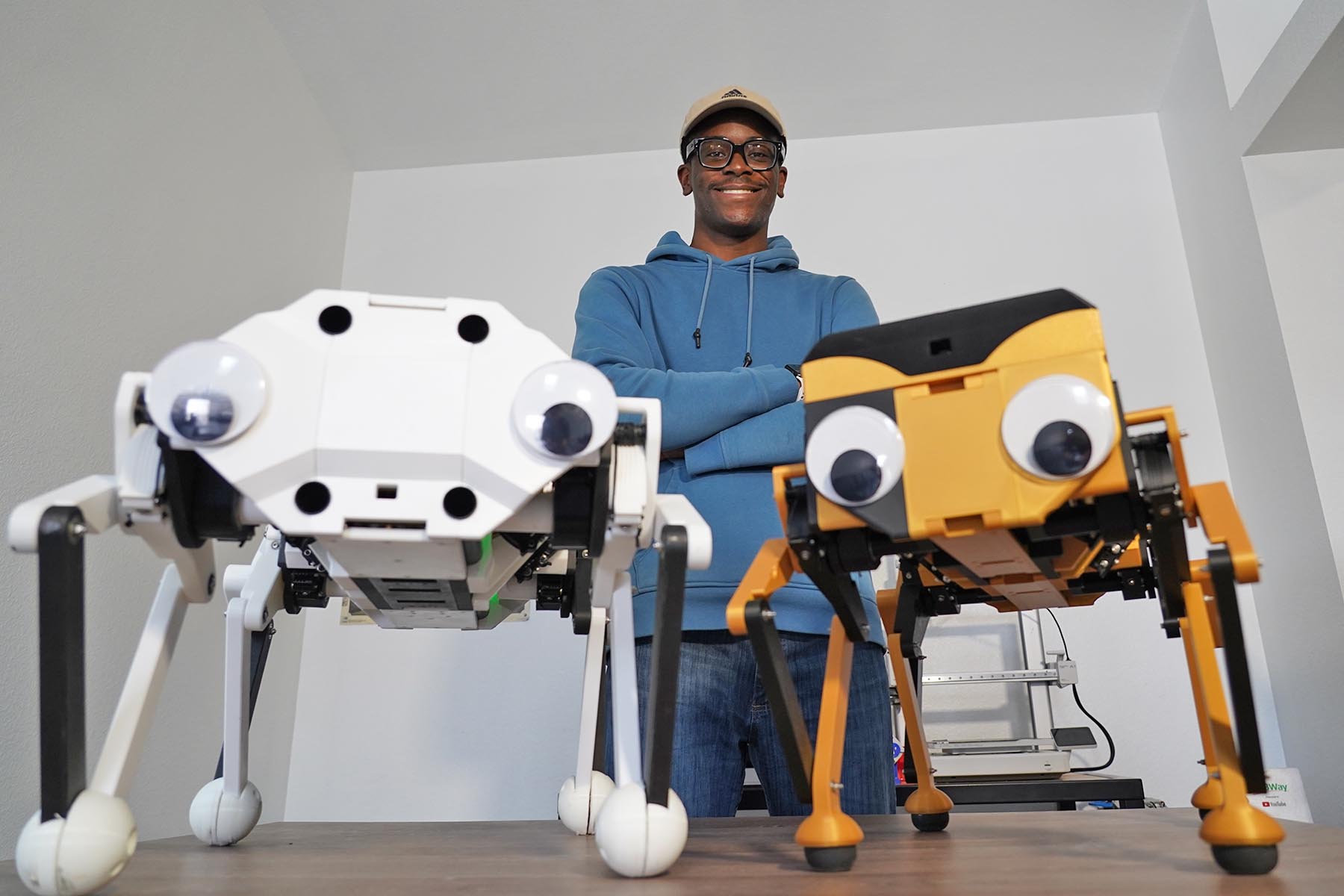
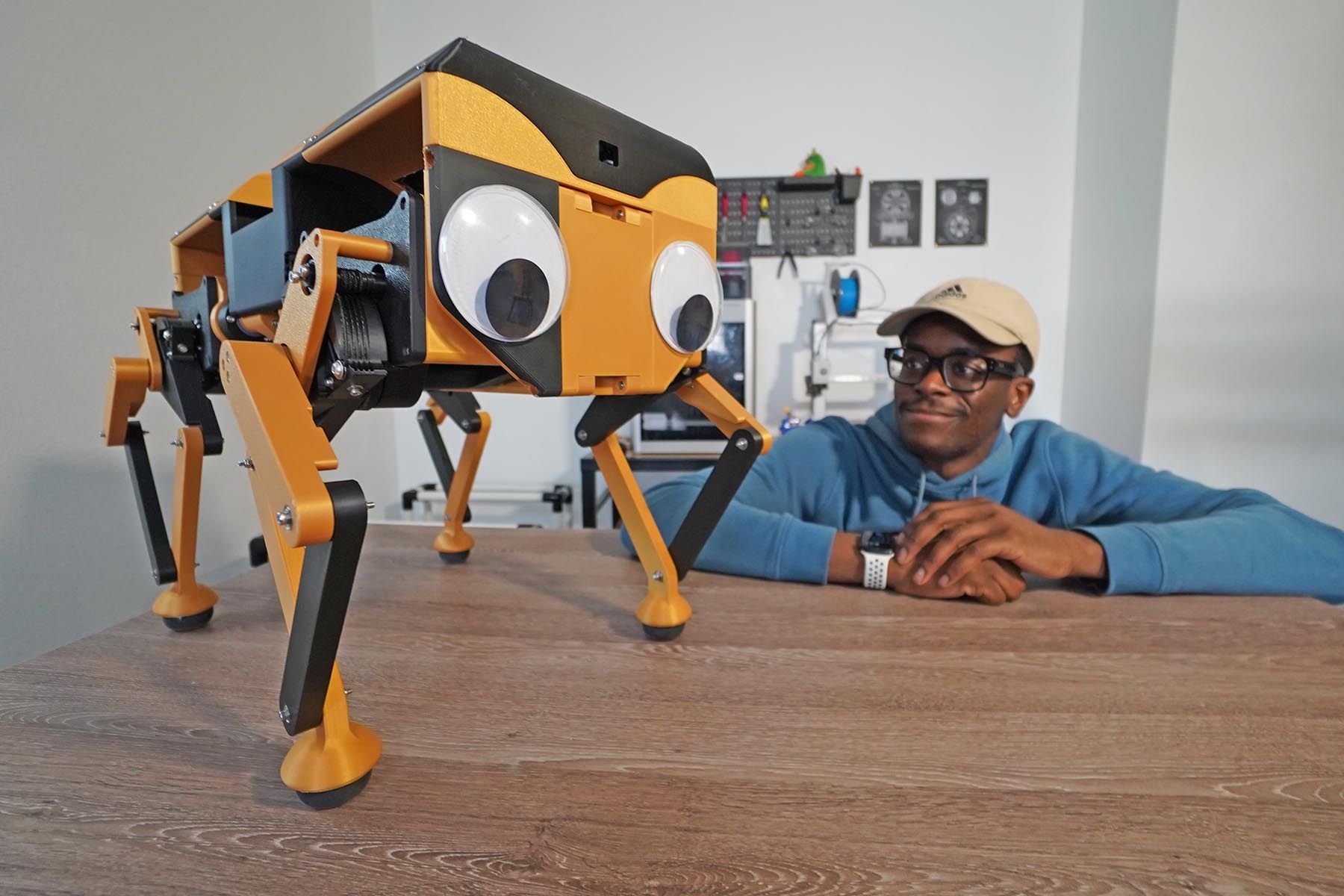
It culminated in Aaed’s magnum opus: CARA, the robot dog. “CARA stands for ‘Capstans Are Really Awesome,’” laughs Aaed. “I had been experimenting with capstan drives, which use very strong rope instead of gears. When I built a quadrupedal robot using capstans, it was much smoother and quieter than previous robots, with zero backlash.”
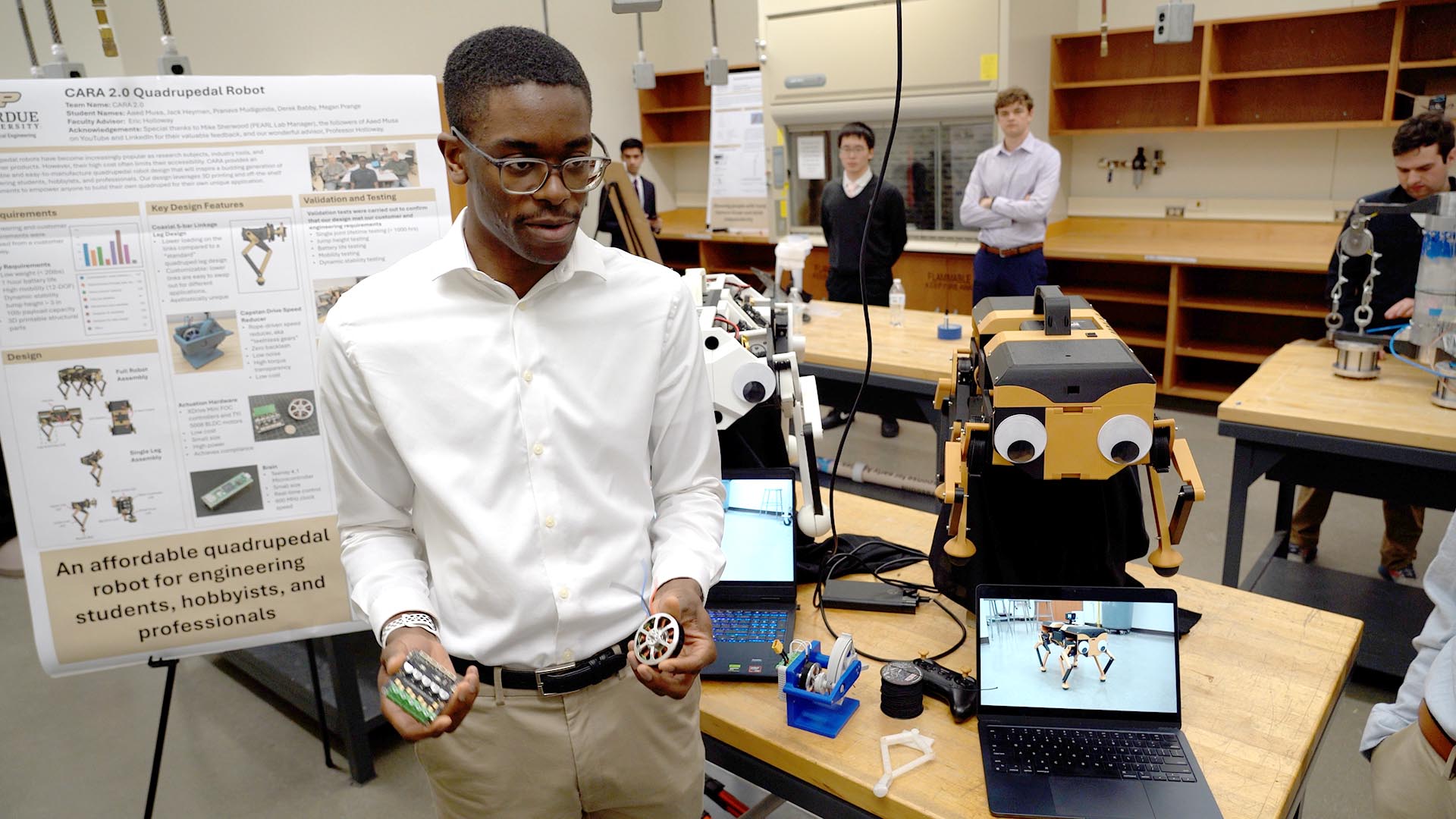
CARA was a big hit, but Aaed felt there was room for improvement. So he teamed up with fellow Purdue students to design CARA 2.0 as part of their Capstone Design project. “Most of my YouTube projects I build by myself, so it was amazing to work with a team,” he said. “Having different perspectives helps you to solve problems much more quickly. We ended up chopping $2,000 off the cost, and also dropped 13 pounds — all while improving CARA’s functionality.”
Secret Sauce
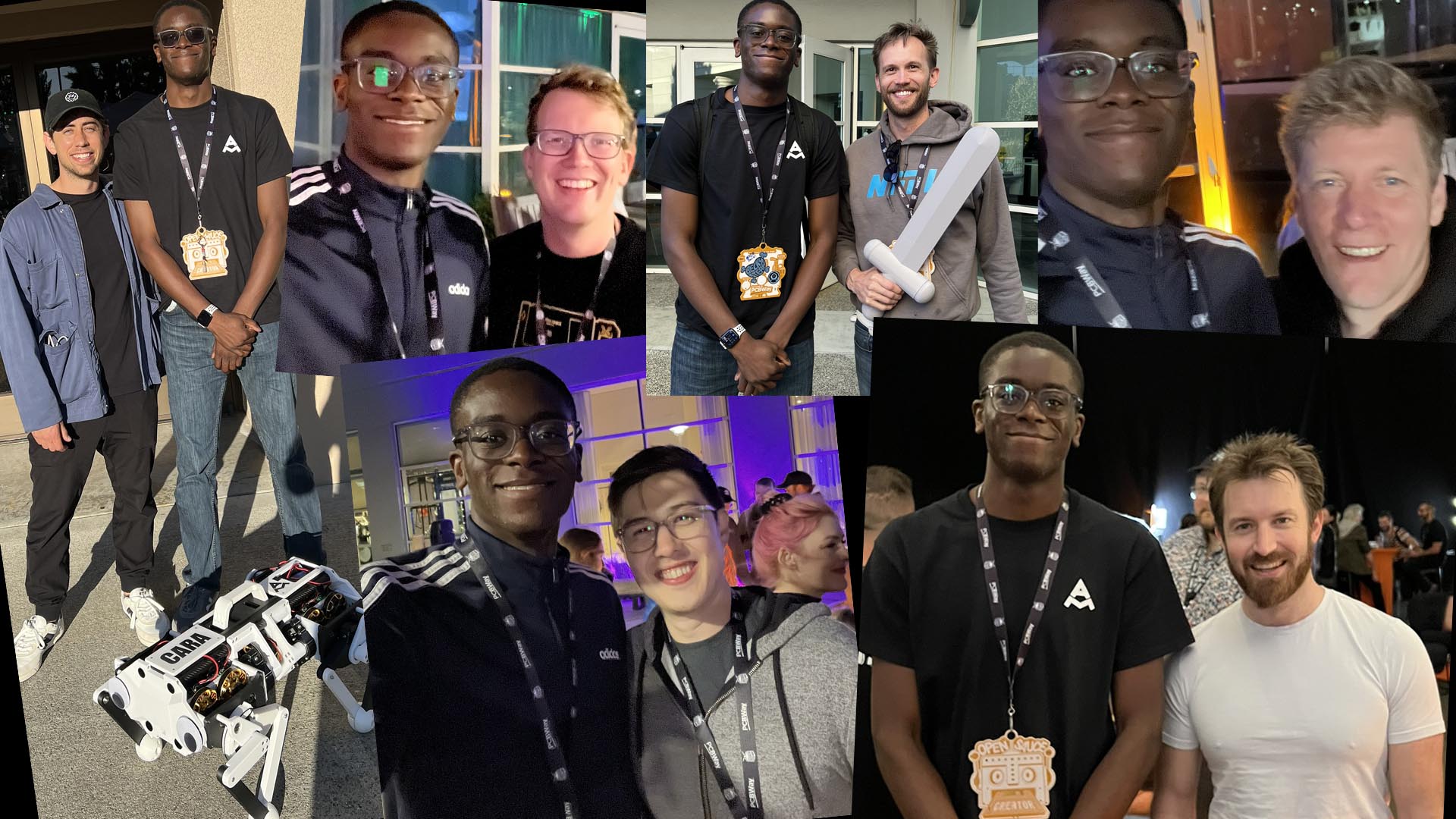
Aaed’s YouTube success began to open doors, including to the mecca of makers: Open Sauce. “Open Sauce is this annual convention for YouTubers and makers,” he explains. “In 2025 I was fortunate enough to be invited to Open Sauce as a Featured Creator, which meant I had the cool little badge that took me behind the scenes.”
CARA also made the trip to California for Open Sauce, allowing Aaed to share his work in person with many of his heroes. “Getting to talk to creators I’ve been watching since middle school was very surreal,” he said. “I talked to the Hacksmith, Jeremy Fielding, Colin Furze, Hank Green, Everyday Astronaut, NileRed, StyroPyro, and even William Osman, who created Open Sauce. It was super cool.”
Aaed graduated from Purdue with his BSME in December 2025. Wherever he ends up, he’ll still be thinking about his next YouTube project. “I have tons of ideas,” he said. “I don’t know if I’ll live long enough to build everything I want to build!”
“Every time I post a video, I get tons of comments and messages and LinkedIn requests,” he said. “Seeing that outpouring of support is very humbling. It lets me know that what I’m doing actually matters, and that people care about it. It’s also motivation to keep on building more projects!”
Follow Aaed Musa
YouTube: https://youtube.com/@aaedmusa
Instagram: @aaedmusayt
https://aaedmusa.com
Writer: Jared Pike, jaredpike@purdue.edu, 765-496-0374