
Synthetic DNA structure demonstrates a jitterbug transformation
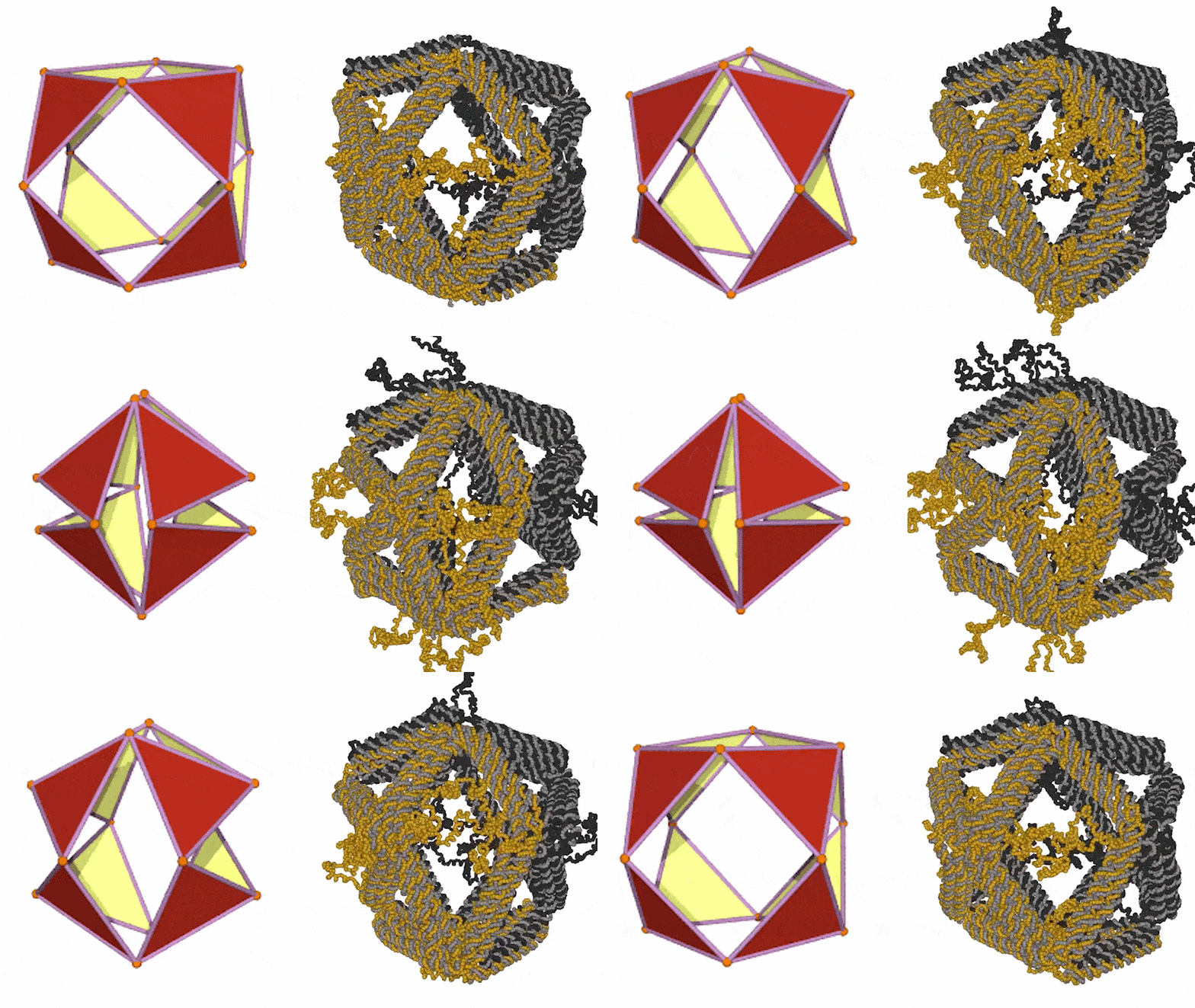
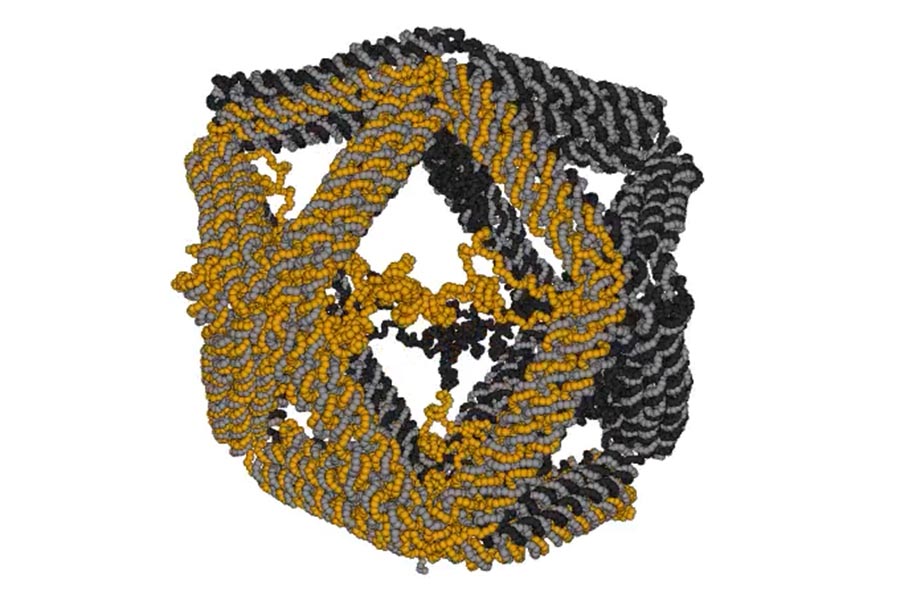
“This is our first deployable 3D structure made of DNA,” said Jong Hyun Choi, professor of mechanical engineering. “It changes its size and shape, but maintains its geometric symmetry. It replicates the same mechanisms used in nature, except this is a synthetic creation from our lab.”
Choi’s lab uses CAD software to assemble nanoscale mechanical structures using DNA strands as building blocks. Because the four bases of DNA (A, C, G, and T) always connect the same way, their designs can be translated into specific DNA sequences, causing the strands to self-assemble into any shape they want.
They started with the simplest possible 2D shapes — triangles — and assembled them into a Hoberman ring. They next demonstrated mechanical frustration, showing that their DNA origami structures exhibit the same mechanical behaviors as macro-scale objects.
The next step? Going three-dimensional.
They decided to re-enact a jitterbug transformation, a deployable 3D geometric construct first proposed by Buckminster Fuller. The jitterbug involves one of the five Platonic solids, the octahedron: eight equilateral triangles forming a 3D shape that looks like two pyramids stacked on top of each other. When the triangles rotate away from each other, six squares emerge and the structure transforms into a new 14-sided shape called cuboctahedron, one of the thirteen Archimedean solids.
Choi’s team took this purely mathematical construction and created a nano-sized version of it with DNA strands, each one just 28 nanometers long (3,000 times smaller than a human hair).
“The octahedron (or ‘closed’) state takes more energy to maintain, because of the elasticity of the structure,” Choi said. “So we added small DNA strands as ‘jacks’ to zip the structure closed. When we removed the jacks, the structure naturally performed the jitterbug transformation and turned into its ‘open’ cuboctahedron shape, which is more stable.”
Their research has been published in Nature Communications.
The choice to mimic a jitterbug transformation is not merely out of aesthetics. “We looked to nature for our inspiration,” Choi said. “Certain viruses have a similar geometric structure that transforms based on environmental conditions. When the transformation is triggered, the virus’ outer wall forces open the membrane of the cell it’s attacking and deploys its payload inside, all in one motion.”
To test whether their synthetic nanostructure could accomplish the same thing, they built an artificial cell in their lab. They filled their DNA transformer with enzymes that would produce a visible signal if they made it inside the cell. They actuated the jitterbug transformation, and watched what happened.
“We observed that the octahedron did indeed transform and opened a hole in the cell’s membrane,” Choi said. “Its enzyme contents were then injected into the cell cavity. So we successfully re-created the action of real-world viruses, but with totally synthetic structures.”
The force generated by the jitterbug amounted to 100 piconewtons — about a billionth of the force it takes to click a computer mouse. “That may sound tiny, but that is actually quite a large force in the molecular world,” Choi said. “But philosophically it also makes sense. Automobiles have many times the power of a horse. Robot arms can lift much more than human arms. We want to make synthetic nanostructures that are more powerful and effective than natural ones.”
However, this jitterbug is not quite ready for out-of-the-box applications. “These nanoscale structures are very sensitive to temperature, pressure, and chemical conditions of their environment,” Choi said. “If the conditions change, they may just dissolve away. That’s why this type of engineering work is so much more challenging than building human-scale structures.”
The future roadmap of Choi’s work includes attempting actual biological processes, rather than constructed synthetic ones. “We’ve all heard of bacterial resistance to antibiotics,” he said. “If we could deliver antibiotic payloads mechanically using these nano-transformers, we wouldn’t have to rely on chemistry alone. Someday, we could actually learn how to control and even program behaviors of biological cells.”
Source: Jong Hyun Choi, jchoi@purdue.edu
Writer: Jared Pike, jaredpike@purdue.edu, 765-496-0374
This research was supported by the U.S. Department of Energy, Office of Science, Basic Energy Sciences under award no. DE-SC0020673. A patent application has been filed by the Purdue Innovates Office of Technology Commercialization, which applied for a patent from the U.S. Patent and Trademark Office to protect the intellectual property.
A nanoscale Jitterbug transformer from DNA
Seongmin Seo, Alexander A. Swett, Mallikarjuna Reddy Kesama, Anirudh S. Madhvacharyula, Ruixin Li, Yancheng Du, Markus Eder, Friedrich C. Simmel & Jong Hyun Choi
https://doi.org/10.1038/s41467-026-74070-4
Many viruses have evolved remarkably intricate polyhedral shells capable of undergoing symmetric transformations in response to external stimuli to initiate payload release. So far, such deployable auxetic nanostructures are not available in the synthetic realm. Here we present a nanoscale Jitterbug transformer realized by a DNA origami structure that can reconfigure its conformation upon chemical and optical signals while maintaining a Poisson’s ratio of −1. By combining mechanical design principles with molecular dynamics simulations, we design the DNA Jitterbug to form a compact octahedron that stores elastic energy and spontaneously transitions into an expanded cuboctahedron by releasing it. DNA transformers are demonstrated to act similar to viruses that can create nanopores on lipid membranes and regulate payload release into vesicles. Integrating programmable DNA self-assembly with free-energy-guided mechanical design, this work provides a pathway toward adaptive nanomaterials with potential in synthetic organelles and stimuli-responsive nanodevices.