
Shooting lasers at batteries to characterize outgassing
The project originates in the lab of Chris Goldenstein, the Avrum and Joyce Gray Rising Star Professor in Entrepreneurship and Innovation. His team typically uses lasers to diagnose challenging high-temperature environments, such as the combustion of hypergolic rocket fuel or the plasma generated by a spacecraft entering the atmosphere.
So why shoot lasers at batteries? “We were working with Ford Motor Company to characterize engine exhaust, and building on that relationship, we decided to study the batteries in electric powertrains as well. So we made some important modifications to measure key hydrocarbons, and achieved some pretty amazing results,” Goldenstein said.
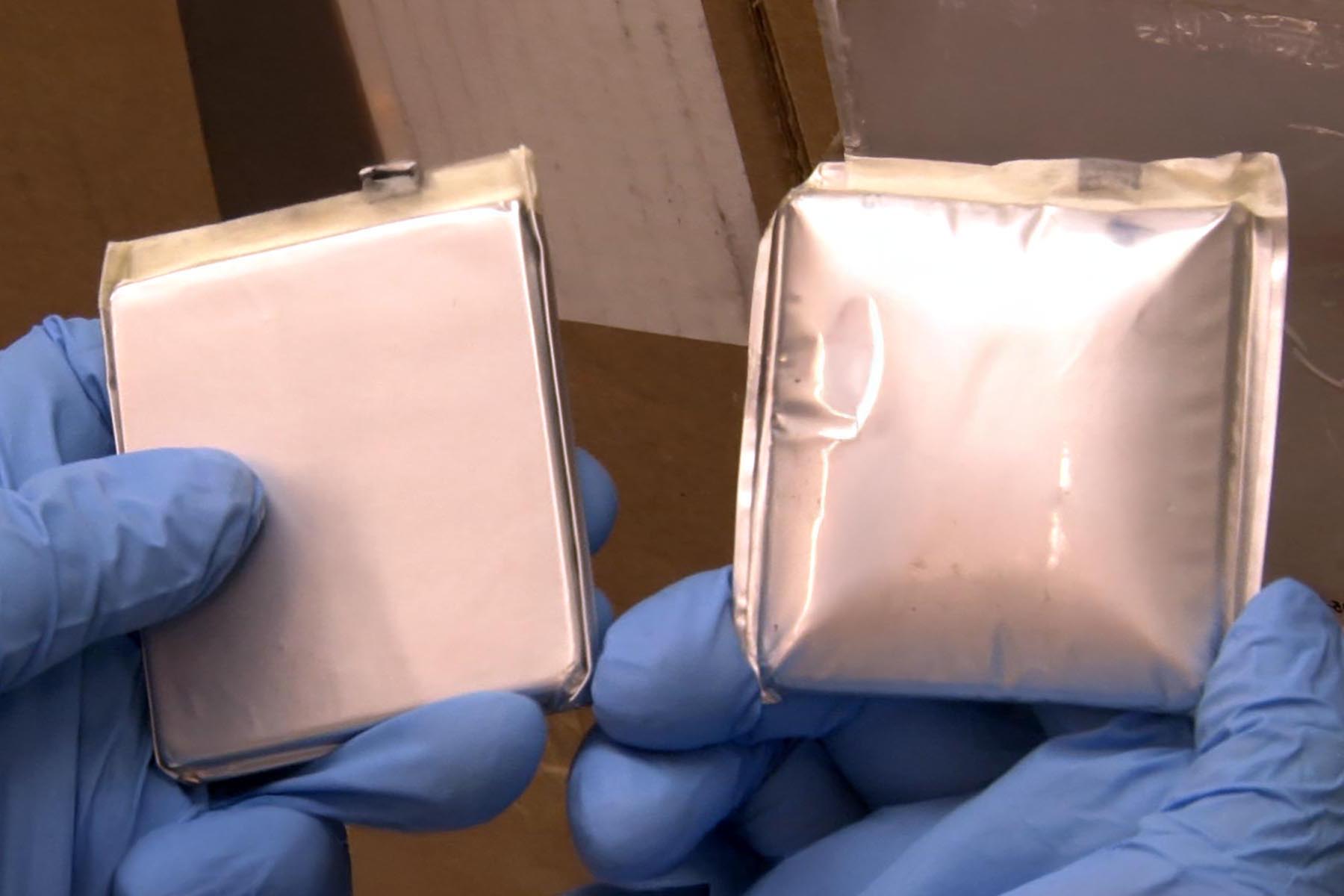
Lithium-ion batteries are known to produce gaseous by-products, especially during the first time they are charged at the factory. This is caused by the electrolyte gradually reacting with the electrode. During normal operation, however, gas production typically indicates degradation of the cell. As these gases build up within the battery pouch, it can lead to a “puffed-up” appearance, potentially reducing the cell’s lifetime.
“Rather than wait until the end of its life, we wanted to see if we could detect these gases in a brand-new battery during the ‘formation cycle’, when it is first charged in the factory,” Goldenstein said. “There’s a lot of interesting material science and electrochemistry that happens with these components, and understanding them is beneficial to engineering better batteries.”
Their research has been published in Analytical Chemistry.
“People have been analyzing these gases for many years,” said Raghav Poddar, Ph.D. student in Goldenstein’s lab and lead author of the paper. “However, all the existing methods require physically extracting the gas from the battery, and then separately running it through a mass spectrometer. That can alter the chemical processes taking place in the battery. Instead, we wanted to characterize the gases in situ, without unnecessarily disturbing the existing battery environment.”
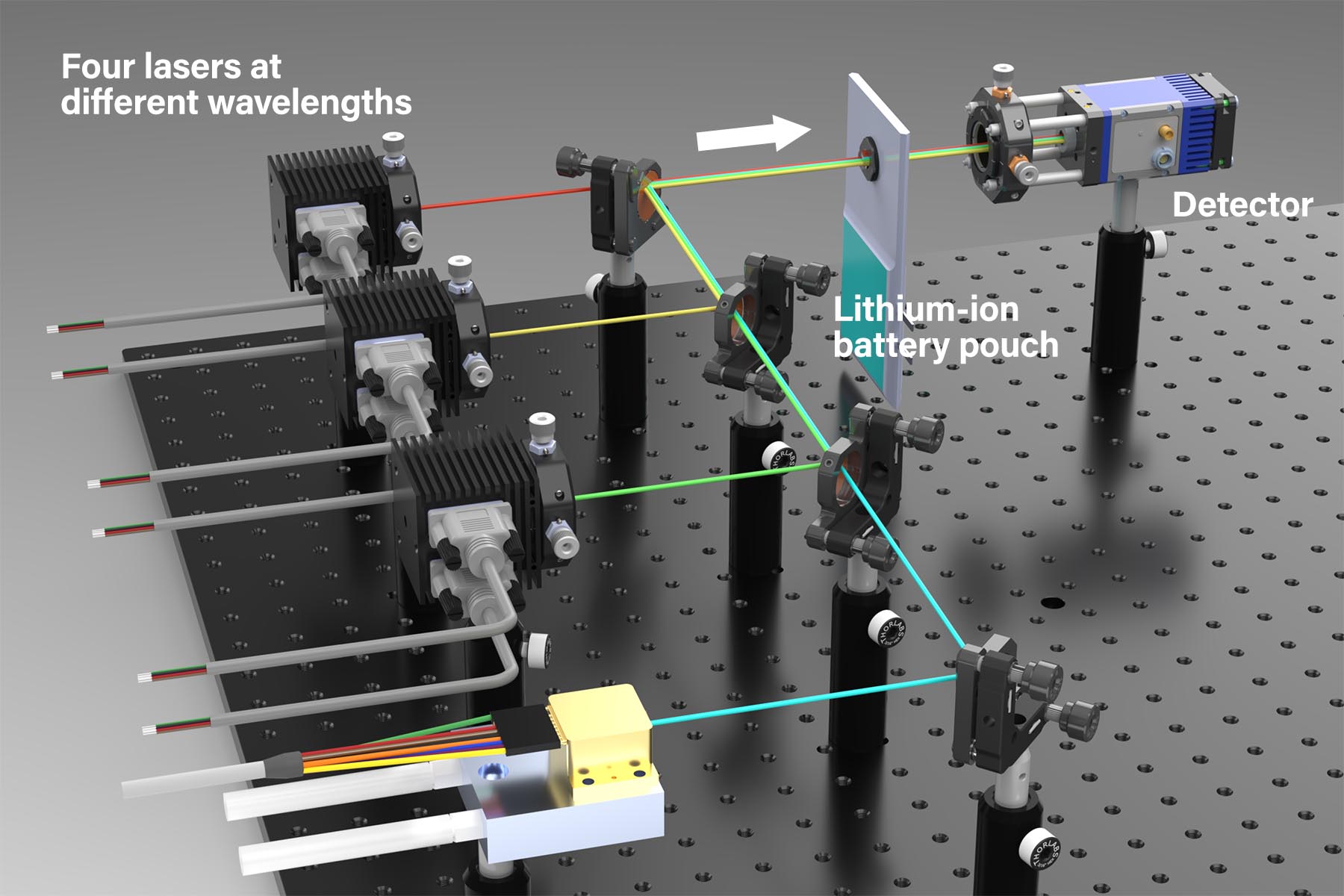
To do this, they utilized an optical method called laser absorption spectroscopy. When they shoot laser light through the battery, some of the light is absorbed by specific gases within. By measuring how much light makes it through the battery at very specific wavelengths, they can precisely calculate the concentration of specific gases, as well as their temperature and pressure.
“We frequently do this in hot reacting flows — like flames,” Poddar said. “So we have experience in which specific wavelengths of laser light we need to detect certain gases. In this experiment we used four different lasers firing sequentially in just 10 milliseconds.”
They continued to measure throughout the battery’s initial 8-10 hour charging cycle, gathering data on the gases until their composition stabilized. They successfully measured precise amounts of CO (carbon monoxide), CO2 (carbon dioxide), CH4 (methane), C2H4 (ethylene), and C2H6 (ethane). This set of gaseous species can provide insight into different reaction pathways occurring in the battery, potentially helping researchers produce more durable cells.
“Our results revealed the same trends with voltage that are published in the literature; however, the in situ nature and high time resolution of our measurements offers numerous benefits, like greater accuracy," Poddar said. "This is an excellent proof-of-concept that our method can work in many circumstances where measuring gas generation in batteries is useful. As battery manufacturers test different components and materials and operating conditions, they can use this method to instantly measure the impact on gas production without sampling the gas and perturbing the electrochemistry taking place in the battery.”
“The battery field is such a crucial area of study, as electrification becomes more prominent in countless technologies,” Goldenstein said. “It’s not just the automotive industry; almost everyone is looking for battery experts. Researchers across many fields — engineers, material scientists, chemists — are now collaborating in this space, because the stakes are so high. We are thrilled to work with Ford and use our skills to help advance battery science.”
Source: Chris Goldenstein, csgoldenstein@purdue.edu
Writer: Jared Pike, jaredpike@purdue.edu, 765-496-0374
In Situ, Time-Resolved Measurements of Lithium-Ion Battery Gases During Cell Formation Using Mid-IR Laser Absorption Spectroscopy
Raghav G. Poddar, Joshua Stiborek, Nathan J. Kempema, David Bilby, and Christopher S. Goldenstein
https://doi.org/10.1021/acs.analchem.5c04714
ABSTRACT: Real-time non-extractive measurements of gaseous byproducts are needed to understand the buried interfacial formation chemistry of lithium-ion batteries at various scales; however, conventional gas sensors (e.g., those based on mass spectrometers) do not fully meet this need. This manuscript presents the design and application of a mid-infrared laser absorption spectroscopy (LAS) diagnostic for in situ measurements of CO, CO2, CH4, C2H4, C2H6, and OCS near-simultaneously during the formation cycle of pouch-style lithium-ion batteries. Scanned-wavelength direct-absorption measurements of these species were made near 4.85, 4.19, 3.27, and 3.35 μm, respectively, at 100 Hz using four distributed-feedback semiconductor lasers. Tests were conducted with NMC622-Gr pouch batteries containing 30:70 (v/v) ethylene carbonate (EC)/dimethyl carbonate (DMC) and 1.2 M lithium hexafluorophosphate charging at a rate of C/8. Between 40%−60% by mole of the total gas produced was measured consistently, with C2H4 and CO representing the largest fractions. Trace amounts (100−300 ppm) of carbonyl sulfide (OCS) were also measured. The evolution of gas mole fractions, moles, and their production rates with respect to time and voltage are discussed in the context of production mechanisms and electrochemical events. The presented results demonstrate the ability of LAS to provide quantitative non-extractive and calibration-free speciation measurements with high temporal resolution in Li-ion battery cells.