
Measuring hypersonic velocity with a single laser
Hypersonics — the study of vehicles traveling faster than Mach 5 — is so specialized and cutting-edge, that only a few institutions are properly equipped to do research in the field. Purdue University’s latest contribution is a demonstration of hypersonic velocity measurements using just a single laser and a 100,000 frame-per-second camera.
In order to construct vehicles that can travel faster than Mach 5, you need to be able to test designs under real world conditions. But it's extremely difficult to replicate those speeds and pressures in a wind tunnel. That's what makes Purdue's Boeing/AFOSR Mach-6 Quiet Wind Tunnel unique.
"This is one of two quiet hypersonic flow facilities in the entire country," said Carson Lay, research scientist in the School of Aeronautics and Astronautics. "If you just propelled air through a normal wind tunnel at hypersonic speeds, the friction against the tunnel walls creates all sorts of chemical interactions you don't get at lower speeds. The beauty of our wind tunnel is that we maintain a laminar boundary layer on the tunnel walls, which gives us the 'quiet' conditions that are more like actual flight."
There are, of course, challenges to this approach. The amount of air you can send through the Mach 6 tunnel is dependent on how big a vacuum you can pull at one end. Due to the size of the vacuum tank at Purdue's wind tunnel, their 'quiet' hypersonic bursts only last 1-2 seconds.
The other challenge is how to accurately characterize what's going on in the test section. "In most flow tests, we would do something called velocimetry, where we inject particles into the flow and then visually track them," said Mikhail Slipchenko, research professor in the School of Mechanical Engineering, who has been studying optical diagnostics at Purdue since 2015. "But injecting particles into a Mach 6 airflow would cause damage to the tunnel, and affect the flow properties we're trying to measure. So we have to find a non-invasive way."
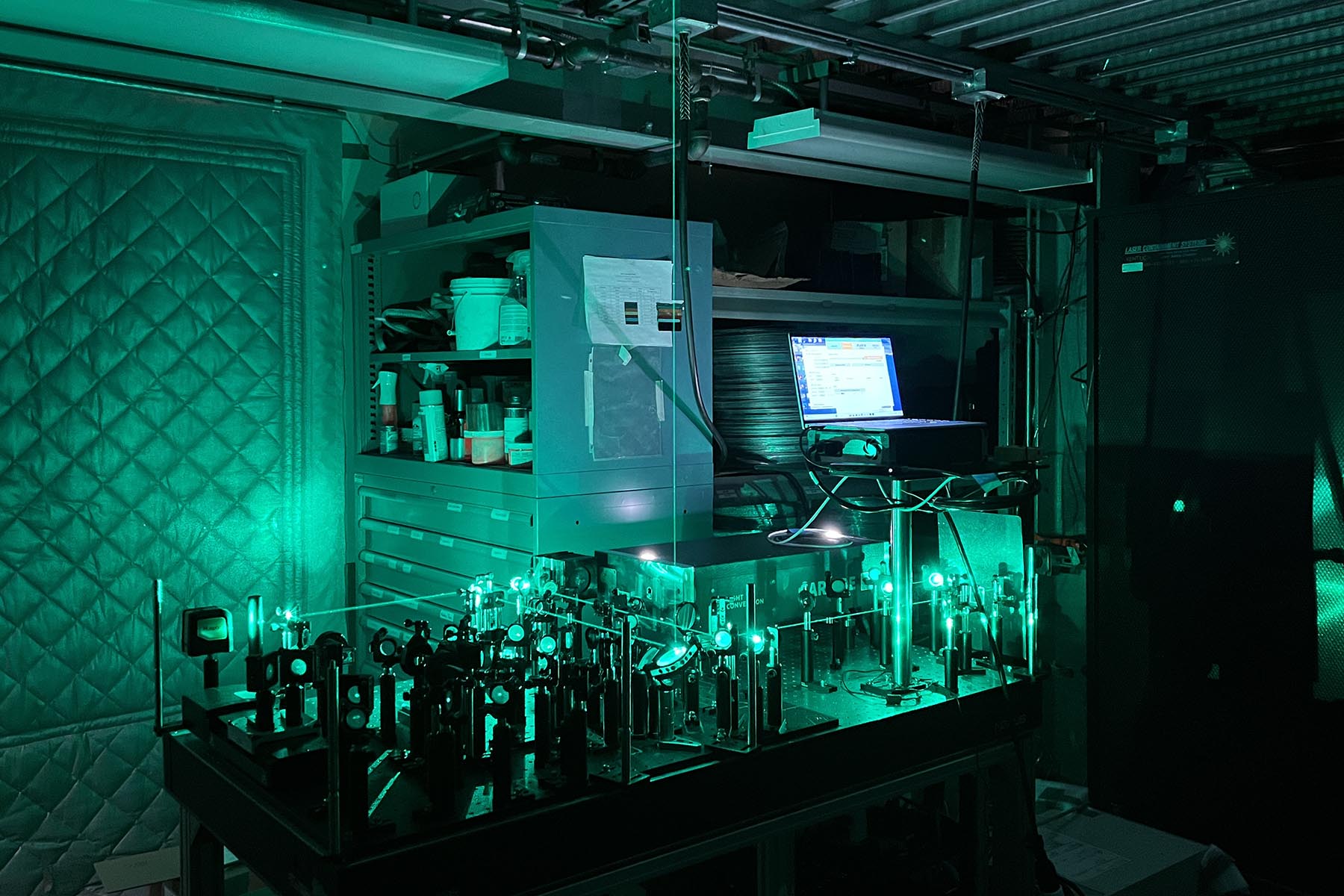
The answer is femtosecond laser electronic excitation tagging (FLEET). "We're basically shooting a laser into the flow, and exciting the nitrogen particles that are already in the air," said Jakob Harbers, Ph.D. student in the School of Aeronautics and Astronautics, and lead author of the paper. "The tagged nitrogen produces photons, which we can then track with a high-speed camera."
This technique, developed in 2011, had previously been demonstrated at roughly 1,000 frames per second. But Harbers and Slipchenko wanted to see if it could also be used at the extreme velocities of the Mach 6 tunnel. "There was a dead zone in the research between 1,000 and 100,000 frames per second where nobody was able to use this method," said Slipchenko. "Our 'quiet' tunnel was perfect because it gave us the opportunity to experiment with very steady flow with no turbulence. So we were able to successfully demonstrate this technique with tremendous accuracy."
Their research has been published in Applied Optics, and highlighted as a "Spotlight on Optics", one of a select group of highlighted papers across all of Optica Publishing Group's suite of 20 monthly academic journals.
Second to None
While hypersonic experiments may only last one second, a lot has to go right to make that one second happen.
"We pressurize one end of the wind tunnel up to 300 psi, and we pull a vacuum at the other end down to less than 0.1 psi," said Lay. "There is a narrow section in the middle with a metal diaphragm. When we evacuate the air in that section, the massive pressure difference causes the diaphragm to rupture, and all the air rushes through the test section on its way into the vacuum tank. We can get 3-5 seconds of turbulent hypersonic flow, or 1-2 seconds of 'quiet' flow before we have to reset."
In the middle is an optically clear test section about 9 inches in diameter, which allows for visual measurements of scale models and other objects in the airflow. In Harbers' experiments, they ran the test section empty because they only needed to track the nitrogen particles in the air itself to verify their methods.
"We saw the results almost immediately," said Harbers. "The high-speed camera gave us enough signal that we knew we were getting good data " and that was only confirmed when we went back afterwards and began to process the data."
"One second doesn't sound like a lot," Lay said. "But that's actually quite a long time when it comes to Mach 6 wind tunnels. When you're measuring 100,000 samples every second, that's a lot of data you can gather in a very short time."
The next step is to apply this particular velocimetry method in the real world. "Most designs for hypersonic vehicles use computer modeling to validate their fluid dynamics," Slipchenko said. "Now that we have verified this technique, we can back up their models with real experimental data. Researchers don't have to custom-build an exotic measurement system; they can use our research to build their own laser system that is modular and transportable."
For Slipchenko, that achievement is what keeps him going. "I'm an engineer, and engineers are problem solvers," he said. "If there is a problem that is hard to solve, I'm here for it!"
Harbers and Lay enjoy breaking new ground in the still-burgeoning hypersonics field. "This is a new realm of flight," Harbers said. "How do we get measurements for stuff where instruments may not survive? Being able to do this work and actually seeing results pay off is amazing."
"You put in all the effort for an experiment, and deal with 50 different things that may go wrong that day," said Lay. "Finally you see all of the new images and data pop up on the screen and realize: you're the first person to see that! That's really great."
Source: Mikhail Slipchenko, mslipche@purdue.edu; Carson Lay, lay7@purdue.edu
Writer: Jared Pike, jaredpike@purdue.edu, 765-496-0374
100kHz-rate femtosecond laser electronic excitation tagging velocimetry in Mach 6 quiet flow
Jakob Y. Harbers, Amanda M. Braun, Jake Wohld, Vidyadhara B. V. Kumar, Karna Patel, Ashish A. Bhave, Adam C. Lay, Sukesh Roy, Joseph S. Jewell, Terrence R. Meyer, Hans U. Stauffer, and Mikhail N. Slipchenko
https://doi.org/10.1364/AO.604902
ABSTRACT: Velocity measurements in high-speed flows are critical for the understanding and predictive modeling of instabilities in laminar and transitional boundary layers. Femtosecond laser electronic excitation tagging (FLEET) velocimetry is a robust seedless method for measuring velocity while only requiring a single ultrafast laser and single high-speed camera. In this work, FLEET velocimetry is demonstrated at 100 kHz in the Boeing/AFOSR Mach 6 Quiet Tunnel (BAM6QT), representing the first, to our knowledge, application of 100 kHz molecular tagging velocimetry in a steady-state quiet tunnel. This enables rigorous characterization of the precision and accuracy of 100 kHz FLEET measurements at pressures <1 Torr and at densities <0.01 kg/m3. Single-shot velocity fluctuations (1σ/mean) range from 0.54% to 1.07%, depending on the time delay between tracked FLEET emission signals, with a best-case value of 0.54% observed at a 10μs signal separation. Mean velocity measurements were within 0.3% of expected values in the tunnel freestream flow.