
From Purdue Grand Prix to Formula 1: Roberto Figueroa helps McLaren win a World Championship
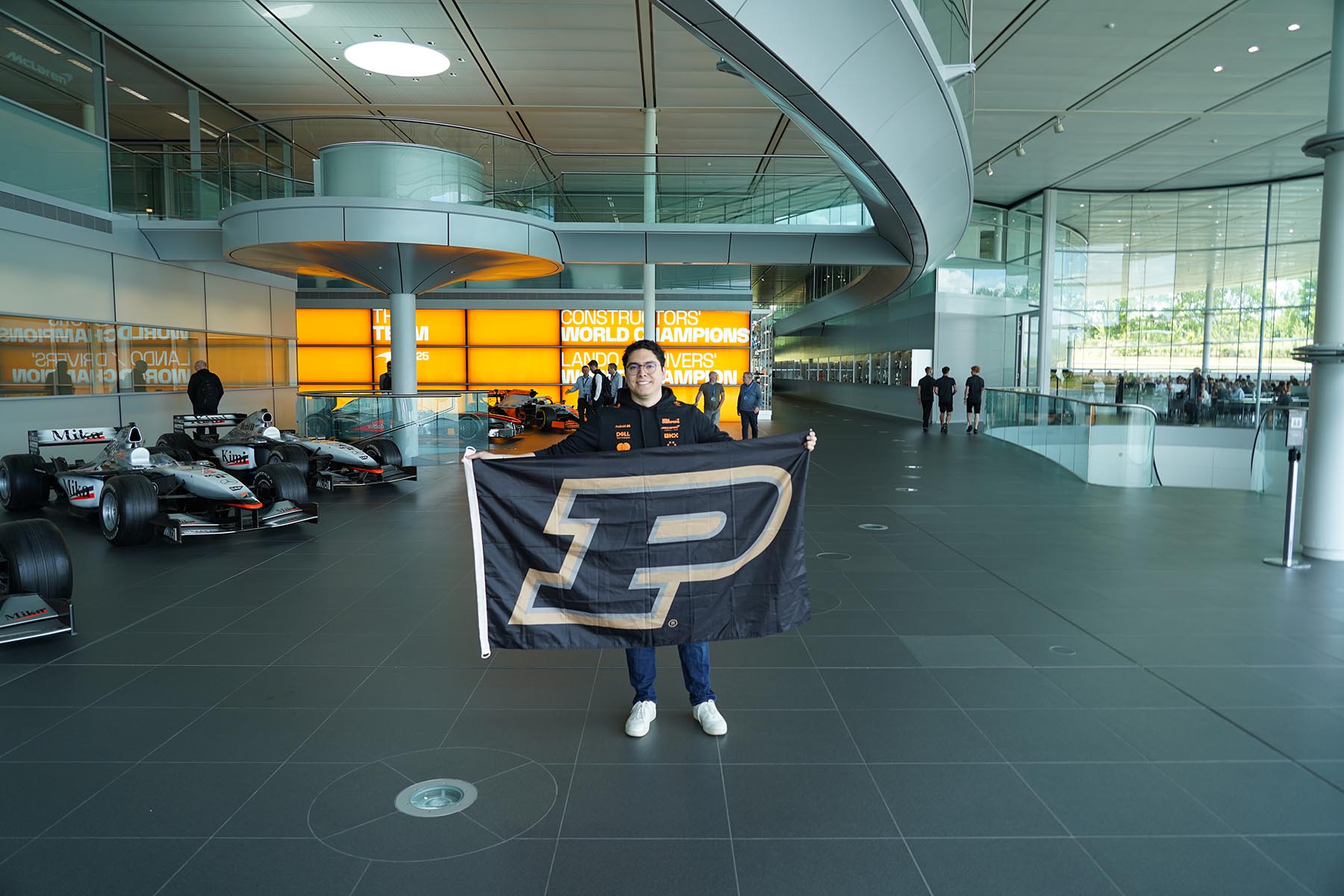
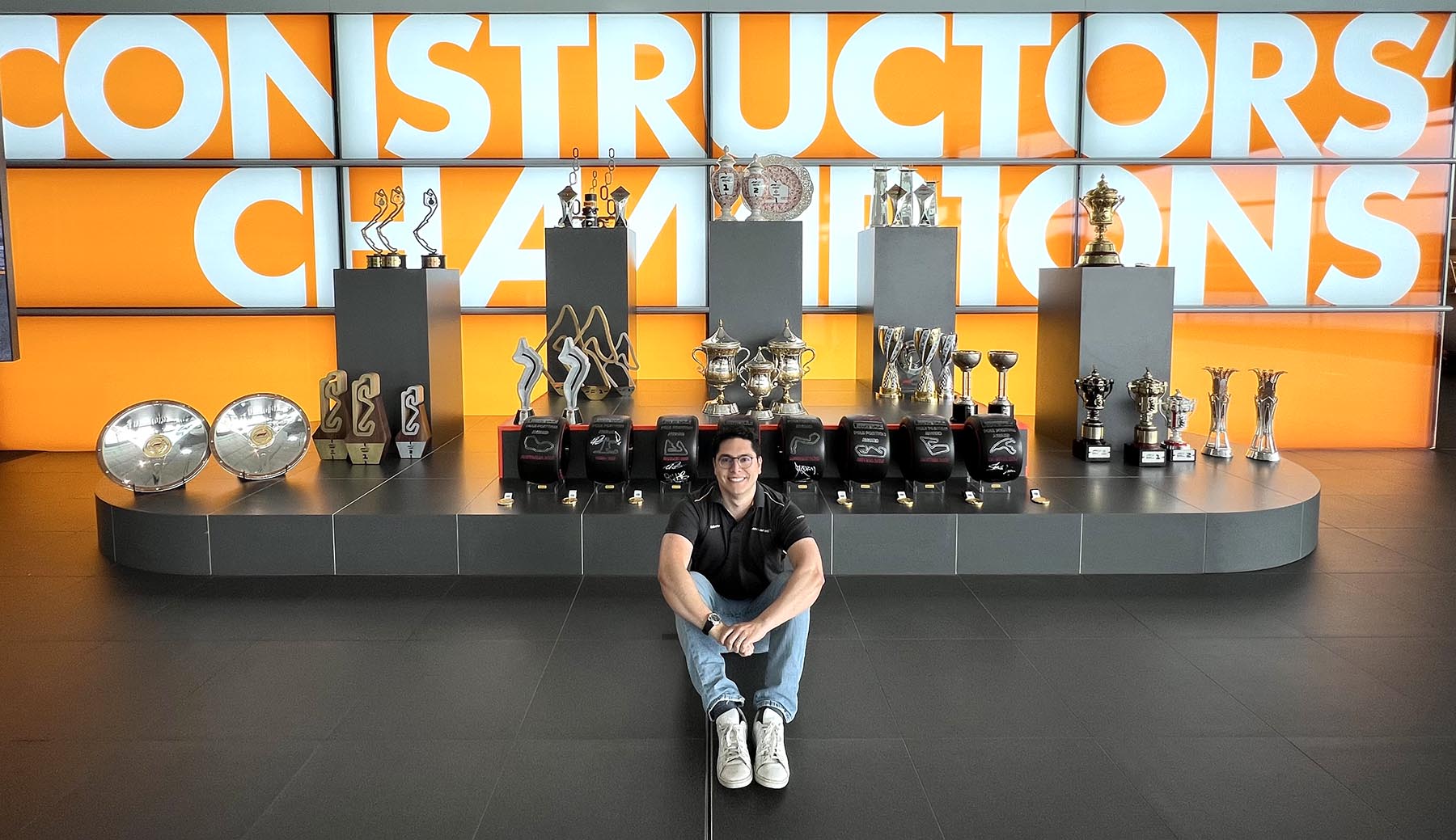
Even as you stand in the middle of it, the McLaren Technology Centre seems like a spaceship that has landed in the middle of the British countryside. Sunlight pours through futuristic glass that surrounds you on all sides. Curved walkways and spiral staircases lead to state-of-the-art garages and laboratories. An overwhelming number of racing trophies fill hallway display cases. Men and women dressed in papaya orange casually walk past historic vehicles driven by former F1 champions Alain Prost, Ayrton Senna, and current champ Lando Norris.
“This is really the pinnacle of motor racing,” said Roberto Figueroa, a 2012 Purdue graduate who calls this spaceship his office, as Aerodynamics Project Leader for McLaren Racing. “There are people who have wanted to visit this place their whole lives, and I get to come here every day. I try to never take it for granted.”
Hammer Down
Roberto Alejandro Figueroa grew up in Honduras. “I always knew I was going to be an engineer since my high school years,” he said. “I even got a scholarship to spend my final year in Parma, Italy, before deciding to come to Purdue.”
At Purdue, Roberto majored in mechanical engineering. “Those classes were pretty hard,” he said. “I remember Machine Design quite clearly, and also Fluid Mechanics, which turned out to be a real passion of mine. I still use the methods I learned in those classes in my work here at McLaren!”
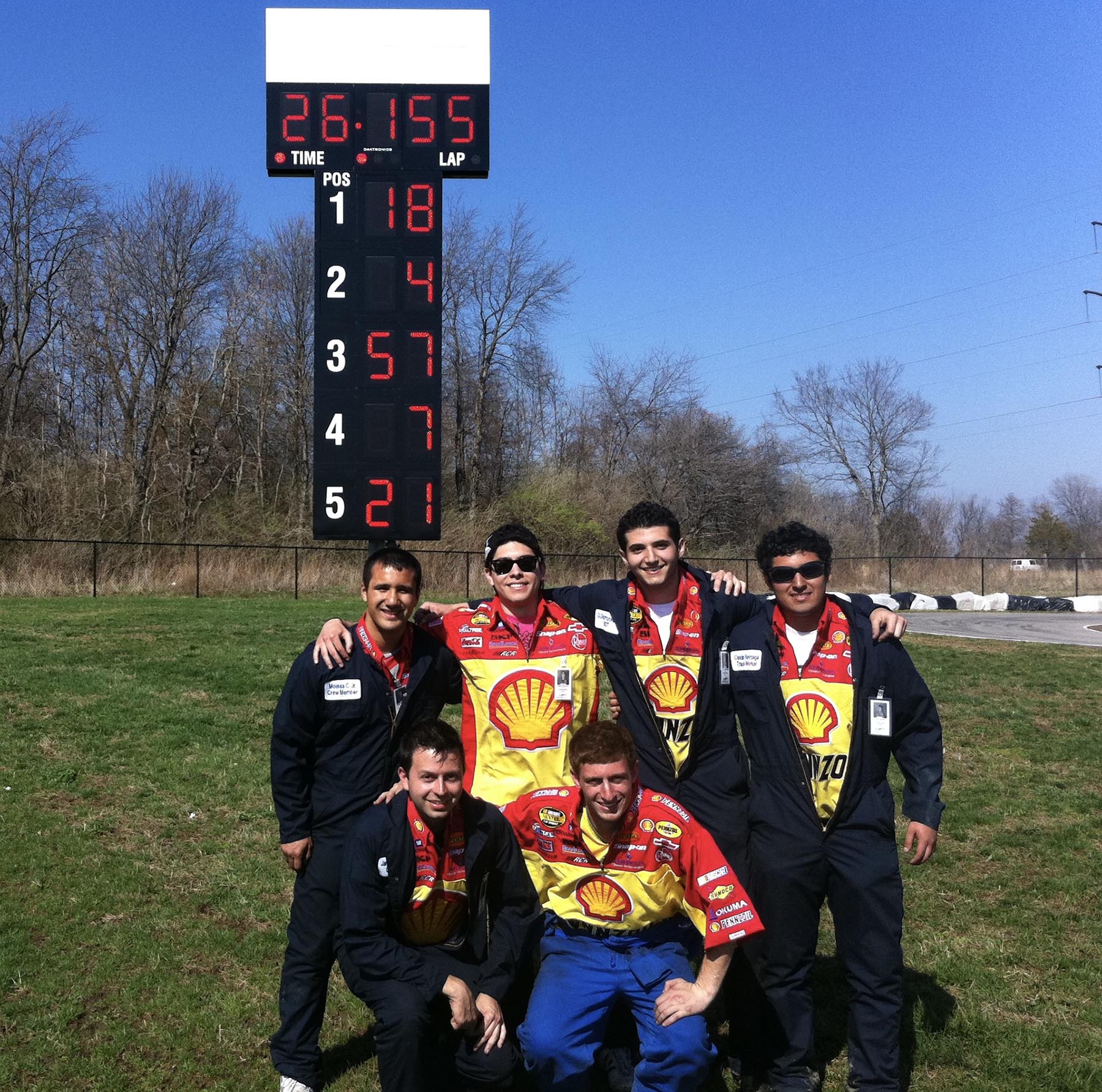
While he generally appreciated all things automotive, it was at Purdue that he fully delved into motorsports — specifically the annual Purdue Grand Prix go-kart race. “I had a friend who was in Society of Hispanic Professional Engineers (SHPE), who entered a kart in the Grand Prix,” he said. “I helped out the first year, and the next year I became crew chief.”
In 2011, SHPE’s kart scored a pole position, leading the most laps and finishing 2nd overall. Roberto was hooked. “Racing is so addictive,” he said. “The adrenaline of getting everything ready, staying up nights to prepare the kart, and then reacting to pit stops as well. So many great memories.”
Passion for Speed
Roberto decided he wanted to shoot for the moon, working at the highest level of motorsport: Formula 1. Positions in F1 teams are highly sought after — even the lowest-level internship openings receive thousands of applications from around the world. Very few American students make the cut.
But Roberto had a plan. “Most F1 teams are based in the UK, so I decided to go for a Master’s degree in England,” he said. “After graduating from Purdue, I worked at Cummins and saved my money for two years. Then I moved to the UK to attend Cranfield University, which is well known for aerodynamics. While I was at Cranfield, I was recruited by Force India.”
Roberto initially joined Force India (now Aston Martin) in 2016 as a wind tunnel engineer. And then in 2020, McLaren came calling.
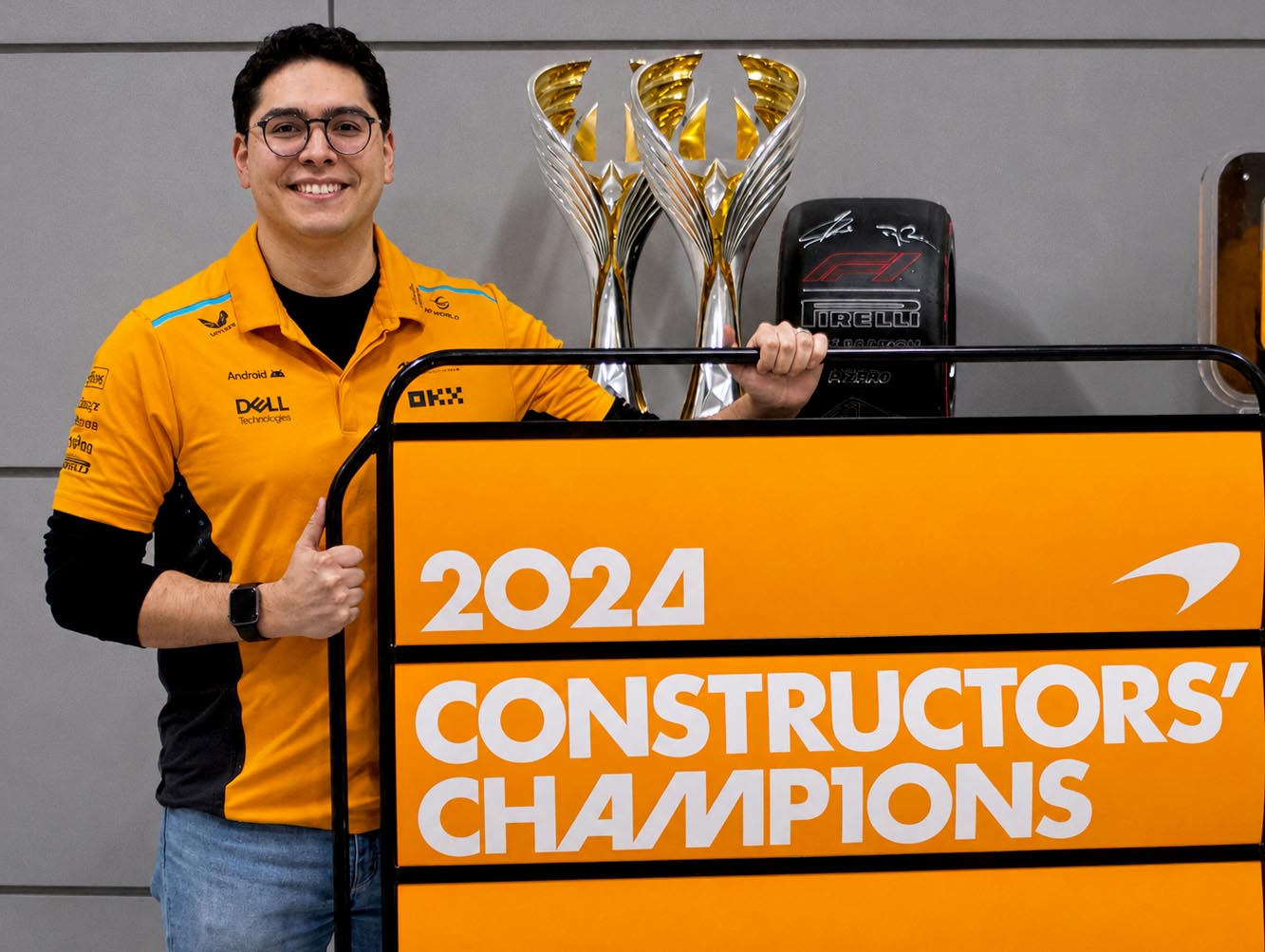
“McLaren have a storied history in Formula 1,” Roberto said. “We’ve won the Constructors’ Championship for the last two years. This is really as big as it gets.”
Roberto currently works as an Aerodynamics Project Leader. He and his team tweak the geometries of the car to reduce drag and increase downforce. When championships hinge on a tenth of a second, even the smallest difference in the car’s design can have a huge effect.
“We are all about the stopwatch,” Roberto said. “When you are experimenting with new designs, you can see instantly on the track whether your changes have been working or not. It’s pretty gratifying to watch the races and know that something I did contributed to a good result for the team.”
Those moments of joy are equally balanced with enormous amounts of pressure. Thousands of people work at McLaren, and their livelihoods hinge on those tenths of a second. As such, working in motorsports is not for the faint of heart.
“This job requires a significant amount of time and effort,” Roberto said. “I actually get a lot of enjoyment working under pressure. You have to have a passion for it; that’s the only way to get through it. There’s a lot of lows in this industry, but it also can be a lot of fun at the end of the day. You just need to be willing to put in the work.”
Boiler Up
Roberto is one of hundreds of Boilermakers who now work in professional motorsports — not just in Formula 1, but IndyCar, NASCAR, IMSA, and many more. Purdue hosts the only accredited motorsports engineering degree in the country, forming a pipeline from Indianapolis to garages and pit boxes around the world.
“A Purdue degree comes with quite a bit of prestige,” Roberto said. “The caliber of graduates that come from Purdue says a lot about the school. You get a solid academic foundation, and the opportunities to network and make connections. But the passion is up to you! You have to volunteer for racing teams, and get involved in extracurricular projects in order to get noticed. Don’t just sit there; push to get to your objective. Combine that academic background with having a passion for what you do, and you can end up anywhere.”
Writer: Jared Pike, jaredpike@purdue.edu, 765-496-0374