
Factories in space: Purdue hosts first ever In-Space Manufacturing class
To sustain operations in space, you have to be able to build in space. That’s the idea behind one of the first ever university courses focused on In-Space Manufacturing — hosted by the Cradle of Astronauts, Purdue University.
“We as a society are changing the way we think about space,” said Ajay Malshe, the R. Eugene and Susie E. Goodson Distinguished Professor of Mechanical Engineering. “Space used to be about exploration only — you go on a mission for a short time, and then you come back. That’s Space 1.0. We’re now shifting the vector to sustaining a permanent human presence in space, and that requires manufacturing.”
Malshe is acknowledged as a worldwide expert for in-space manufacturing, service, and assembly, having established the fundamental concepts of "factories in space" back in 2018. In 2025, he established the first ever Center for In-Space Manufacturing at Purdue. Now, he’s bringing these high-level concepts to the undergraduate classroom for the first time.
“This class is about creating factories in space,” Malshe said. “A factory is not just a building, it's a platform — a system that needs to be designed, engineered, and functionalized. In space, that engineering takes a very different form. Resources are scarce. Costs are high. Even the physics are different! Our goal was to get students to think foundationally about what a factory in space would look like, and how it would operate.”
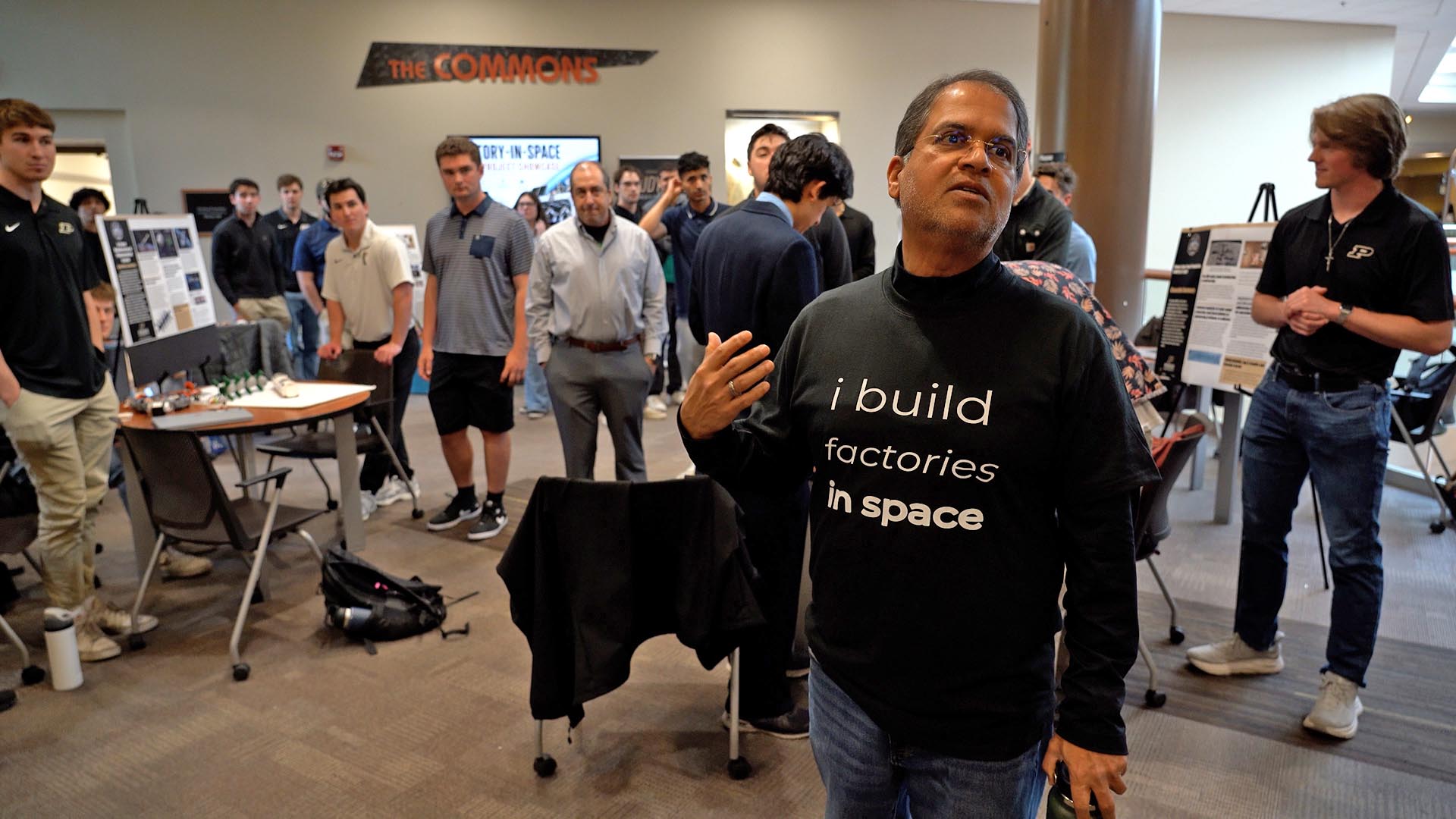
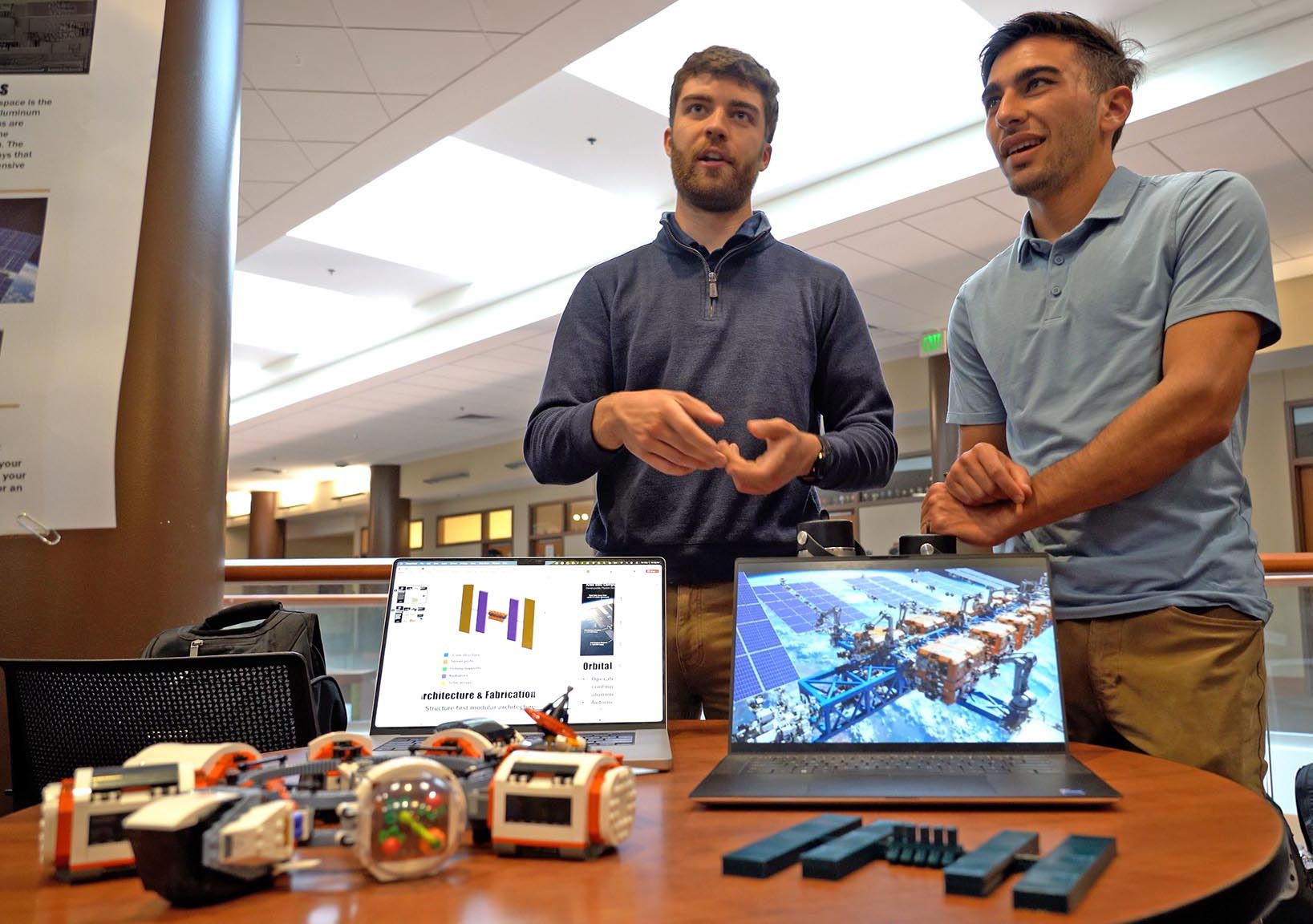
These factories come to fruition through a four-phase process: ideation, invention, innovation, and implementation. And the first step uses the engineer’s best friend: LEGO bricks. “LEGO is an incredible tool for learning at any age,” Malshe said. “Engineers can use LEGO to quickly put their ideas into a physical form. Then the team members can easily refine their ideas to get to the next phase.”
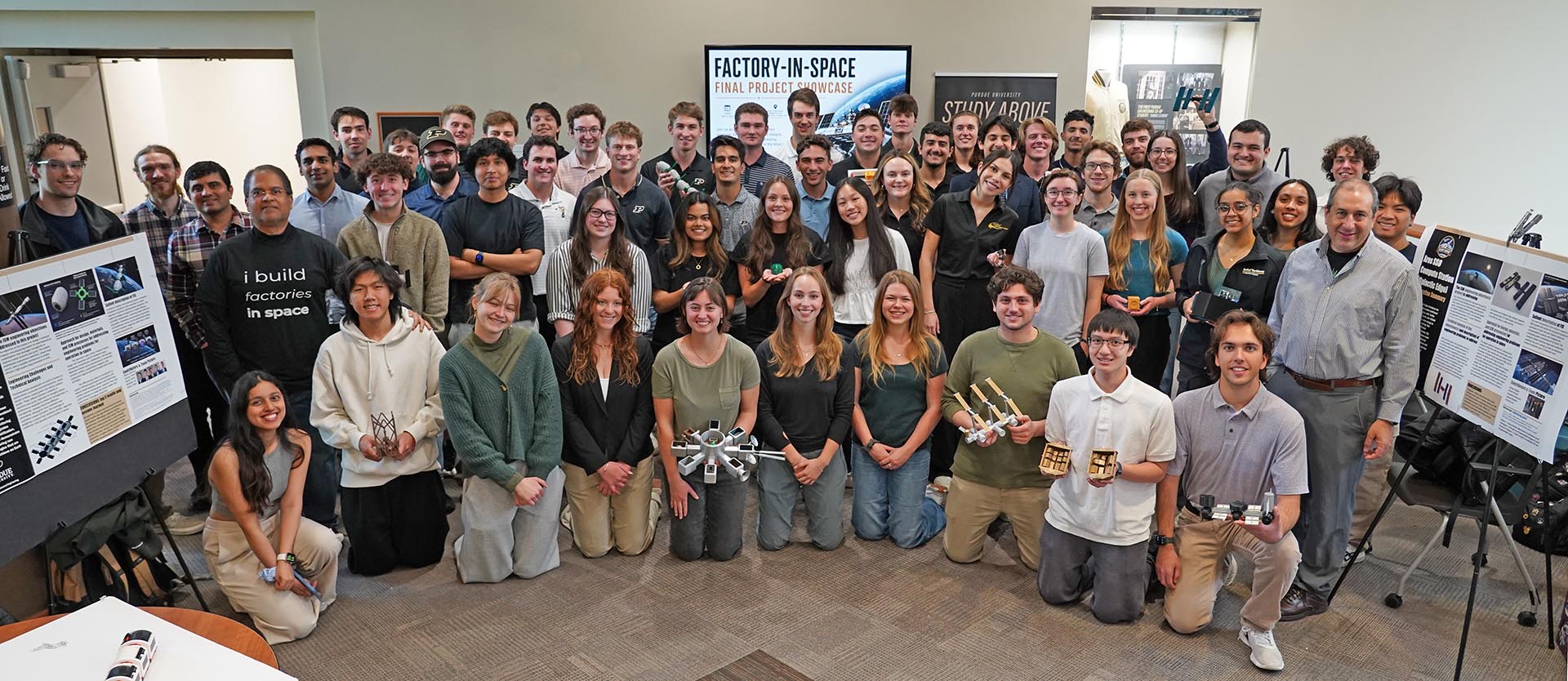
Each student team tackled a different opportunity for building things in space: nuclear power plants, pharmaceuticals, solar cells, fiber optics, semiconductors, data centers, and even growing plants. After the ideation phase, they used CAD and 3D printers to design more advanced stages of prototypes.
“The concepts they came up with were really innovative, and manifested their critical thinking skills we taught in the class,” Malshe said. “Even though they were all different, they shared a few common themes. One is circularity: there is no waste in space, so they have to find ways to recycle and reuse materials. The second is modularity: every bit of machinery must be flexible and serve multiple purposes. And the third is viability: there has to be a valid business case for manufacturing in space.”
And this is more than just talk (or LEGO!) Malshe is currently building a manufacturing experiment that will travel on Purdue 1, the first ever all-university spaceflight, scheduled to launch on Virgin Galactic in 2027. And he has even more ambitious goals than that. “In the future, I want to be able to teach this class from space!” he said. “Imagine I am in space and my digital twin is teaching students on Earth; or my students are in space, and I’m teaching them from Earth.”
“In-space manufacturing is all about democratization,” he continues. “Space is not a far-off place only accessible by a few; it is an extension of Earth. This coming generation will be the first to operate in space just like they operate on land, at sea, and in the air. It will be an incredible opportunity for invention, discovery, and improving society at scale for everyone.”
Source: Ajay Malshe, amalshe@purdue.edu
Writer: Jared Pike, jaredpike@purdue.edu, 765-496-0374