
Does direct air capture create more carbon than it removes?
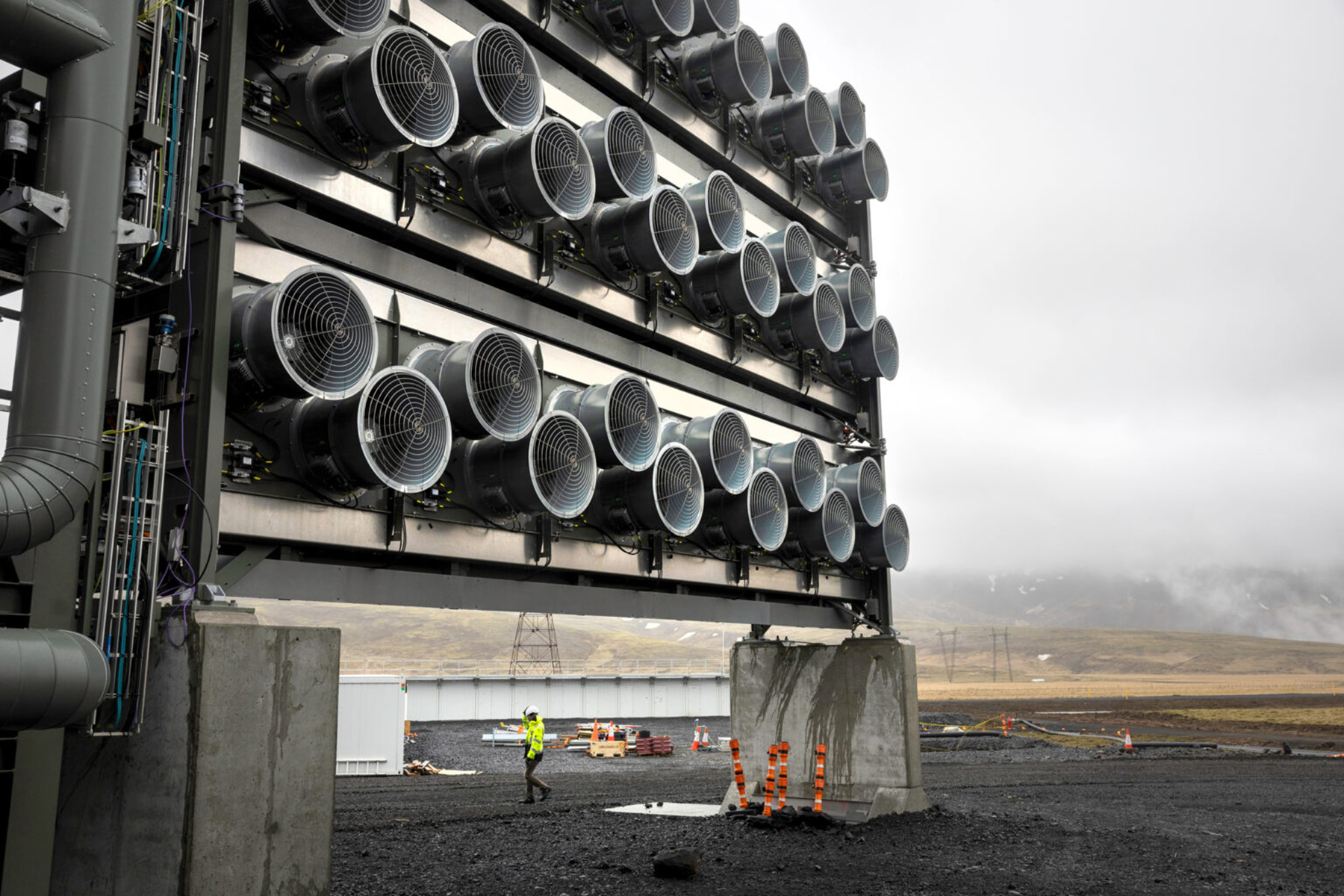
Direct air capture systems pull in air and remove the carbon dioxide using honeycomb-like structures coated with an adsorbent material. Acting like a sponge, the material captures the carbon dioxide which can then be stored underground or in other facilities.
While this technology has gained attention as a promising tool for reducing CO2 in the atmosphere, there is a critical part of the process that is often overlooked.
“There’s been a lot of lab scale testing,” said Rebecca Ciez, assistant professor of mechanical engineering and sustainability engineering and environmental engineering. “But there’s less on what this means for the long-term and our ability to sustainably manufacture these adsorbent materials.”
The lifespan of these materials is uncertain, and there has been little research on the environmental impacts associated with manufacturing them — something that Ciez and her team have found to have a bigger impact than originally assumed.
Their research has been published in Energy & Environmental Science.
To better understand those impacts, they evaluated several different adsorbent materials: examining how much energy it took to make each one, what materials were needed, and how much pollution was created while making them. Silica gel-based adsorbents were found to have the lowest environmental impact. However, one of their most important findings was that the lifespan of these materials plays a major role in the technology’s effectiveness.
“If the sponges have a longer lifespan, then these manufacturing impacts are a lot less important,” said Ciez. “If the materials aren’t as durable, the manufacturing ends up producing a pretty significant amount of CO2, sometimes comparable to the amount of CO2 removed later.”
Previous research has relied heavily on proxy data and overlooked the environmental costs of manufacturing these materials. By bringing attention to these impacts, Ciez’s research provides a more complete picture of direct air capture and emphasizes the need for more research.
“Direct air capture isn’t a silver bullet,” said Ciez. “It’s important to explore all the details to make sure it’s actually cutting the amount of carbon in the atmosphere.”
We gratefully acknowledge the support from the Alfred P. Sloan Foundation (grant no. 2024-22422) and the Research Corporation for Science Advancement for hosting the Scialog Negative Emissions Science conference.
Source: Rebecca Ciez, rciez@purdue.edu
Writer: Julia Davis, juliadavis@purdue.edu
Process-based lifecycle climate, energy, water and material constraints of solid adsorbent production for gigaton-scale direct air capture
Ioannis Keroglou, Rebecca E. Ciez
https://doi.org/10.1039/d6ee03173k
ABSTRACT: Negative emissions technologies like direct air capture are critical for achieving global decarbonization targets. Sorbent materials are central to direct air capture systems, with solid adsorbents requiring lower regeneration temperatures and avoiding the evaporative losses of liquid sorbents. As use-phase emissions decline due to technological advances and the use of low-carbon power sources, sorbent manufacturing impacts become increasingly important. Prior studies of sorbent manufacturing rely on oversimplified life cycle inventories and proxy data, resulting in substantial uncertainty. Here, we apply a process-based model to develop sorbent-specific inventories for scaling the production of polyethyleneimine-based solid adsorbents and evaluate their cradle-to-gate climate change, fossil resource scarcity, and water use impacts in the United States. Our results reveal higher material and energy requirements than previously assumed, leading to larger environmental footprints for this stage. Depending on the sorbent type, for a sorbent lifetime of 1 year, sorbent production requires an average of 0.40 × 10⁻³–6.43 × 10⁻³ m3 water per kg CO2 captured, consumes an average of 0.019–0.150 kg oil-eq per kg CO2 captured and emits an average of 0.053–0.438 kg CO2-eq per kg CO2captured. Longer or shorter lifetimes result in average emissions ranging from 0.027–0.877 kg CO2-eq per kg CO2captured. Silica gel-based adsorbent manufacturing has the lowest environmental impact, while γ-Al2O3- and MCM-41 adsorbents exhibit the highest burden. Impact uncertainty is driven by differences in support material synthesis and sorbent consumption rates. Producing sorbents with low-emitting grid electricity can reduce emissions intensity, but gigaton-scale deployment would require expanded supply chains for key chemical feedstocks.