ICON keeps steady progress in enhancing research collaborations both internally and externally
Since launching in September 2020, the Center for Innovation in Control, Optimization and Networks (ICON) has focused on integrating diverse expertise to tackle fundamental challenges in complex, connected and autonomous systems. Together with 75 ICON-affiliated faculty from more than 12 departments across Purdue, co-directors Shaoshuai Mou, associate professor of aeronautics and astronautics, and Shreyas Sundaram, the Marie Gordon Associate Professor of Electrical and Computer Engineering, have made significant progress in enhancing ICON’s collaborations with industry, government agencies and intentionally well-known leaders.
ICON has started to build strong relations in working with major industrial players in autonomy. ICON researchers have received funding from Saab to develop distributed algorithms for coordination of multiple unmanned vehicles with human-on-the-loop. ICON also hosted the visit of Alinikula Petteri, chief technology officer at Saab, Finland, in September 2022 to further facilitate the collaboration between Saab and a broad set of ICON-affiliated faculty. ICON has teamed up with Saab to respond to call-for-proposals from DARPA and ONR to provide innovative solutions based on control and machine learning for uncrewed surface/underwater vehicles.
ICON hosted summits on frontier research topics with government agencies. Beside two panels on intelligent robotics swarms and precision agriculture — featuring panelists from DARPA, the U.S. Army Research Lab, Northrop Grumman and John Deere, among others — ICON hosted the Summit on Trusted Autonomy Research and Technology (START) with the US Department of Defense. In addition to 23 program managers from DoD and over 65 researchers from academia, attendees also included high-level representatives from DoD, including David Honey, Deputy Under Secretary of Defense for Research and Engineering (OUSDR&E), and Jaret Riddick, principal director for autonomy with OUSDR&E. Also participating were Theresa Mayer, Purdue’s executive vice president of research and partnerships, and Mung Chiang, president-elect of Purdue University. The summit helped to establish a community spanning academia, government and industry in the emerging area of trusted autonomy.
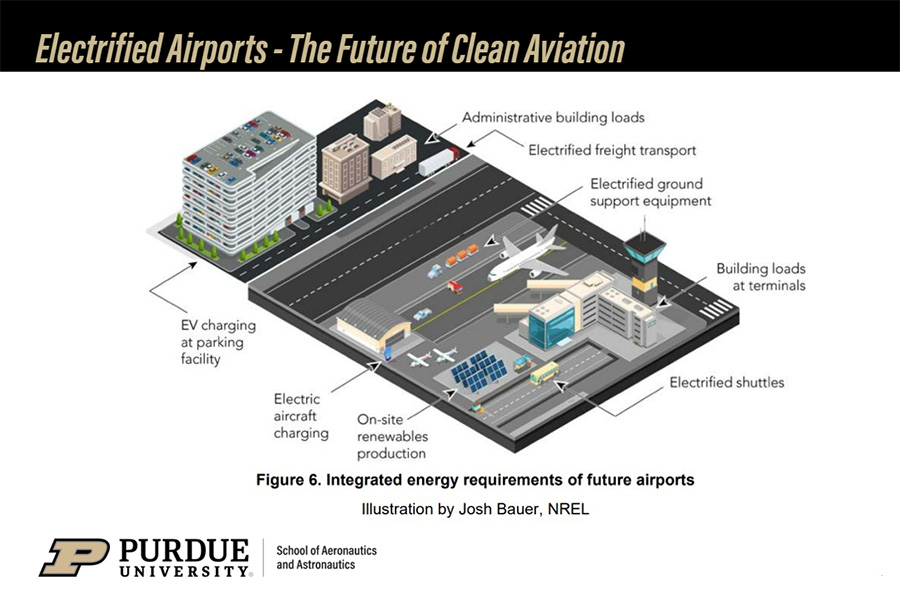
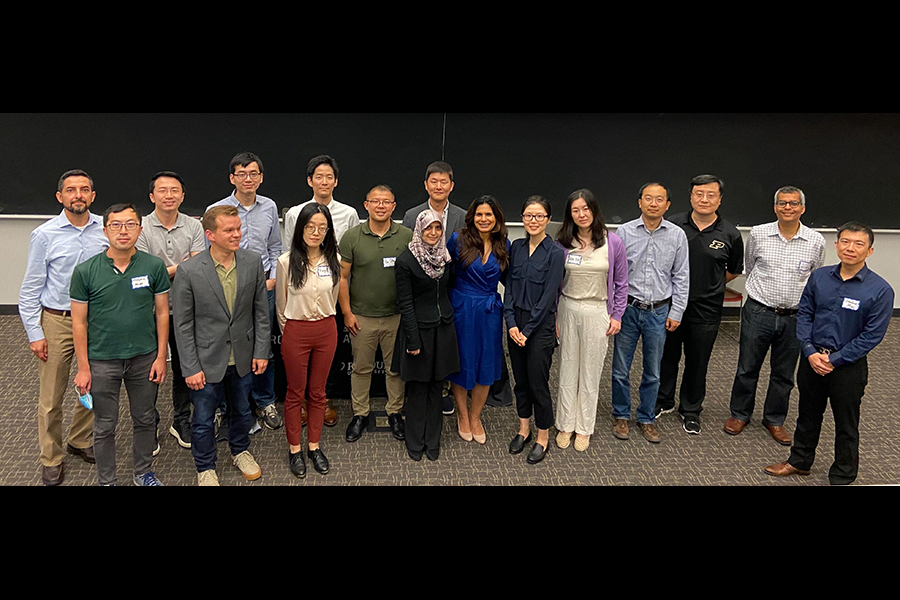
ICON also has focused on enhancing research collaborations and student mentoring within Purdue. ICON hosted an in-person, new faculty orientation in September 2022, featuring 10 new faculty members from AAE, CE, ECE, ME and Purdue Polytechnic Institute. ICON also organized an Outstanding Students Symposium, and several ICON-affiliated faculty supervised winning student teams in competitions including DoD’s Challenge in “AI Tracks at Sea,” FAA’s “Smart Airport Competition,” NSWC Crane’s “AI for Small Unit Maneuvers’ competition” and FAA’s challenge in electrified airports.
ICON has been hosting weekly seminars by speakers from a variety of departments on research topics including autonomy, control, robotics, machine learning and IoT. These seminars are organized and run by junior faculty at ICON. A current list of events and seminars can be found on the Purdue College of Engineering website.
“ICON is a great platform for idea exchange, collaboration establishment and professional networking," said Wayne Chen, associate dean for research and innovation,. "It is becoming a base to spin off focused research centers, to define future research directions and to grow industrial consortia.”