Program Overview
The Internet of Things (IoT) is playing a significant role in modern society including smart cities/homes, healthcare systems, social networks, etc. Current and future engineers will be faced with significant challenges in employment and implementation of IoT in extensive engineering applications. As such, there is a significant demand for students to further enhance their core skills and knowledge in analysis and design of IoT, especially in embedded systems, VLSI, and wireless communications. Students can greatly benefit from this accessible online option.
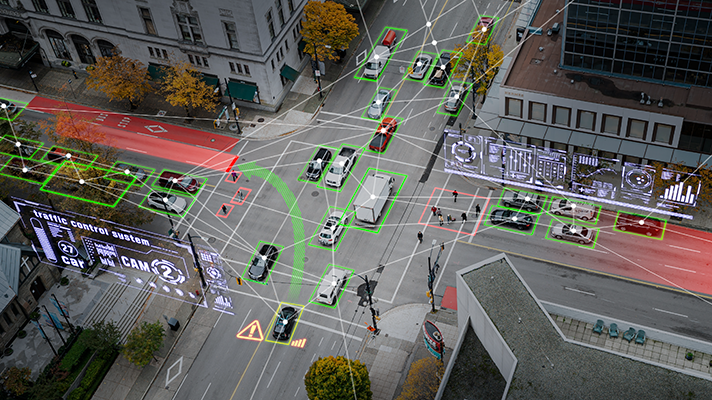
The Major in IoT within the Interdisciplinary Engineering master’s program (IDE ) focuses on the area of analysis and design of internet-of-things such as a system of interrelated computer devices, mechanical and digital machines, sensors and so on that connect and exchange data over the internet or other communication networks. This area spans a variety of application domains. The courses in this major will establish fundamental theories and tools in computing, sensors, embedded systems, chip design, and wireless communications.
A degree in Internet of Things from Purdue University:
- Increases leadership skills and ability to effectively lead diverse teams across multiple engineering disciplines.
- Promotes effective technical communication of complex concepts, analyses and solutions.
- Increases learner technical abilities and skills in a wide variety of cutting-edge engineering disciplines.
Curriculum
This degree requires 30 credit hours total with at least 18 hours of Purdue graduate engineering courses. Course subjects suggested for the online master’s in IoT includes:
- Data Science for Smart Cities
- Embedded Systems
- Advanced IoT Design and Applications
- System-on-Chip Design
The degree awarded is either the Master of Science in Engineering (MSE) or the Master of Science (MS) depending upon your undergraduate degree; the major is Internet of Things. The full curriculum can be found here.
After you begin your studies at Purdue, an academic advisor will provide you with tools to map out a plan of study and help you define a concentration tailored to align with your specific goals. Your academic advisor will also help you identify a faculty advisor.
Admissions Requirements
Criteria for Admissions
- Minimum GPA of a 3.0
- Math Background: One semester each of Calculus I, Calculus II and either Linear Algebra or Differential Equations
- Engineering Background: Preferred undergraduate degree in Engineering, Science, Mathematics or Technology.
Application Requirements
- Transcripts from all universities attended
- 3 recommenders
- Academic Statement of Purpose
- Personal History Statement
- A professional resume
- Math prerequisite checklist, if applicable
- Full admissions requirements
Application Deadlines
- For Fall Start: August 1
- For Spring Start: December 1
- For Summer Start: May 1
Tuition*
- Resident of Indiana: $1,139 per credit hour
- Nonresident of Indiana: $1,459 per credit hour
- Domestic students and permanent residents may qualify for the following types of financial aid: US federal financial aid, Military, veterans, and military-connected students
*The cost of attending Purdue varies depending on where you choose to live, enrollment in a specific program or college, food and travel expenses, and other variables. The Office of the Bursar website shows estimated costs for the current aid year for students by semester and academic year. These amounts are used in determining a student’s estimated eligibility for financial aid. You can also use our tuition calculator to estimate tuition costs.
Quanser partnership to create educational experiences
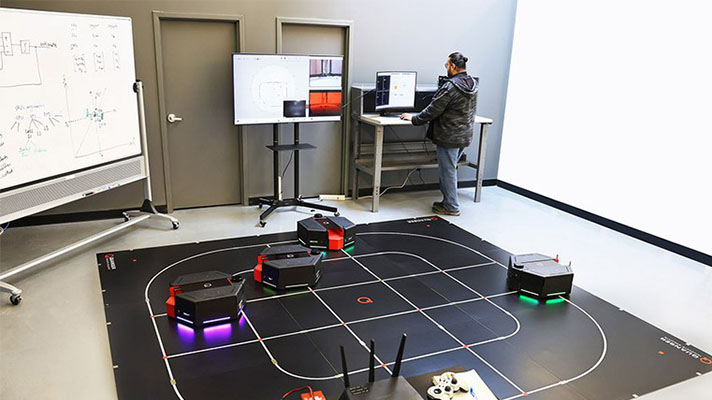
A new collaboration between the Purdue College of Engineering and Quanser will provide Purdue Engineering students interested in autonomous and connected systems (ACS) unique, real-world educational experiences, offered on a larger scale, and accelerate research in this growing field. “The partnership with Quanser represents a significant advance in our continuing drive to nurture the nation’s largest and best-prepared engineering talent pool,” said Arvind Raman, the John A. Edwardson Dean of the College of Engineering. “As the leading developer and distributor of educational equipment in controls and autonomy, Quanser is an ideal partner in our efforts to invest further in training the next generation of engineers in the booming field of autonomous and connected systems. We also expect the collaboration to strengthen our research capabilities and national prominence in this critical area.”