
Purdue launches comprehensive quantum degrees program
Program is designed to build quantum workforce and economy
Quantum technologies, which harness nature at the tiniest scales, hold the potential to transform how people compute, communicate and sense their environments. Critical areas that could benefit from emerging quantum technology include AI design of new functional materials for safer and cheaper consumer products, therapeutic drug development, cybersecurity, and deployment of sensors with extreme sensitivity and spatial resolution.
But to realize the promise, a next-generation workforce needs to be educated at scale, and we must act swiftly.
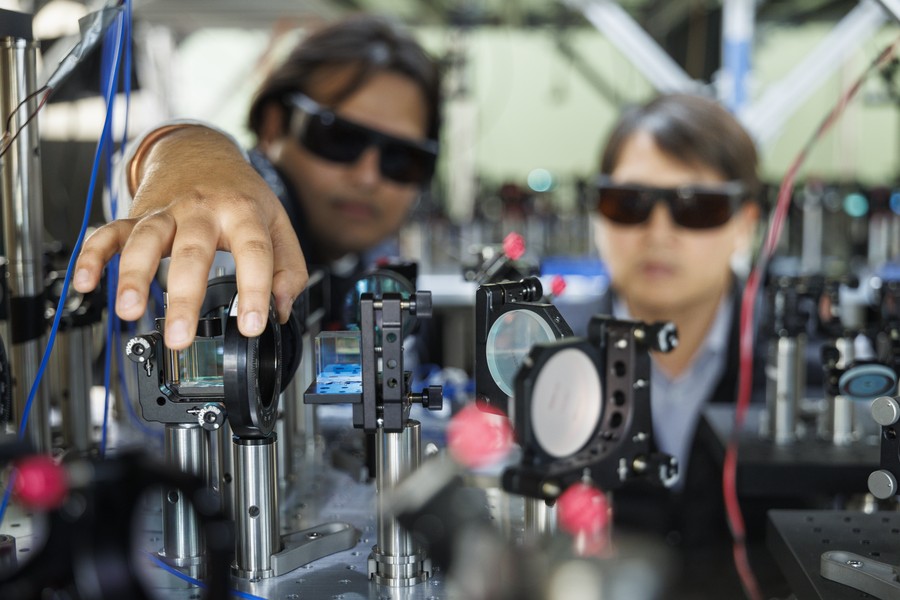
Purdue University is launching an innovative quantum degrees program to meet this challenge. The College of Engineering and the College of Science are preparing to roll out an expanded array of educational opportunities, combining theory and practical application and covering quantum computing, sensing and communications.
In the Midwest alone, quantum technology is expected to create hundreds of thousands of jobs within the next 10 years, across roles spanning various skillsets, industries and education levels. These Midwest job numbers are expected to grow by more than 200% from 2027 to 2030 and by 550% from 2030 to 2035.
“The comprehensive quantum degrees program will be the latest of several groundbreaking degree programs we have launched to address student and industry needs in critical, rapidly emerging fields,” said Arvind Raman, the John A. Edwardson Dean of the College of Engineering.
“Realizing the full potential of quantum technologies depends on how quickly we prepare the workforce,” said Lucy Flesch, the Frederick L. Hovde Dean of the College of Science. “By offering multiple entry points, from certificates and minors to professional master’s and PhD concentrations, Purdue is making quantum literacy and quantum capability accessible at scale.”
“We strive to amplify the impact of Purdue’s broad range of quantum research by forming strategic collaborations to propel real-world advances,” said Michael Manfra, Purdue’s chief quantum officer, Bill and Dee O’Brien Distinguished Professor of Physics and Astronomy, and director of the Purdue Quantum Science and Engineering Institute (PQSEI). “In partnership with industry and government, we’re building the future quantum workforce and powering the nation’s quantum economy.”
Program elements
Spanning various academic levels, disciplines and skill sets, the quantum degrees program will encompass the following offerings:
Undergraduate level:
- Quantum information science and technology certificate (jointly offered by the College of Science and the College of Engineering)
- Quantum technology concentration for Electrical Engineering in the College of Engineering
- Quantum science minor offered by the Department of Physics and Astronomy in the College of Science
Graduate level:
- Master’s concentration/professional master’s program in quantum
- Online Master of Science in quantum (This program has been submitted to our accreditor and is pending review by the Higher Learning Commission.)
- MicroMasters in quantum technology: computing and sensing
- PhD concentration in quantum interdisciplinary studies in science in the College of Science
- Electrical and Computer Engineering PhD concentration in quantum
Complementing these components, Purdue hosts several quantum seminar series, quantum workshops, and quantum-focused summer schools throughout the year to enrich students’ quantum learning experience. Students also benefit from extensive study abroad, internship and co-op experiences available through Purdue University.
Scale and breadth
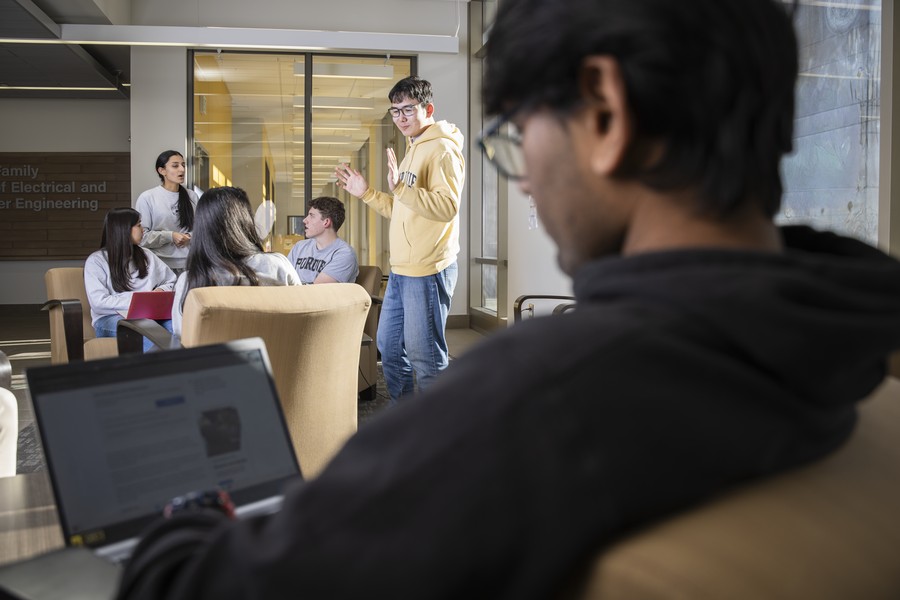
“The scale and breadth of our quantum program allow us to reach wide-ranging populations, including undergraduates, graduates and professionals,” said Pramey Upadhyaya, associate professor of Electrical and Computer Engineering. “Many courses are available in one-credit increments, enabling us to quickly train a well-rounded workforce.”
Thomas Roth, assistant professor of Electrical and Computer Engineering, said: “The strong partnership between the colleges of Engineering and Science continues to shape our research and curriculum developments. Under our new comprehensive quantum degrees program, students will take courses from both science and engineering perspectives. Students will participate in project-based education, pushing their learning to the next level to see how concepts in class are applied in the real world.”
“Our faculty and students are exploring nature at all length scales, including the quantum realm,” said Erica Carlson, the 150th Anniversary Professor of Physics and Astronomy. “Together, we’re pushing the boundaries of quantum science and technology from the lab to the real world. With the emergence of this new quantum industry, a quantum-aware and quantum-proficient workforce is needed.”
Quantum leadership
Purdue is eminently qualified to address this growing demand and help students seize career opportunities.
Among the university’s distinctions:
- The PQSEI is home to more than 65 faculty members with vibrant research programs in quantum computing, sensing and communications.
- Purdue is home to Microsoft Quantum Lab, West Lafayette. Microsoft Quantum employees work with Purdue faculty and utilize Purdue facilities to generate next generation quantum computing hardware.
- The university leads quantumHUB, a suite of free online educational materials to help the world learn about quantum science.
- Purdue’s Birck Nanotechnology Center is one of the nation’s most advanced academic facilities for nanotechnology research, including quantum materials development and quantum device fabrication.
- Purdue is the lead university of the National Science Foundation-backed Center for Quantum Technologies, a founding member of the Midwest Quantum Collaboratory and a member of the Chicago Quantum Exchange.
- Purdue researchers recently demonstrated a functioning quantum network linking multiple laboratories, positioning the university alongside top quantum research institutions.
- Quantum Insider named Purdue as one of the 20 top universities for quantum computing research.
- The Quantum Photonic Integrated Design Center, a U.S. Department of Energy, Office of Science-funded Energy Frontier Research Center, aims to discover, design, and realize robust many-body entangled photon and matter states.
- The study of pioneering quantum spin liquids earned Purdue scientists and Engineers a prestigious W. M. Keck Foundation Grant of $1.2 million.
What they’re saying
Industry notables and students are applauding Purdue’s comprehensive quantum degrees program initiative, anticipating its impact for industry, government and students. Here is a sampling of their comments:
Kate Waimey Timmerman, CEO, Chicago Quantum Exchange: “Scaling a well-prepared quantum workforce is critical to our nation’s quantum leadership — and Purdue’s new quantum degree programs are a vital addition to this effort. By providing students with a clear, comprehensive pathway into quantum science and engineering, Purdue is not only expanding the talent pipeline but ensuring that the Quantum Prairie remains the premier destination for quantum innovation. This kind of dedicated educational infrastructure—coupled with Purdue's deep collaborative ties to our other member institutions like Argonne and Fermilab—is how we continue to build a fully integrated discovery-to-deployment ecosystem with the talent and resources to help our sector scale.”
Dr. Dana Anderson, Founder and Chief Science Officer, Infleqtion: "As one of the top engineering universities in the country, with pioneering quantum research pursued within its College of Science, Purdue is exceptionally well positioned to expand its emphasis on quantum technology through its new degree and certificate programs. Purdue understands that the nation’s workforce needs extend well beyond quantum information science alone to a broader range of quantum-relevant disciplines, including electrical, mechanical, materials, and aerospace engineering. I admire Purdue’s foresight and am confident that the students it trains will help shape the future of the rapidly growing quantum industry."
Dr. Chetan Nayak, CVP and Technical Fellow, Microsoft Quantum: "Talent is the biggest bottleneck for the rapid development of quantum technologies today. Workforce development to drive quantum technologies requires universities to develop new degree programs to train students in quantum-specific subjects that are needed in industry. Microsoft Quantum applauds Purdue's launch of a comprehensive degree program in Quantum. We have hired Purdue graduates at Microsoft Quantum who make critical contributions on a daily basis. Training a quantum workforce at scale is exactly what the quantum industry needs to thrive. Purdue's comprehensive quantum degrees program is an important step in this direction."
Ryan Manley, Electrical Engineering student and Vice President, Quantum Student Organization: “Purdue will provide the curriculum, hands-on learning opportunities and outreach efforts for students like me to become the quantum engineers and scientists of the future, equipping us for rewarding careers in the booming quantum industry.”
To learn more about the comprehensive quantum degrees program, including our new online M.S., click here. This program has been submitted to our accreditor and is pending review by the Higher Learning Commission.