
I became Purdue's storyteller: Thendral Kamal (AAE '26) goes from T2M rejection to moderating history
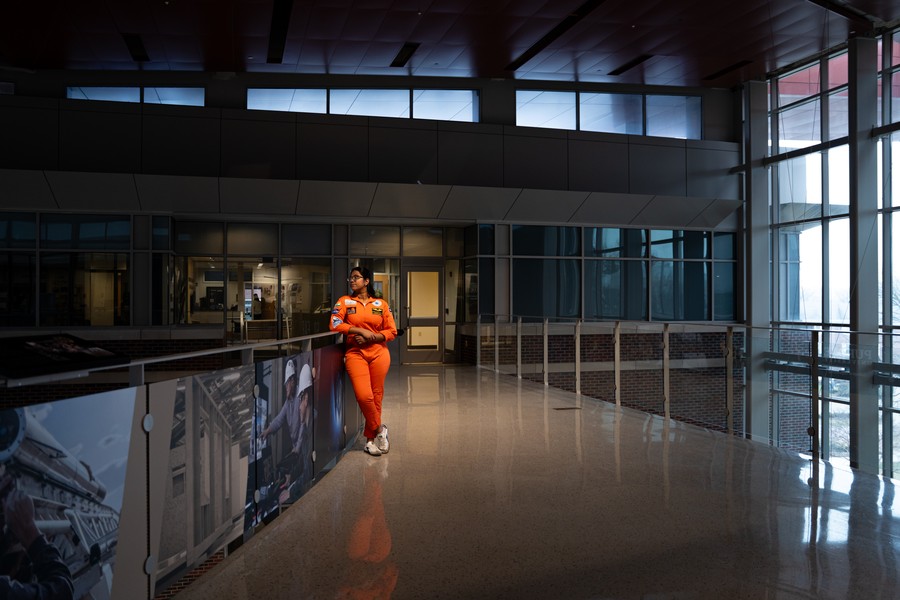
The night Thendral Kamal arrived in West Lafayette, she had three heavy bags, a 17.5-hour flight behind her, and no one she could call a friend in the entire country. It was 10 p.m. She was 7,400 miles from home in Dubai. When she walked into her dorm room at Purdue University’s Meredith Hall, she found a small pile of candy on her bed. A note from her new roommate read: "It's not much, but welcome to the United States!"
"It was such a small gesture, but it meant the world to me," Kamal says now, just weeks before graduating with a degree in aeronautical and astronautical engineering (AAE). In that moment, a stranger's quiet act of welcome became a kind of compass for everything that followed.
Five years later, Kamal has become something of a spokesperson for Purdue. She’s served as moderator for all three announcements related to the historic, all-Boilermaker spaceflight, called Purdue 1, that is set to launch next year. She is Purdue’s inaugural Co-op Student of the Year Award recipient, a Brooke Owens Fellow and a Society of Women Engineers Outstanding Collegiate Member. She has interviewed an astronaut, participated in discussions on furthering STEM outreach within rural American communities at a National Space Council meeting at the White House and mentored more than 20 first-year engineering students. In the final weeks of her undergraduate degree, she presented aerospace policy research to senior officials at Global Affairs Canada in Ottawa and served as master moderator at the 41st Space Symposium in Colorado Springs. She is also working on an experiment in professor Steven Collicott's AAE 418 course that will fly aboard Purdue 1.
None of it was guaranteed. Very little of it came easily.
The door that closed
Kamal had dreamed of becoming an aerospace engineer since she was 13, when she told her parents she wanted to be the first Indian woman to set foot on Mars. She chose Purdue specifically, over any Ivy League, over any other program, because it was Neil Armstrong's alma mater. When Purdue accepted her, she stopped checking her other applications.
But the first year and a half at Purdue tested everything she had imagined. She called her parents at least twice a day, working through homesickness sharper than she had anticipated. She was applying everywhere, chasing every opportunity, and getting nowhere. "I certainly didn't expect the difficulty to be as high as it was," she says.
The lowest point came when she didn't make it into the AAE program through T2M, the transfer mechanism that would allow her to officially declare her major. For an international student with no backup plan in the U.S., the rejection felt like the floor had dropped out. "As an international student, I had no Plan B," she says. "I had left everything 7,400 miles behind."
That summer, while her peers traveled or took internships, Kamal stayed in West Lafayette. She worked as a lifeguard at the Córdova Recreational Sports Center to afford rent, met with professors to dissect her failures and studied with a focus that her earlier self hadn't yet found. Among those professors was Karen Marais, the associate head for undergraduate education at Purdue’s School of Aeronautics and Astronautics, who became her most consistent mentor.
"What has always stood out to me about Thendral is how early and consistently she distinguished herself, not just through talent, but through purpose," Marais says. "When she encounters challenges, she seeks feedback, reflects honestly and applies what she learns with perseverance and optimism."
By the end of that fall, Kamal had earned her place in AAE, but the initial rejection, she says, changed something permanent in her. "I stopped waiting to be picked and decided I would forge my own path."
The fellowship and the baggage carousel
Since high school, Kamal had known about the Brooke Owens Fellowship, a highly competitive program for women and gender minorities pursuing careers in aerospace. She applied as a college freshman, just to get a feel for the process. She made it to the semifinals. When the final rejection came, she read the feedback carefully: the differentiator was experience.
So she spent the next year building it.
For her second application, Kamal submitted a poem about overcoming self-doubt and claiming her place in aerospace, called "Fearfully and Wonderfully Made,” that she had written in a moment of what she calls catharsis. She was at Los Angeles International Airport, fresh off a flight, when her phone rang with the news that she had been selected for the class of 2023.
"I was in so much disbelief that my luggage traveled multiple times around the baggage carousel before I realized I had to pick it up," she says.
She was not only the only Boilermaker selected that year; she was the first international student from Purdue University to ever hold the title. Navigating the visa complications required to actually accept the fellowship took weeks of persistence and relentless emails. But she got there.
"It felt like Purdue was on that map with me," Kamal says, "and like I was carrying my community with me into rooms I used to only read about."
The recruiter who almost fainted
Around the same time, Kamal was standing in a long line at Purdue's Industrial Roundtable career fair when she noticed a Delta Airlines recruiter who looked like he was about to faint on that hot September day. She stopped her elevator pitch mid-sentence and asked if he needed water.
That instinct, developed in lifeguard training, turned out to be the moment that got her hired. Months later, over coffee in Atlanta, the recruiter told her exactly why he had chosen her over a pool of equally qualified applicants. "At Delta, we tell our employees to embody servant leadership," he said. "That single act of kindness proved that you were someone capable of following that advice."
Kamal spent the entirety of 2023 on co-op at Delta, working as an aircraft structural support engineer. Her performance there ultimately earned her the Office of Professional Practice’s inaugural Co-op Student of the Year Award, an honor she received as the program's first international student recipient.
She has turned the Delta story into one of the centerpieces of her mentoring. "Technical competence gets you to the table," she tells her mentees, "but empathy and authenticity are what people remember long after you're gone."
Telling Purdue's story
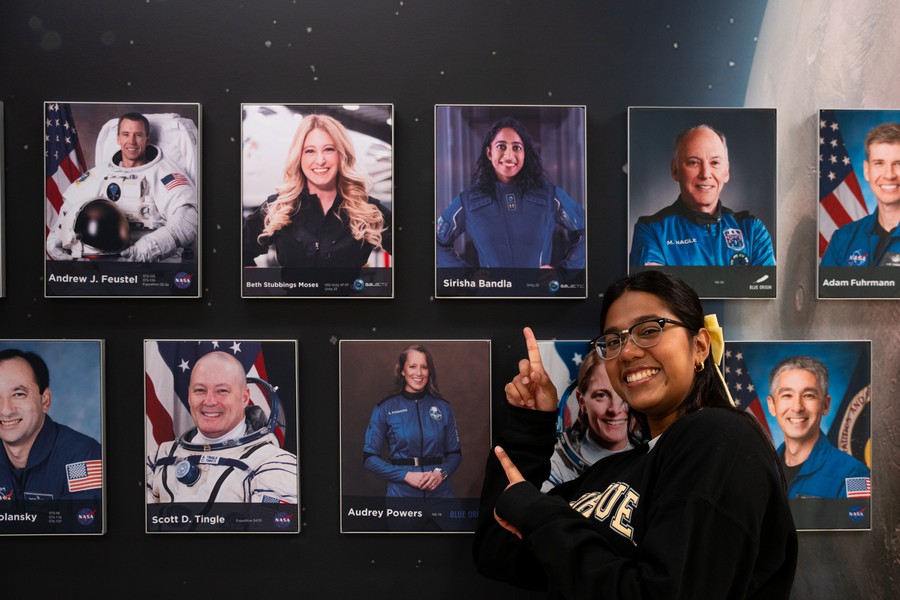
Kamal's path back from the T2M rejection had led her somewhere she hadn't fully anticipated: a reputation as a storyteller. She had started building it long before Purdue, volunteering as a student guide at the Sharjah Planetarium in high school, delivering a TEDx Talk at age 17, and starting an astrophysics club. At Purdue, she expanded it, interviewing Virgin Galactic astronaut Sirisha Bandla for Purdue Engineering’s Engineering Heroes series, serving as an AAE Ambassador, and delivering sessions at national conferences.
Bandla’s launch on Virgin Galactic’s Unity 22 had been a particular inspiration. Kamal had watched it live with her little sister in Dubai, just months before starting at Purdue. When she was asked to interview Bandla during her co-op semester, she flew from Atlanta to West Lafayette for it. "The whole conversation shifted her for me, from viewing her as a role model to a mentor," Kamal says. "It made the industry feel smaller in a good way, like the people you admire aren't entirely unreachable."
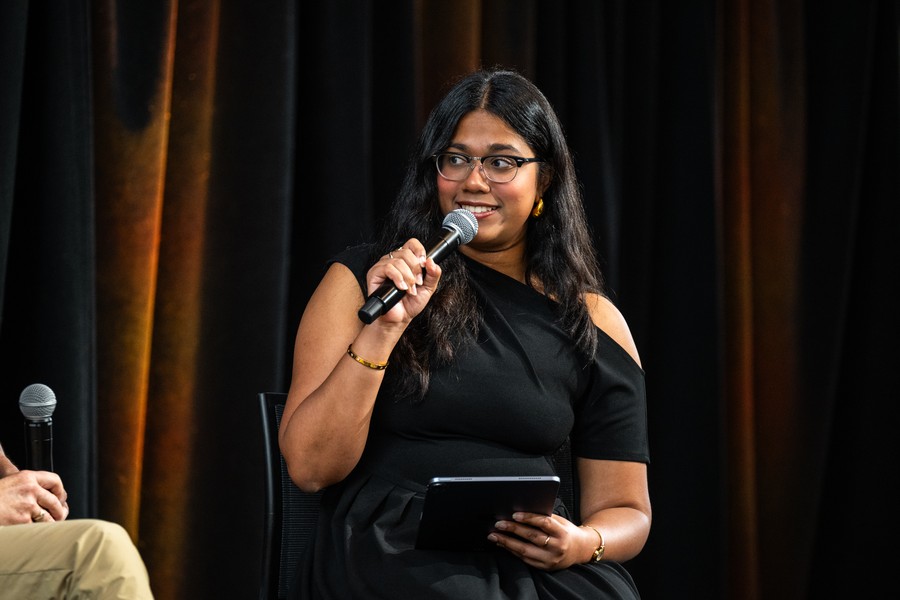
That reputation for translating complex ideas into accessible language eventually made her the de facto student voice of Purdue 1. She was moderator for all three flight announcements: the first event introduced crew members Collicott, graduate student Abigail Mizzi and alumnus Jason Williamson; the second revealed two additional experiments that will fly aboard the spacecraft; and the third brought together the last two crew members — alumni Beth Moses and Florence Stahura — for a total of five. Standing at the podium, Kamal thought about the years between the nervous freshman who couldn't get into AAE and this moment.
"I kept thinking about how this isn't just an event," she says. "I was part of history in the making. And it was so fitting that we were in the Neil Armstrong Hall of Engineering, the same building I used to sit in as a first-year student before I had even gotten into AAE, just to remind myself of what was to come."
"I am very honored to be able to wrap my undergraduate degree on such a high note," she adds.
The visibility she earned through those announcements opened another door. In April 2025, Kamal served as master moderator at the 41st Space Symposium in Colorado Springs, one of the largest gatherings of aerospace industry leaders in the world, courtesy of the Brooke Owens Fellowship. She met the NASA administrator and the heads of the Japanese and Brazilian space agencies. "It was a huge source of pride to represent Purdue and the College of Engineering on the largest stage of my life," she says.
An experiment headed to space
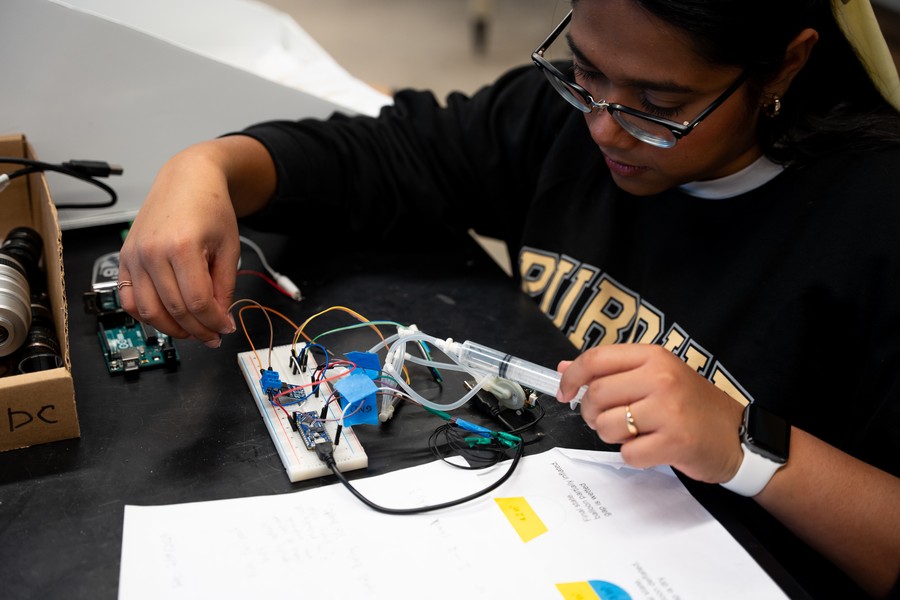
Kamal's connection to Purdue 1 runs deeper than the stage. This semester, she has been working in Collicott's AAE 418: Zero Gravity Flight Experiment course, developing hardware for an experiment that will fly aboard Purdue 1 in 2027.
"Thendral and her teammates are working with me to develop the original hardware for the novel Spaceflight Liquid Interactive Control Experiment, which I will fly with and perform on a Virgin Galactic mission dubbed Purdue 1," Collicott says. "I love that at Purdue, I am able to immerse our undergraduate engineering students in hands-on, project-based education experiences on actual spaceflight hardware. Alumni from this class often tell me that these experiences are uniquely valuable parts of their Purdue education."
For Kamal, who has spent five years chasing a dream that started with a 13-year-old's declaration that she would go to Mars, having her own experiment headed to space before she has even finished her undergraduate degree is not lost on her. "It is so exciting to know that an experiment with my fingerprints will fly on board the first all-Boilermaker spaceflight," she says. "I hope I can follow the experiment into space very soon!"
One victory
Kamal is staying at Purdue after graduation; she has been accepted to the graduate program in aeronautics and astronautics and will continue working toward her long-held goal of becoming an astronaut and, someday, the first Indian woman to set foot on Mars.
When asked to name her single victory from five years at Purdue, she does not hesitate.
"I became someone Purdue trusted with its story,” she says.
She is aware of what that trust represents, not just for her, but for the students who will come after her. Marais sees it the same way. "I hope students see in Thendral an example of how resilience, leadership and a commitment to lifting others can shape not only an individual's success, but the community around them," she says.
For incoming international students who are nervous, far from home and uncertain whether they belong, Kamal's advice is to start small. "Look for the little kindnesses, because they are all around you," she says. "People often think that belonging arrives in major milestones. But for international students, I think it starts smaller: a classmate who shares notes, a professor who learns to pronounce your name correctly. Building a home for yourself starts by following and thanking people for those little acts of kindness. And when the time comes, be sure to share your own."
She is also direct about the fear that many international students carry quietly, that they might do everything right and still be seen as an outsider. "Even though the world may feel bleak right now, and like there are walls up against you preventing you from doing the things you are truly passionate about, don't let that convince you that you have to do college alone," she says. "Purdue, and the United States, is a big place, but it is full of people who want to help. You just have to be brave enough to open yourself up to being helped and let them find you."
It is a message she delivers not just in words but in practice. She has mentored more than 20 first-year engineering students, many of whom failed their own T2M attempts, standing as living proof that rejection does not have to be the end of the story. "I stand not in spite of my rejections," she says, "but because of them."
Someday soon, she says, her goal is to carry that banner beyond planet Earth.
This story was developed as part of "Victories & Heroes: Your Campaign for Purdue." Join us in elevating Purdue Engineering education and excellence. Click here to be a part of Purdue history.