
Purdue Engineering students use AI to tackle societal challenges in ShahLab.AI competition

Seven Purdue Engineering student teams presented AI-driven solutions to real-world social and economic challenges on Oct. 21 during Phase 2 of the 2026 ShahLab.AI: AI For Social Good competition. The event was organized by Global Engineering Programs and Partnerships and hosted at the newly opened Purdue Hub for Innovation, Ventures, and Entrepreneurship (Purdue HIVE).
The teams competed for funding to advance their projects, with $90,000 awarded to the top three teams. The competition challenges students to identify partners with pressing societal needs and explore how AI can help address them, from expanding access to health care to reducing food waste and supporting addiction recovery.
Manu Shah, Purdue Engineering alumnus and benefactor of the ShahLab.AI at Purdue, emphasized that the competition’s purpose extends beyond developing new technology.
“What excites me most about ShahLab.AI is not simply AI, but the last four words of the competition: AI For Social Good,” Shah said. “People provide the compassion. AI provides enormous capability. Our responsibility is to bring the two together.”
Student teams propose solutions to pressing challenges
Three teams earned top honors for projects designed to address challenges affecting communities around the world.
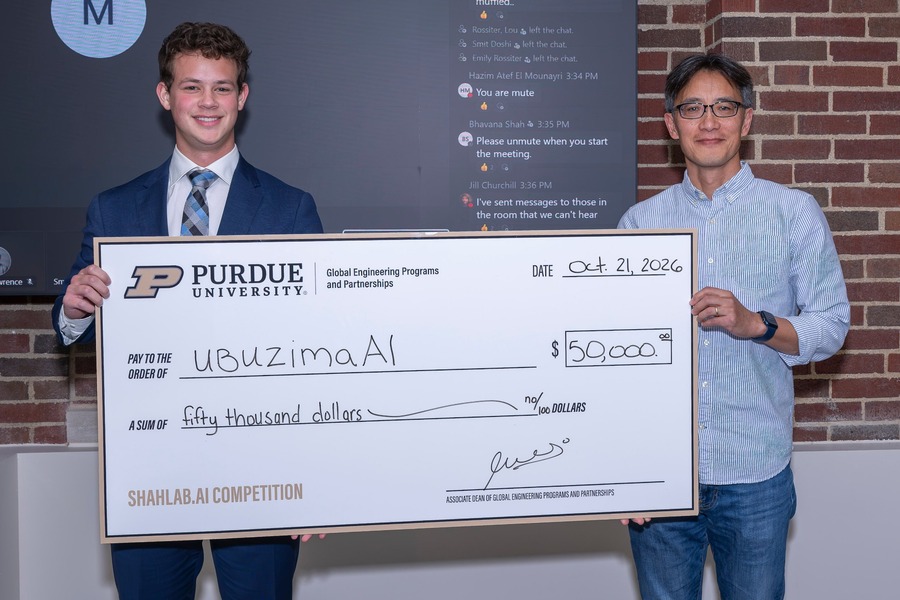
First place: UbuzimaAI — $50,000
UbuzimaAI is a proposed multilingual mobile health diagnostic assistant designed for rural Rwanda. Its offline, voice-guided triage system would support community health care workers serving Kinyarwanda-speaking populations, helping extend access to health information and care in communities with limited resources.
Team member Dennis Kountouris is a senior in Biomedical Engineering.
Second place: FreshGuard — $25,000
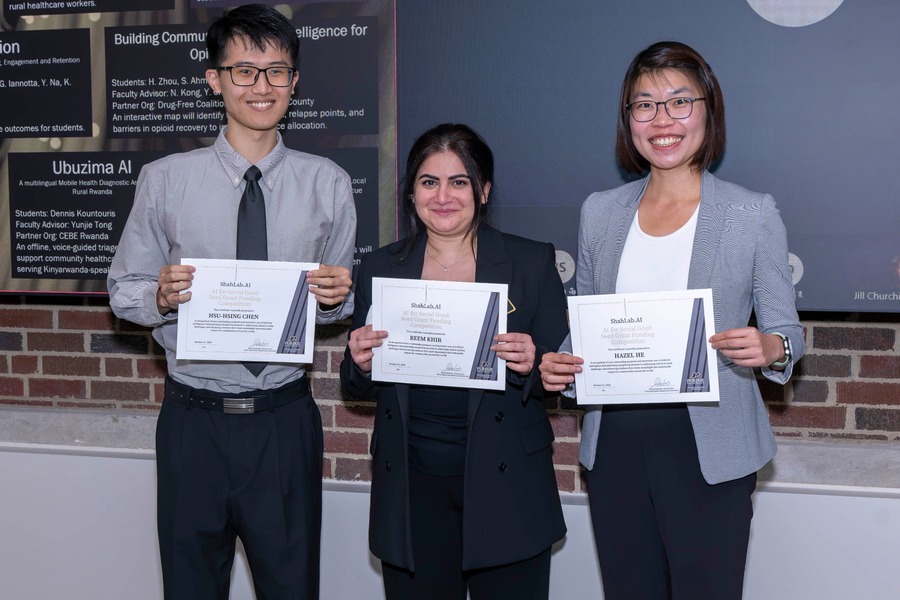
FreshGuard uses AI-driven inventory optimization to help local businesses better manage perishable goods and reduce food waste. By forecasting product expiration dates, the system aims to improve inventory management while helping create a more consistent supply of fresh food donations for communities in need.
Team members Mark (Hsu-Hsing) Chen and Hazel He are doctoral students in Industrial Engineering.
Third place: Building Community Pathway Intelligence for Opioid Response — $15,000
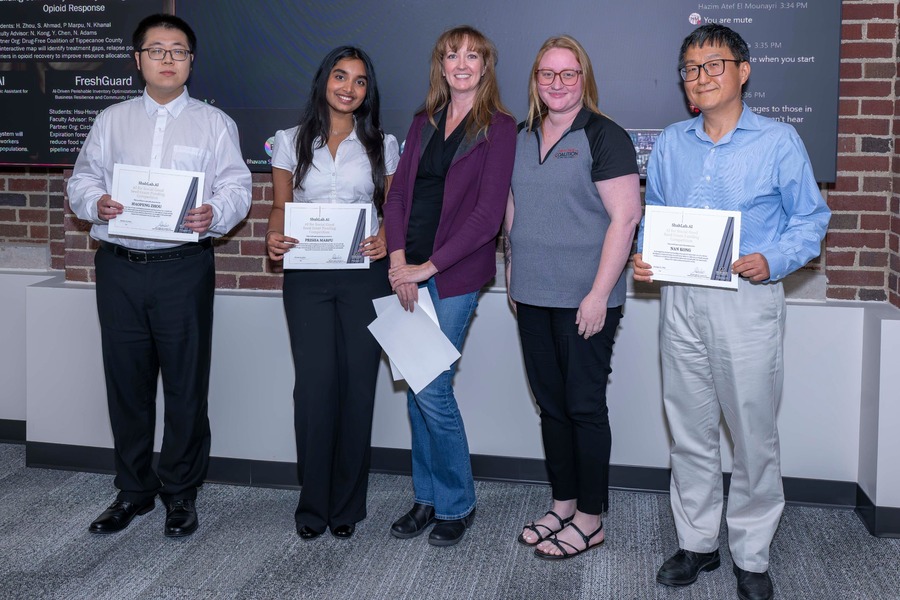
This project proposes an interactive map to identify gaps in treatment access, potential points of relapse risk and other barriers to opioid recovery. The goal is to help communities better allocate resources and strengthen support for people navigating recovery.
Team members are Haopeng Zhou, a PhD student in Industrial Engineering, Prisha Marpu, a sophomore in Computer Science, and Nabin Khanal, a PhD student in the School of Applied and Creative Computing.
Applying AI to improve lives
The projects reflect the broader mission of ShahLab.AI, an initiative under Purdue’s Global Engineering Programs and Partnerships that connects engineering innovation with real-world challenges. Through the competition, students work with partners to explore how emerging technologies can be applied to solving problems they face and develop solutions with the potential for meaningful social impact.
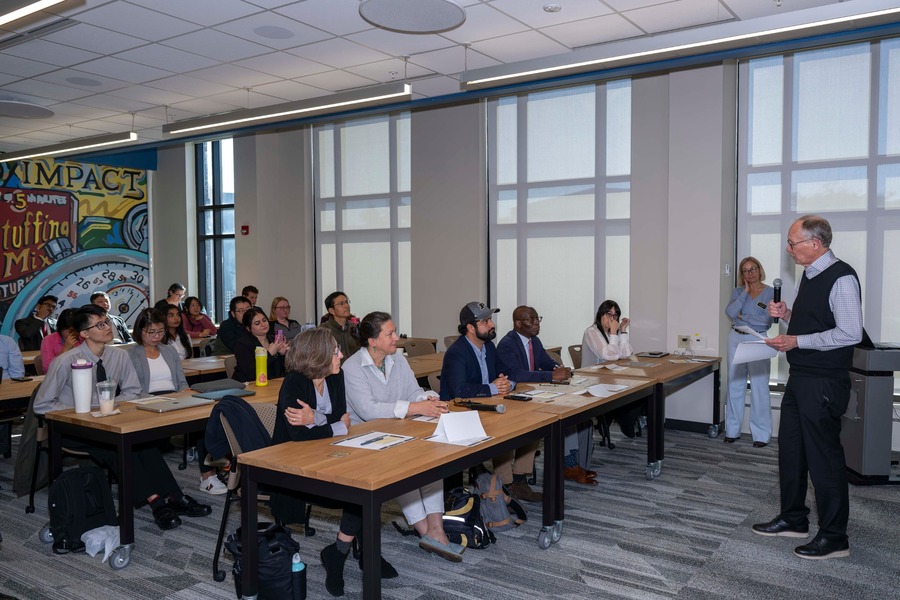
Mark Lundstrom, John A. Edwardson Dean of the College of Engineering, described artificial intelligence as a new chapter in the Shah family’s legacy of global innovation. He challenged students to focus on the problems they hope to solve and the people their work could help.
“The future is changing rapidly, but as engineers we have to ask: What can we do with this? What problem can we solve? Whose life can we improve?” Lundstrom said.
Lundstrom praised the teams for beginning with real needs, including health care access, education, addiction recovery, food waste and building safety, and exploring how AI could help address them.
“This is very much in keeping with Purdue’s land-grant mission,” Lundstrom said. “The tools have changed over the more than 150 years of this institution, but the responsibility remains.”
ShahLab.AI is named for benefactor Manahar “Manu” Shah, who earned a master’s degree in Mechanical Engineering at Purdue and received a Distinguished Engineering Alumnus Award in 2021.
Since 2019, Shah Lab has advanced more than 20 projects drawing on the expertise of 36 Purdue faculty members and 42 students, building partnerships across 10 countries. “The Lab’s model is about more than developing technology – it is about identifying meaningful problems, working with partners who understand those problems, and creating solutions that can be practical, sustainable, and scalable,” said Marisol Koslowski, Associate Dean for Global Engineering Programs and Partnerships. “The problem, the people it serves, and the potential for meaningful impact are what matter. The technology is only as valuable as the problem it helps solve.”