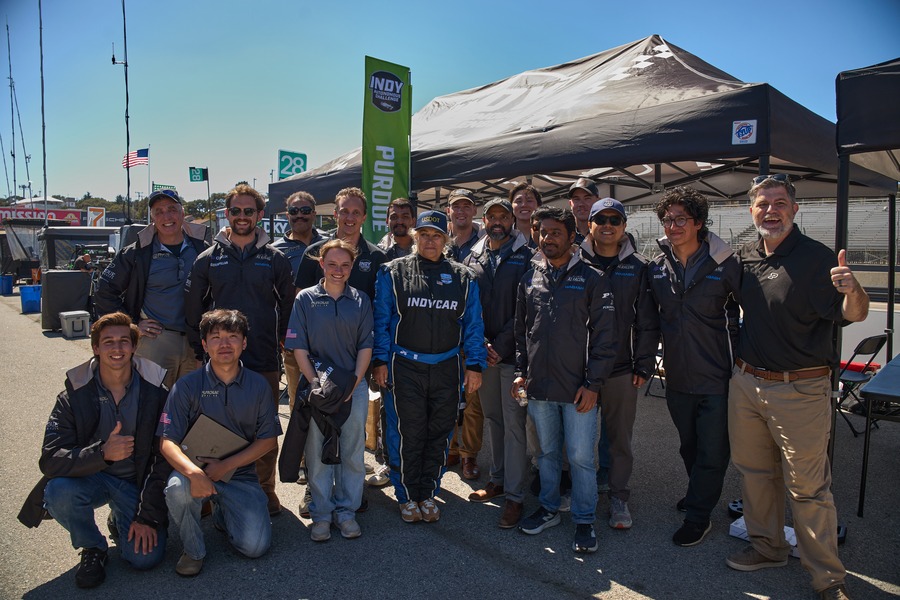
WATCH: Purdue AI Racing sets track record during Indy Autonomous Challenge at Laguna Seca
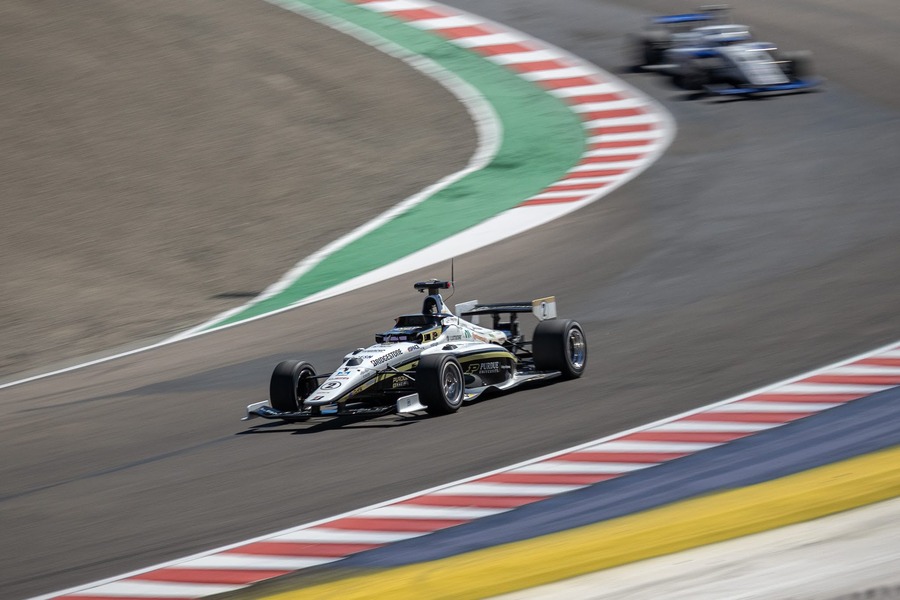
WEST LAFAYETTE, Ind. — Purdue Engineering is fueled by “firsts,” and on Sept. 3, the Purdue AI Racing (PAIR) team contributed a milestone achievement to that long list. PAIR set a new track record and won first place in the time trials with a 1:27.731 lap, becoming the first autonomous car ever to beat 1:28 at WeatherTech Raceway Laguna Seca in Monterey, California.
“It was really an incredible feeling, especially seeing those lap times come in,” said Alec Pannunzio, a long-time member of the team and a PhD student in the Elmore Family School of Electrical and Computer Engineering. “We knew we could push, and we did.”
PAIR was the only American team to qualify for the Indy Autonomous Challenge’s first-ever passing competition on a road course, a component that significantly elevated the level of difficulty.
"It's a real thrill for us. We have been at this now for a couple years and I think we've slowly figured things out — what is really required to go fast at a place like this," said Dan Williams, a professor of engineering practice and the team's faculty director. "We have learned a lot of the new perception and strategic planning wrinkles that we need for the competitive passing, and so it's been fun to see all that come together here."
In the end, the team earned a spot on the podium for the passing competition, finishing as the runner-up behind Unimore, an Italian team from University of Modena and Reggio Emilia.
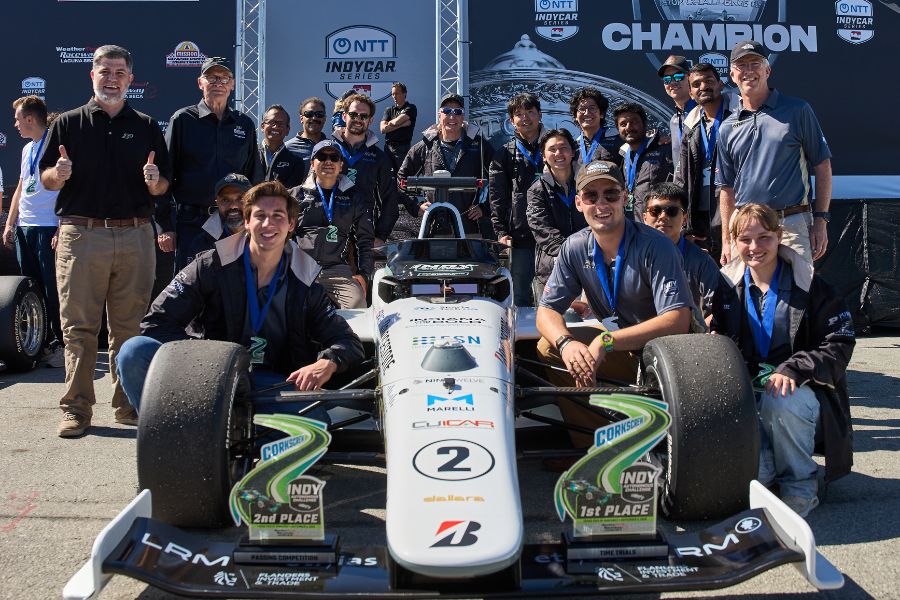
“It was a great outcome for Purdue,” Greg Shaver, Reilly Professor of Mechanical Engineering, said minutes after the race ended. “We had a lot of fans come out, and we’re going to take home some hardware tonight, and we couldn’t be prouder.”
Shreyas Sundaram, the Marie Gordon Professor of Electrical and Computer Engineering and a faculty adviser for the team, concurred.
“We’re very pleased that we put up an incredible fight with the top teams in the world and earned our place among them,” Sundaram said.
This year’s PAIR team was composed of more newcomers than veterans, making the group’s finish even more impressive.
“I can say with 100% certainty that we couldn’t do this without any one member of the team,” Pannunzio said. “Every member has a role and does it extremely well, and I’m incredibly proud of every single one of them.”
As expected, adapting the team’s strategy for passing was stressful, but PAIR rose to the challenge, said Yuchen Song, a fourth-year PhD student in the School of Mechanical Engineering who developed the control algorithms and software. “We’re competing with probably the fastest team in the world. We’re so happy that we could beat them in the time trial and be competitive in overtaking.”

The team logged dozens of hours in simulation testing and spent three weeks practicing at Laguna Seca leading up to the race.
“We had simulations, but we didn’t know exactly how fast we were going and how much we could push the car today,” Pannunzio said.
After simulation qualifications last weekend, the team knew what they needed to work on, said Alex Schleizer, a master’s student in mechanical engineering and part of the simulation sub-team.
“That helped us identify a lot of bugs and gaps in our software that we were able to patch and then actually implement today,” Schleizer said. “It was super rewarding to see those changes that we made help us get the great result we had today.”
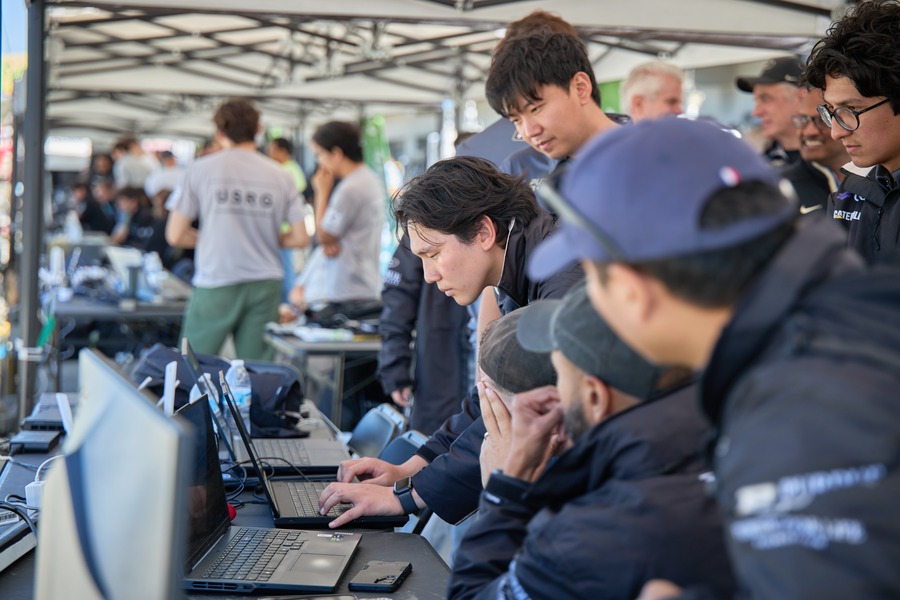
This race was uncharted territory for every team participating, Sundaram said. “We were nervous going in today. To run one car autonomously at Laguna Seca is complicated. Having two cars at those speeds with very tight spacings and no accidents out here today is just an incredible testament to how far our systems have come.”
With PAIR recording the fastest lap of the race, Manuel Mar, senior operations manager, said all of the long nights, coding, data review, programming and training paid off. “I want to thank the team, the faculty and the organizers. They were awesome this year.”
Pannunzio, still riding high, concluded, “Autonomous racing is one of the most stressful but rewarding things that you can compete in. We’re incredibly happy with the result.”
Before the race, team members had the opportunity to meet Seval Oz, assistant secretary for research and technology with the U.S. Department of Transportation. Oz served as grand marshal for the event and joined the Purdue team on the podium as they accepted their first- and second-place trophies.
Oz and several Purdue stakeholders were interviewed during the competition broadcast. View the livestream and watch full race here.