
Purdue Engineering names four winners of faculty Thinky Competition focused on AI
WEST LAFAYETTE, Ind. — This summer, Purdue Engineering faculty created innovative web apps, AI skills, and agents in support of teaching and learning, combining their strong technical domain knowledge with critical human judgment. These creative outputs are part of the Thinky Competition, which was initiated and organized by Stanley Chan, director of Engineering AI Education in the College of Engineering and a professor in the Elmore Family School of Electrical and Computer Engineering (ECE).
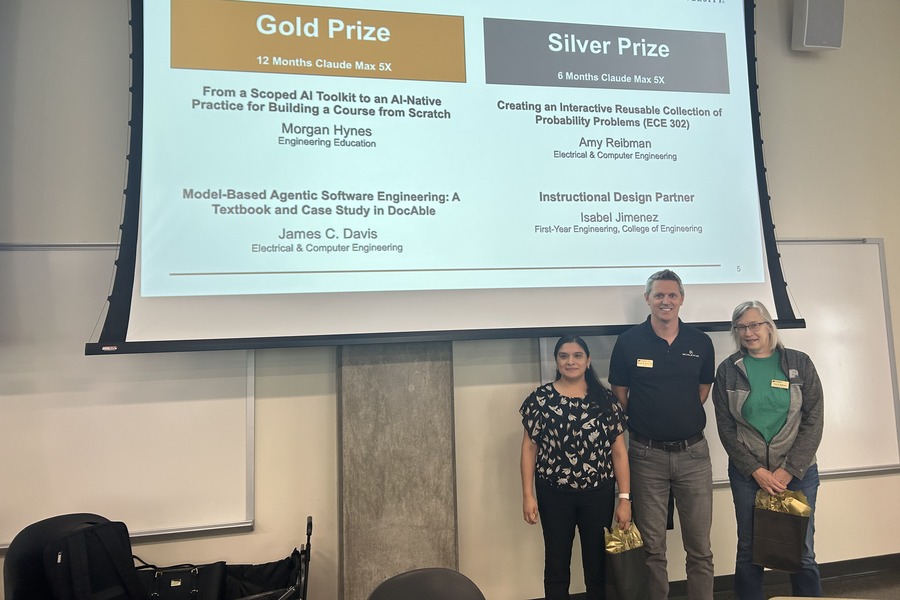
As part of the competition, Purdue Engineering named four faculty members as winners during the ThinkAI Teaching Fair on Aug. 17. The competition named two gold prize winners, Morgan Hynes and James Davis, and two silver prize winners, Isabel Jimenez and Amy Reibman.
Hynes, an associate professor in the School of Engineering Education (ENE) and the Multidisciplinary Engineering program, won for "From a Scoped AI Toolkit to an AI-Native Practice for Building a Course from Scratch." According to the full abstract, Hynes used Claude over the summer to build an AI-workflow toolset for IDE 495, a new course teaching students to prototype physical, sensing and interactive experiences. That toolset grew into a full course design: a 15-week, six-project curriculum, six public workflow guides now live at facelab-air.org and a field test with high-school students through the MicroArtistry summer short-term course. The work led to the development of two research papers on designing a course in close collaboration with an AI partner.
Davis, an assistant professor of ECE, won for "Model-Based Agentic Software Engineering: A Textbook and Case Study in DocAble." The abstract describes a "two-birds, one-stone" project: software engineering has been transformed by AI coding agents without a corresponding methodology or textbook, and new ADA accessibility requirements make remediating course materials prohibitively labor-intensive. Davis addressed both by using development of DocAble, an automated accessibility remediation system, as a laboratory to derive model-based agentic software engineering, a methodology for building trustworthy software with AI agents, producing both a deployed web application and a textbook articulating the method.
Jimenez, assistant director of first-year engineering, won for the "Instructional Design Partner," an open-source AI skill that helps faculty create active-learning materials through a structured co-design process, guiding instructors through alignment, scaffolding, artifact creation and validation while keeping faculty in control of final decisions. It's designed for use across ChatGPT, Claude and Gemini.
Reibman, the Elmore Professor of Electrical and Computer Engineering, won for "Creating an Interactive Reusable Collection of Probability Problems (ECE 302)." According to the abstract, the project creates a toolset to rapidly build problem sets for a course without AI intervention: Python scripts split files and generate output in LaTeX and HTML, letting instructors navigate a problem taxonomy and assemble custom sets.
The competition is part of a larger effort the college calls ThinkAI, which also included a May bootcamp on job interviewing in the AI era and a summer workshop series drawing roughly 400 total attendance and 200+ unique attendees, including recognition of 70 Thinky Faculty Fellows.
David Inouye, an assistant professor in ECE, served as the competition's evaluation lead.
"The Thinky Competition was an incredible showcase of how Purdue College of Engineering faculty are exploring AI in teaching," Inouye said. "From automated ADA compliance to full course design, this summer challenge revealed that we are all still learning; AI has surprising strengths and weaknesses. We found that success requires two ingredients: the deep domain expertise our world-class faculty already possess, and explicit control over AI, a skill we are actively learning. By deliberately structuring AI tasks around clear goals, effective workflows, and individual teaching styles, outcomes improve significantly. Ultimately, our driving question remains: how do we most effectively teach our students in the age of AI?"
Senay Purzer, a dean’s faculty fellow and professor of ENE, led faculty upskilling workshops over the summer.
“The Thinky Competition provided a glimpse into the future of education,” Purzer said.
Purdue faculty are leading the way with exemplars integrating human judgement, faculty expertise and AI.”
About Purdue University
Purdue University is a research institution ranked among the top 10 public universities in the United States. More than 106,000 students study at Purdue across multiple campuses, including more than 57,000 at our main campus locations in West Lafayette and Indianapolis. As a land-grant university committed to affordability and accessibility, Purdue’s main campus has frozen tuition 14 years in a row, enabling more students than ever to graduate debt-free.