
Purdue researchers receive donations to produce soil safety guide for homeowners affected by wildfires
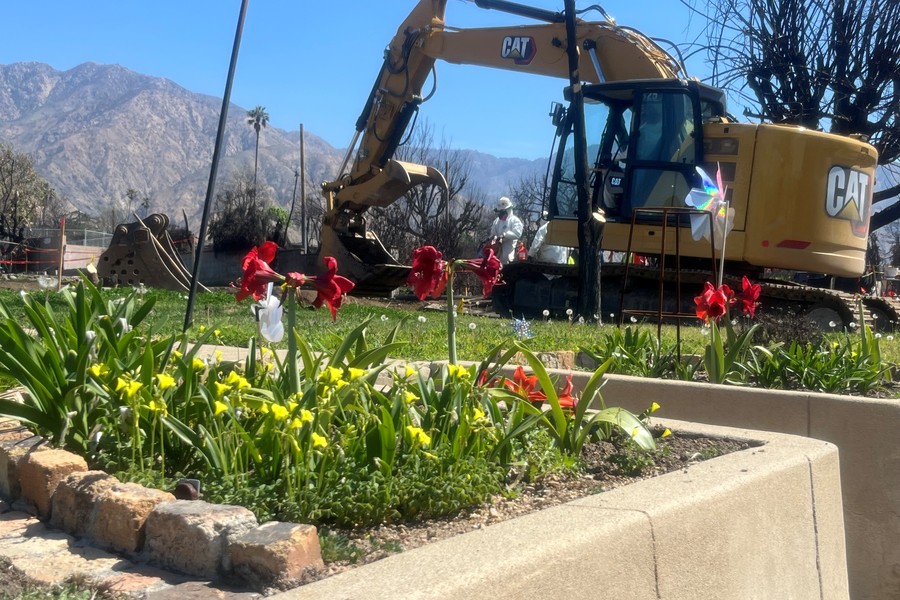
Two Los Angeles-area donors see so much value in expertise provided by Purdue University professor Andrew Whelton and his team after the January 2025 wildfires that they are investing in it.
Whelton, who has a joint appointment in the Lyles School of Civil and Construction Engineering and the School of Sustainability Engineering and Environmental Engineering, is set to receive $50,000 in donations from LightBox and Palisades residents Mario and Chantal Spanicciati to support his team in creating a resource tailored for homeowners dealing with soil damage brought on by the catastrophic fires.
LightBox is a major provider of location intelligence, property data and workflow solutions for commercial real estate and serves more than 30,000 clients across finance, government and environmental sectors. In October 2025, Whelton and Eric Bollens, chief technology officer of LightBox, briefed the Smoke Claims and Remediation Task Force, which recommends action and standards.
“LightBox has supported environmental professionals with data and decision support for due diligence and site assessment work for more than 30 years, so we have a strong appreciation for what happens when practitioners have clear, credible guidance and when they do not,” Bollens said.
Whelton and Bollens connected directly in the aftermath of the Los Angeles fires when both were engaged in supporting public agencies, engineering firms, practitioners and communities facing urgent technical questions.
“The available guidance often did not match the reality on the ground. What brought us together was a shared belief in applied engineering — using science to solve real-world problems when people needed answers immediately,” Bollens said.
Through their collaboration, they answered questions about contamination risks and the steps necessary for residents to return home safely or to begin rebuilding.
“From there, we worked together in areas where we saw major knowledge gaps, including questions around soil, air, water and how to think about testing still-standing homes affected by an urban megafire,” Bollens explained. “Along this same lens, we ultimately co-authored a paper on considerations for environmental testing of fire-impacted homes.”
Mario Spanicciati, too, was introduced to Whelton while the professor’s team was on site after the fires. He lives next to a house that burned down and spread ash onto his property.
“I met with him because our home, unfortunately, was in the fire’s perimeter. I was left with lots of questions regarding if it was safe to live there and what we needed to investigate and remediate,” Spanicciati said.
Addressing a critical public safety need
Fires can release heavy metals and organic chemicals from burned vehicles, plastics, paints, structures and fuels. These contaminants settle into soil and can pose significant risks to residents and visitors if not properly removed.
Despite the scale of this challenge, property owners have lacked a unified, practical resource to help them understand and navigate soil testing and cleanup.
“It was clear that soil management was an area where the science and the operational guidance were not yet where they needed to be,” Bollens said. “That uncertainty affected everyone: community members trying to make decisions about their homes, public agencies trying to act responsibly, and environmental professionals trying to advise in a high-consequence setting without a consistent playbook.”
Seeing these disparities firsthand, Bollens felt strongly about supporting Whelton’s work.
“I grew up in Pacific Palisades and was personally affected by the fire. In drinking water, the field benefited from practical, evidence-based recovery guidance, including Whelton’s ‘Concept of Operations Plan for Water Distribution System Testing and Recovery,’ the first-known comprehensive framework for testing and recovering wildfire-impacted drinking water systems. Soil needs that same kind of practical framework,” Bollens said.
The new guide, “Property Owner Guide for Rapidly Restoring Soil Safety after Fires,” is expected to be instrumental in helping property owners, consultants and government officials navigate this topic.
“Our goal is that this plain-language residential soil safety guide can empower property owners and their consultants to restore fire-impacted land safely and confidently,” Whelton said.
Planned content in the guide will include:
• Post-fire soil contamination risks
• Common hazards from wildfire and urban fire debris
• Clear steps for debris removal and soil cleanup
• Protocols for designing and conducting soil sampling
• Health- and economically-protective cleanup benchmarks
• Visuals and tips to illustrate good vs. poor restoration practices
Having information readily available for future homeowners facing post-fire uncertainty will be a game changer.
“It’ll be a great resource,” Spanicciati said. “It’s clear that Andy is a highly qualified expert in the field, and he is passionate about this work and has been a great support to disaster communities.”
Supporting this guide was mission-aligned for LightBox, Bollens said.
“But just as importantly, it was the right thing to do for communities recovering from disaster and for the professionals asked to help them recover,” he added.
Whelton said the guide will help residents in other states facing similar situations.
Already, the National Interagency Coordination Center has circulated evidence and issued warnings about the likelihood for major fires in the coming months. In addition to California, officials have pinpointed segments of Oregon, Nevada, Idaho, Colorado, New Mexico, Utah, Arizona, Nebraska, Texas, Louisiana, Mississippi, Alabama, Georgia and Florida as having significant wildland fire potential.
“It’s practically nationwide. Summer will be tough,” Whelton said. “This guide is much needed.”
Unique team, tailored assistance
The manual will build upon many other ways that Whelton’s team has been aiding the Los Angeles area.
“This soil guide will expand the support we provide communities as they find themselves restoring their properties after a disaster,” Whelton said.
Over the last year, Whelton’s team—driven largely by students—has played a vital role in assisting Los Angeles–area households and businesses recovering from wildfire impacts.
“A challenge of disasters is that lessons from the past are not shared. The students are helping to change that,” Whelton said.
In collaboration with other universities, these efforts include weekly support to property owners navigating environmental testing decisions, surveying households in the Los Angeles area to inform recovery efforts, and organizing a webinar series to help affected communities access insights from experts in trauma care, children’s health, and wildfire recovery.
Whelton and his collaborators also have begun new studies this year to examine how to stop water system contamination caused by fires and identify opportunities for engaging communities on air and water contamination topics.
“I have seen their work firsthand, and the impact it has. What stands out is that they do not approach research as an abstract exercise,” Bollens said. “They approach it as a way to solve specific recovery problems that communities, agencies and practitioners are facing in real time. That matters in disaster recovery, where unclear guidance can slow decisions, create inconsistent practices and leave people without confidence in the path forward.”