
Purdue students organize one of the world's largest hardware hackathons
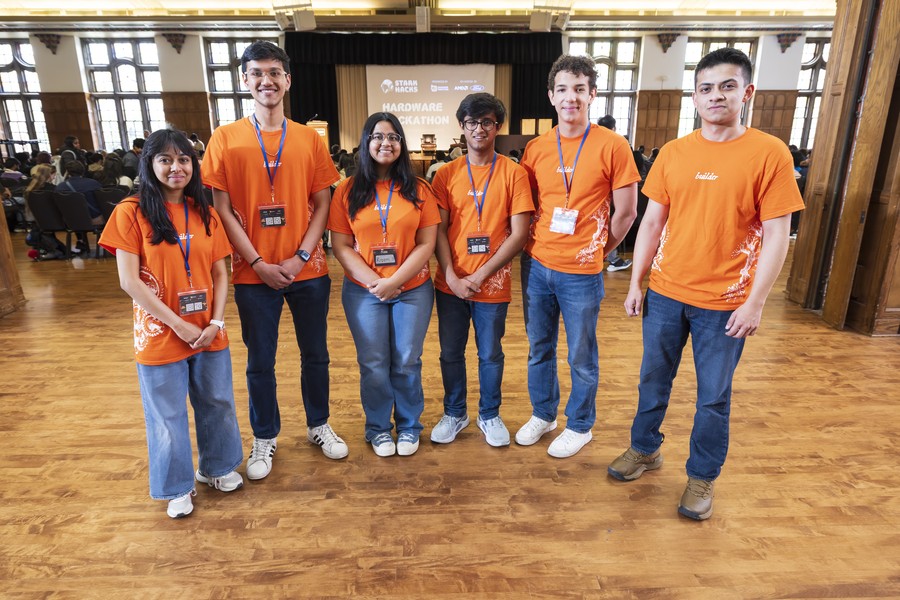
When Aayan Agarwal and his co-founders booked a room for 100 people at the Humanoid Robot Club's first-ever callout meeting, they figured it would be a decent start. Thirty minutes before the event, the room was already full. By the time it was over, more than 350 students had shown up.
That was a year and a half ago. In mid-April, the Purdue University Armory filled with builders from across the country and around the world for StarkHacks, a 36-hour hardware hackathon and one of the largest ever organized.
"We want the future of hardware and artificial intelligence to be built at Purdue," said Agarwal, co-founder and co-vice president of the Humanoid Robot Club.
Inspiration from a Rubik's Cube
The idea didn't come from a boardroom or a strategic plan. It came from watching someone else do something impossible.
In May 2025, Purdue students set a Guinness World Record for the fastest time to solve a Rubik's Cube — a moment that changed the club's trajectory entirely.
"That really inspired us," Agarwal said.
Hardware hackathons, which are focused on physical builds rather than software, are still rare compared to their software-only counterparts, which the group saw as as an opportunity.
"AI has enabled software to leap forward decades," he said, "but we need to invest in hardware innovation to make sci-fi tech possible."
The club had grown rapidly since its founding in 2024, reaching more than 1,700 members in under two years. Their goal for StarkHacks was at least 500 project submissions. In the end, more than 750 hackers from 80 universities and 10 countries showed up to build.
Building something you can touch
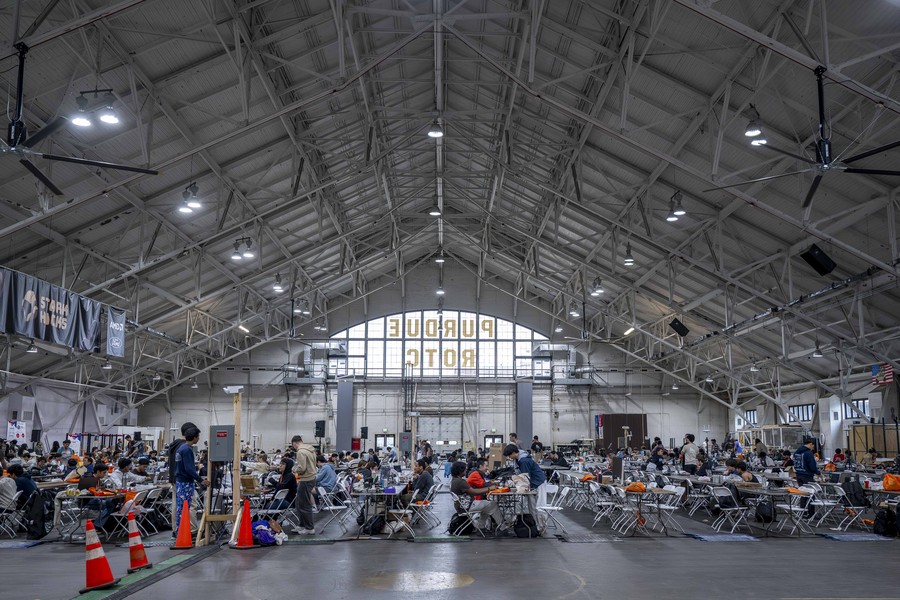
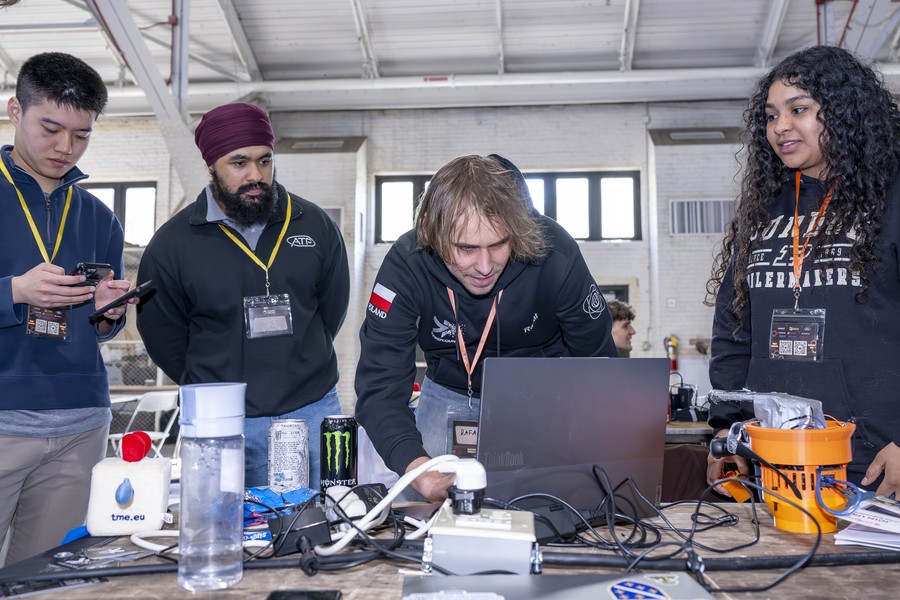
Over 36 hours at the Purdue Armory, participants prototyped, soldered, tested and iterated, turning ideas into real objects using real tools. Soldering stations, 3D printers and hardware kits loaded with sensors and components lined the space from Friday evening through Sunday morning.
Most hackathons are software-driven. StarkHacks was built around the belief that hardware deserves the same platform.
"Hardware is more complex," said Riddhi Gupta, co-founder and president of the Humanoid Robot Club. "This enables hardware to grow much faster, and so this is the best time to encourage more engineers to come up with physical innovations that will change the world."
Nazmin Abbasi, co-vice president of the club and hardware lead for StarkHacks, spent months overseeing the event's technical infrastructure, from equipment selection to coordinating 3D printing workflows and partnering with campus organizations like the Bechtel Design Innovation Center. For Abbasi, the event's inclusivity was just as important as its technical resources.
"I hope hackers can take the opportunity to share memories with new faces and inspire each other through their work," she said. "I hope everyone walks away feeling a part of something incredible."
Gabriel Duarte Rengifo, the event's operations head, brought in third-party vendors for power and networking to handle the scale; existing Purdue infrastructure wasn't built for it. His guiding principle throughout was straightforward.
"Putting the participant first," Rengifo said. "When you care about the people showing up, the work feels worth it in a way that goes beyond just pulling off a successful event."
Industry at the table
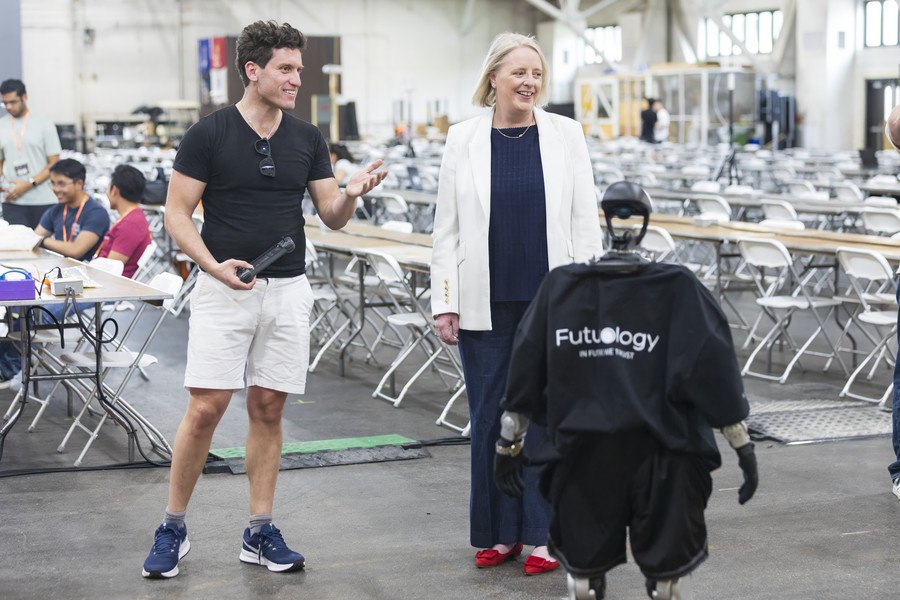
StarkHacks drew its sponsors largely through cold outreach — the same direct approach the club has used to build everything else.
AMD came aboard after Aarav Garg, co-founder and first president of the Humanoid Robot Club, cold-emailed the company's CEO, Lisa Su, who connected the club with AMD's Chief Technology Officer, Mark Papermaster, and eventually with Andrew Schmidt of the AMD University Program (AUP) and Research and Advanced Development (RAD) team. AMD served as a co-host, bringing hardware including cloud access to Instinct™ graphics processing units, Kria™ system-on-modules and mini-PCs powered by Ryzen™ AI processors for participants to work with.
"We are especially excited to bring our open development tools and our commitment to open-source innovation to StarkHacks," Schmidt said, "helping empower students to experiment freely, collaborate with others and contribute back to the broader tech community."
Ford Motor Company co-hosted as well, drawn in part by the hardware focus of the event and a personal connection: the company's chief manufacturing officer, Bryce Currie, is a Purdue alum.
"We were particularly excited to see StarkHacks lean into the hardware space," Ford said in a statement. "Hardware is the essential foundation that makes software possible. In a manufacturing setting, it is the 'bones' of the operation."
Analog Devices, Qualcomm, Microsoft, Tesla, Anthropic and more than 20 other companies rounded out a sponsor list that represented more than $100,000 in prizes across multiple categories.
Faculty who watched it grow
Aniket Bera, an associate professor in Purdue's Department of Computer Science and one of the club's earliest faculty advisors, said StarkHacks reflects something larger happening at Purdue.
"Students are increasingly pairing that hands-on engineering mindset with entrepreneurship, large-scale systems thinking, and leadership in robotics and AI," Bera said. "It reflects a university environment where students feel empowered not only to join important efforts, but to create them."
Yan Gu, an associate professor in the School of Mechanical Engineering and the club's founding and primary faculty advisor, said her role was deliberately limited by design.
"The students really built this effort themselves," Gu said. "They set a very bold goal, but they did not stop at the idea stage. They stayed committed to making it real."
What it means
With more than 750 hackers from 80 universities and 10 countries submitting projects by Sunday morning, organizers say StarkHacks was one of the largest hardware hackathons ever held.
For Agarwal, the moment means more than a certificate.
"Hackathons are a unique platform that gives students a chance to set aside everything and dedicate 36 hours to a real-world problem," he said. "We need a platform where hardware engineers can showcase their talent, bring the best minds together, and develop practical solutions to real-world challenges."
For Abbasi, the validation is personal. "It would mark a new threshold for what I believe I am capable of," she said. "World record or not, we are still incredibly proud of the scale we were able to achieve.