
Purdue hosts 12th Midwest Workshop on Control and Game Theory, advancing research and collaboration
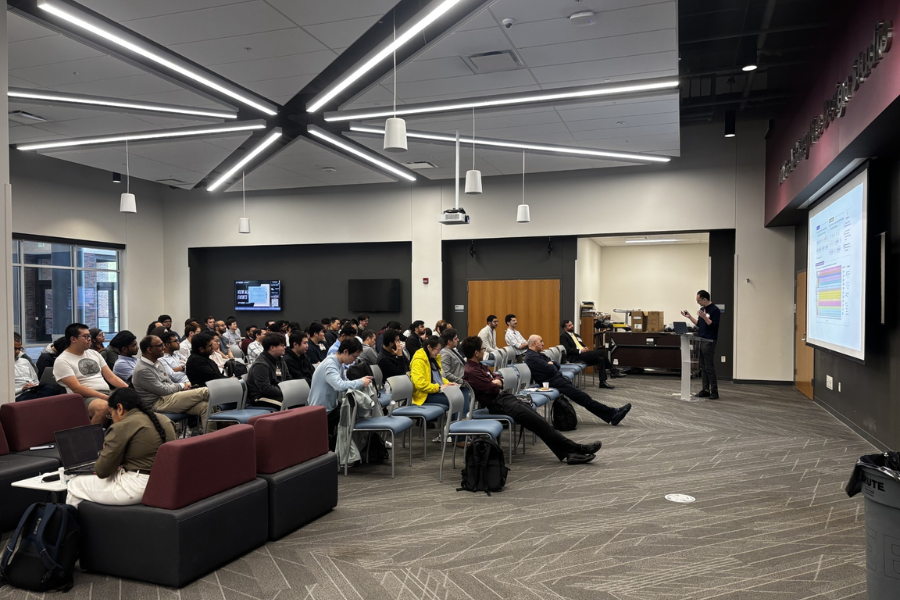
Purdue University welcomed researchers, students and industry professionals from across the region for the 12th Midwest Workshop on Control and Game Theory (MWCGT), held April 25–26 in West Lafayette.
Now in its second decade, MWCGT has grown into a leading regional forum dedicated to advancing both the theory and real-world applications of control systems and game theory. The annual workshop brings together experts to share emerging research, explore innovative applications in decision-making and control, and examine future directions in rapidly evolving fields.
The 2026 MWCGT featured a robust program of invited talks, as well two poster sessions highlighting graduate student and postdoctoral research. For the first time, organizers introduced a series of lightning talks, giving graduate students and postdoctoral researchers a fast-paced platform to present new ideas and spark discussion.
Topics throughout the event reflected the expanding reach of control and game theory, including security, data-driven control systems and distributed decision making — areas increasingly critical to modern engineering and technology systems.
“Workshops like MWCGT are essential for building a strong research community and accelerating innovation,” said Philip Paré, the Rita Lane and Norma Fries Assistant Professor of Electrical and Computer Engineering . “The first time I came to Purdue was as a graduate student to give a talk at this workshop 10 years ago. It was important to me to help recreate a space for meaningful dialogue between researchers, while also giving the next generation of emerging scholars the opportunity to showcase their work and gain valuable feedback.”
Originally founded in 2012 by Tamer Baar, Swanlund Endowed Chair Emeritus and CAS Professor Emeritus of Electrical and Computer Engineering at the University of Illinois Urbana-Champaign (UIUC), the MWCGT continues to rotate among host institutions across the Midwest. Next year, the event will be held at the University of Michigan.
This year’s event was supported by the Army Research Office and multiple Purdue entities, including the Elmore Family School of Electrical and Computer Engineering (ECE), the Edwardson School of Industrial Engineering (IE), the School of Aeronautics and Astronautics (AAE), and the Institute for Control, Optimization, and Networks (ICON). The support enabled organizers to offer the workshop free of charge to attendees, expanding access and participation, as well as travel support for the visitors from other universities.
The organizing committee included Takashi Tanaka (AAE), Sivaranjani Seetharaman (IE) and Jitesh Panchal (ME), with guidance from steering committee members Tamer Baar (UIUC), Rasoul Etesami (UIUC) and Shreyas Sundaram (ECE/ICON), among others.
As the MWCGT continues to grow, organizers say its mission remains clear: to strengthen collaboration, mentor the next generation of researchers, and accelerate discovery in control, optimization and game theory.