
MSE's Bahr joins prestigious ranks of MRS fellows
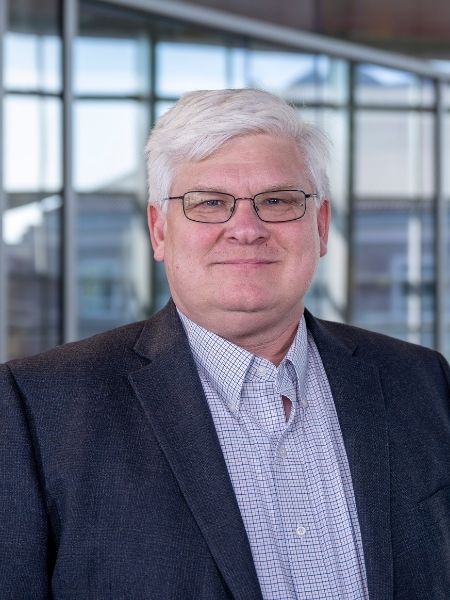
Dave Bahr has been selected as a 2026 Materials Research Society (MRS) fellow in recognition of his sustained and distinguished contributions to the advancement of materials research.
Fellows receive lifetime appointments, with admission intended to reflect distinction in the field rather than an award for a specific achievement. In any given year, the maximum number of new fellows is capped at 0.2% of the current total professional MRS membership, making it an elite honor. He joins other MRS fellows across Purdue, including Haiyan Wang, Alexandra Boltasseva, Carol Handwerker and Vladimir Shalaev.
“MRS Fellows include leaders in the field that I've looked up to — and in many cases worked with — over my career. Getting selected by those leaders to join this community of prestigious scientists and engineers is very rewarding,” said Bahr, the senior associate dean of faculty and the Reilly Professor in the School of Materials Engineering (MSE).
He joined the university in 2012 as the head of MSE. Purdue, however, was not new to him. He was a student from 1988-1993, earning his bachelor’s and master’s degrees.
“I still ride the same bike I had on campus then. And it's the same bike my dad had on campus in the 1960s when he got his ME, BS and MS degrees,” Bahr shared.
Bahr’s MRS fellow designation adds to his long list of accolades:
- The Minerals, Metals and Materials Society (TMS) Alexander Scott Distinguished Service Award (2024)
- American Association for the Advancement of Science fellow (2015)
- ASM International fellow (2012)
- Presidential Early Career Awards for Scientists and Engineers (2000)
The focus of his work is small-scale mechanical behavior.
“We measure the strength, stiffness and toughness of small volumes of materials. This can be a 20-atom thick coating that protects a metal from corrosion or an explosive crystal that is the width of your hair. And, because it's small, it's safer to test,” Bahr said.
The research is tied to making accurate property measurements of samples that are usually hard to test. When small things break, major failures can ensue, he said.
“We try to answer why something bends or breaks,” Bahr said. “Think about a paperclip: Why does it break after bending it several times, but not the first time? There are defects in the material that build up when you bend it. If you can measure the way individual defects form and move, you can predict how they move in larger engineering structures. By testing small volumes, you can isolate individual effects, versus a macroscopic overall that might smear out the details.”
Materials reliability is crucial in engineering, Bahr said.
“If you want to make things stronger, lighter and last longer, it's often the material that is the limiting factor. So, understanding existing materials is only one side of the coin. It’s just as important to use that understanding to develop new materials that my research impacts,” he said.
Consider having new solder materials in electronics that don't include lead, Bahr said.
“We need a replacement material that we can substitute. Small scale-testing lets you test more materials quickly, lowering the cost and time of material development.”
As a faculty member, Bahr appreciates the wealth of talent among his colleagues and the seemingly boundless opportunities for collaboration.
“We're big enough that there's an expert here in all sorts of areas. Collaborations are where the best engineering gets done,” he said. “You can find the person you need help from, and you get to help people who need your specialty.”
His advice for early-career faculty is to make sure they are “T-shaped.”
“Have depth in an area where you're the leader, but have breadth to find how your hammer can be used with someone else's nail,” he said.
Materials engineering is entering a period of rapid transformation, driven by both necessity and imagination. What once required decades of painstaking development is now accelerating at an unprecedented pace, reshaping how materials are created and how quickly they can transform industries.
“Historical materials development was a multi-decade process,” Bahr said. “New alloys for aircraft engines took half a career to go from idea to use. The tools we have now to increase throughput are booming, so we can look at moving not only faster but also smarter.”