
Purdue researchers unite to pioneer "living" neuroelectronics; paper published in Science
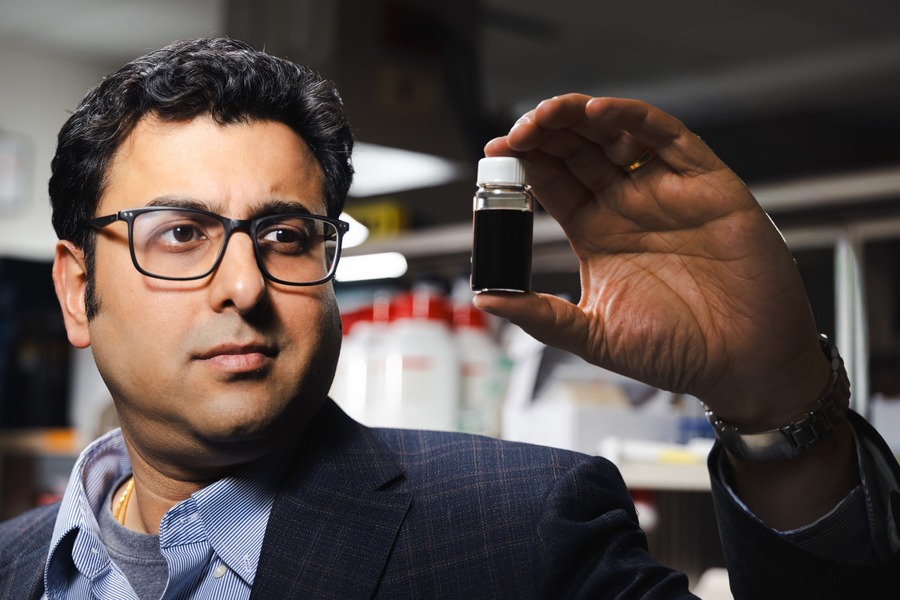
The ability to stimulate and modulate neural activity in the brain in a minimally invasive manner is critical from both a neurotechnology and a therapeutic perspective for patients suffering from nervous system disorders. Developing synthetic materials that are conductive, biocompatible, and stable, and can grow within living organisms by leveraging life’s own chemistry, is central to this innovation and requires both novel materials and innovative engineering methods.
Krishna Jayant, the Leslie A. Geddes Assistant Professor in the College of Engineering’s Weldon School of Biomedical Engineering, and Jianguo Mei, the Richard and Judith Wien Professor in the James Tarpo Jr. and Margaret Tarpo Department of Chemistry, along with collaborators across Purdue University in a multidisciplinary endeavor, have made an important breakthrough toward enabling this capability. The research led to findings that could help address the major challenge for the field: biocompatible integration of synthetic materials with living tissue, most notably the brain.
Jayant and Mei are corresponding authors of a paper spearheaded by co-first authors Sanket Samal and Shulan Xiao, both postdoctoral scientists across the two laboratories. The research was published in the prestigious journal Science on April 2; the paper is titled “Blood-Catalyzed n-Doped Polymers for Reversible Optical Neural Control.”
“Our work points to a future where doctors could ‘grow’ soft, wire-free electronic interfaces inside the brain using the patient’s own blood, then gently dial brain activity up or down from outside the head using harmless near-infrared light,” Jayant said. “Because our polymer, n-PBDF, reliably modulates neural excitation and can be turned on and off with millisecond precision, it marks a paradigm change in the way we can modulate neural activity in vivo, and is especially promising for conditions marked by excessive or runaway brain activity, such as epilepsy, Parkinson’s disease, chronic pain, and certain forms of depression or addiction.”
Neuroelectronics interfacing with the nervous system require the use of materials capable of precise and safe electrical communication. Conducting polymer interfaces have potential as biological probes and bio-interfaces due to their biocompatibility, mechanical conformability and tunable electronic, optical and electrochemical properties.

“Earlier efforts used synthetic polymers that had to be synthesized outside the body and then surgically implanted, which often created a mechanical mismatch: hard, brittle materials against soft, moving brain tissue, leading to scarring, signal loss and shortened device lifetimes,” Mei said. “Other approaches have attempted to grow polymers within tissue, but they typically rely on adding high levels of exogenous enzymes or chemical initiators, which can generate toxic byproducts, damage cells and do not readily enable reversible, on-demand control of neural activity.”
Mei laid the foundation for this work by developing the n-type polymer backbone (PBDF) and then establishing a blood-compatible route to transform the BDF monomer into highly conductive, stable n-PBDF under physiological conditions. This provided the soft, near-infrared-responsive material platform that Jayant’s Nano Neurotechnology Lab then leveraged for cutting-edge neurotechnology and optical neuromodulation experiments.
“In addition, most prior work focused on p-type polymers and bulk changes in membrane capacitance, which altered excitability but did not offer the fast, precise, light-driven and compartment-specific control over dendrites and cell bodies that neuroscientists and clinicians increasingly need,” Samal said. “A critical discovery of our work was the thermionic modulation mechanism, which acts directly on channels rather than on whole membranes. Our key idea was to let the body’s own chemistry do the hard work.”
“We designed a small building block molecule (BDF) that is catalyzed by hemoglobin and other natural blood proteins into an n-type conducting polymer, n-PBDF, directly in living tissue,” Xiao said. “This polymer is both ionically and thermally active, meaning it not only conducts charge but also reshapes local sodium and potassium gradients and responds strongly to near infrared light, giving us a powerful, reversible ‘optical brake’ on neurons without needing any genetic modification.”
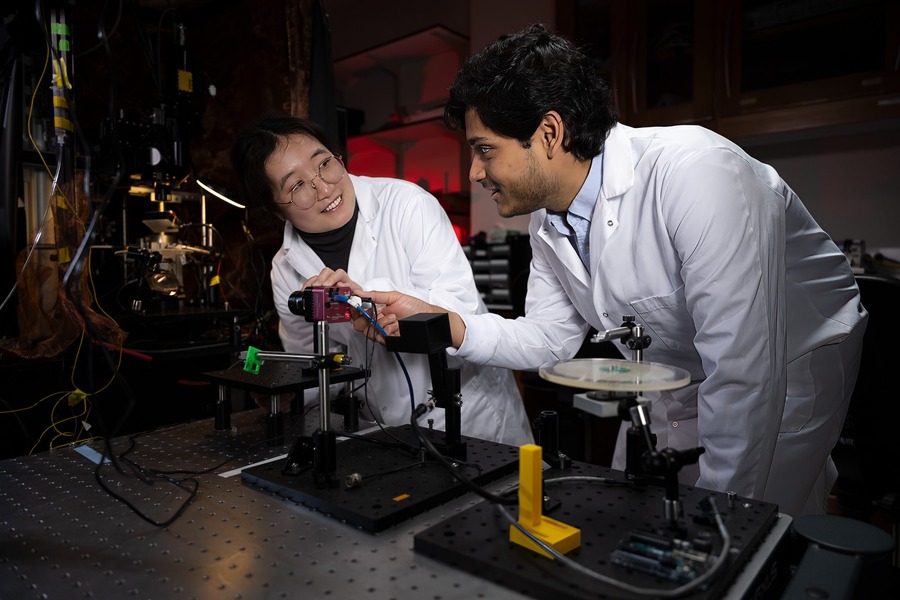
The team, led by Jayant and Mei, demonstrated that this material can be grown in vivo, is well tolerated over months, and can silence specific dendritic branches and behaviors with ultra-low light power. This introduces a new class of soft, injectable, blood-catalyzed neural interfaces for noninvasive neuromodulation: a soft, tissue-like electrode that can be formed and actuated directly within tissues, creating an on-demand, injectable neural interface that holds great promise for both fundamental neuroscience and minimally invasive therapeutic strategies.
“This establishes a powerful new paradigm for bio-integrated electronics,” Jayant said.
The study represents a breakthrough in blood-forged bioelectronics, made possible by trailblazing cross-disciplinary collaboration between professors and postdoctoral scientists in the Weldon School of Biomedical Engineering and the College of Science’s James Tarpo Jr. and Margaret Tarpo Department of Chemistry. Also contributing were researchers from the Department of Biological Sciences and the College of Pharmacy’s Borch Department of Medicinal Chemistry and Molecular Pharmacology.
“This landmark study integrates breakthrough polymer chemistry — grown by blood itself — with advanced two-photon neurotechnology, embodying the fearless interdisciplinary collaboration between Purdue's Colleges of Engineering and Science,” Jayant said.
The work aligns with Purdue's presidential OneHealth initiative, which involves research at the intersection of human, animal and plant health and well-being. “By enabling soft, blood-grown neural interfaces that can safely and reversibly tune activity in specific cell types and dendritic branches, the platform opens new routes to diagnose and treat brain disorders — core to the OneHealth vision of integrated human, animal and environmental health,” Jayant said.
The research is also consonant with Purdue Computes, a strategic university initiative to further scale Purdue’s research and educational excellence in computing. Said Jayant, “Our detailed, mechanistic control of ion channels and spikes at millisecond timescales creates a rich testbed for next generation neural computing, neuromorphic hardware and brain–machine interfaces, directly advancing Purdue’s efforts to connect foundational materials science and neuroscience to future computing architectures.”
Jayant’s next steps will be to refine how and where the polymer grows in the brain, optimize light delivery strategies and rigorously test long-term safety and efficacy in animal models of epilepsy, Parkinson’s disease and other disorders of abnormal neural excitability. He is also exploring ways to make the chemistry more targeted — for example, steering polymer growth to specific brain regions or vascular territories — and to integrate it with wearables.
“In the longer term, similar blood-grown conducting polymers could be used for spinal cord and peripheral nerve modulation, next–generation brain–computer interfaces that do not require large implants and long-term monitoring or control of heart and muscle activity with far less tissue damage than today’s hardware,” Jayant said.
The giant leap in healthcare this research could help usher in is nothing short of breathtaking.
"Imagine growing a soft, tissue-like neural interface directly inside the brain — on demand —using the body's own blood chemistry, then controlling overactive neurons with subcellular precision using harmless near-infrared light, all without surgery, genes or toxicity,” remarked Jayant. “This electrode doesn't just coexist with brain cells for months or years; it becomes part of them, stable across lifetimes. At Purdue, we're not just dreaming of this revolution in neuroelectronics — we're delivering it."
The technology is licensed through the Purdue Innovates Office of Technology Commercialization, which has filed a patent on the intellectual property.
Funding for this research was provided by the U.S. Department of Energy, the U.S. Office of Naval Research, the National Institutes of Health, the National Science Foundation and the Branfman Family Foundation.