
Purdue Engineers successfully test dynamic wireless power transfer on a U.S. highway
Where the charger meets the road
Everyone found it more convenient when wireless charging pads made it easier to power up a smart phone. Now, imagine that the wireless pad is the entire roadway, and you’re a heavy-duty electric truck. It would be the antidote to what everyday drivers call range anxiety — and provide truckers and business owners with transportation fleets a more solid EV business case.
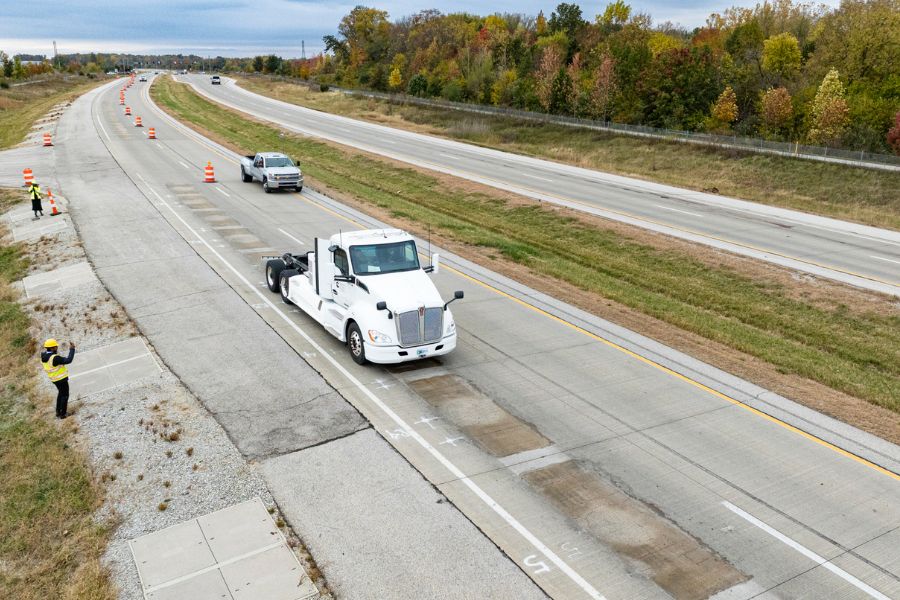
“Where the rubber meets the road” is shorthand for the moment when research encounters the real world to test its viability. That recently took place over a quarter-mile stretch on U.S. 52/U.S. 231 in West Lafayette, Indiana.
In this real world pilot, for the first time in the U.S., a roadway wirelessly charged an electric heavy-duty truck driving at highway speeds — demonstrating a key technology that could help lower the costs of building electrified highways for all electric vehicles to use.
“This is a total paradigm shift in the transportation and power industries,” said Nadia Gkritza, a Purdue University professor of civil and construction engineering and agricultural and biological engineering. “We are moving away from the traditional gas station/charging bank model to bring the charge to the vehicle. That means vehicles will use smaller batteries and will experience less downtime. We’re targeting, at first, fleets and commercial vehicles.”
Purdue and the Indiana Department of Transportation (INDOT) launched the Dynamic Wireless Power Transfer (DWPT) research project in 2018; the system was installed into the section of roadway in 2024 and tested in 2025.
“This began as a feasibility study, to see if the partnership would make sense,” said George McCue, assistant director of INDOT’s Emerging Mobility Division, which works to best position Indiana for the future of transportation by investigating emerging and transformational technologies in the connected, automated and electric vehicle (EV) space. “I feel very fortunate to be part of this talented team of researchers who brought their vision to fruition with this testbed, which has the potential to be paired up with other emerging mobility areas such as vehicle automation.”
The project is affiliated with a National Science Foundation Engineering Research Center called ASPIRE (Advancing Self-sufficiency through Powered Infrastructure for Roadway Electrification), whose members lead most real-world deployments of wireless pavement charging in the U.S.
Purdue is a founding member of ASPIRE, and Gkritza — who leads cutting-edge quantitative and policy-oriented research focused on sustainable transportation systems — is campus director of ASPIRE at Purdue.
ASPIRE integrates academia, scientific research, and real-world tests and deployments involving more than 400 professionals and students from 10 partner universities and other entities across the U.S. and around the globe. These schools are working in tandem with more than 70 industry, government and nonprofit members across the electric transportation ecosystem, as well as community partners and advisors.
“This achievement reflects how our growing ecosystem connects public agencies, private industry, and academic research to turn electrification goals into reality, demonstrating the kind of collaboration that strengthens the foundation for scaling intelligent electrified transportation systems nationwide,” said Don Linford, ASPIRE’s director of industry and ecosystem engagement at Utah State University, the lead partner university.
High power charging
While others are testing roads that enable “dynamic” — in-motion — wireless power transfer, semitrailers and other heavy-duty vehicles pose unique challenges. Because of the faster highway speeds, the charging must take place at higher power levels. During the successful test, the system delivered 190 kilowatts to a truck traveling at 65 mph.
“The test was a resounding success,” said Steve Pekarek, Purdue’s Edmund O. Schweitzer, III Professor of Electrical and Computer Engineering and a project team member. His research interests include the analysis, design and control of electric machines, low-frequency computational electromagnetics, and power electronic-based systems.
“I’m not sure anybody thought we would succeed; they say academics are only successful in the lab,” Pekarek said. “ASPIRE has set a goal of implementing 1,000 miles of electrified roadway by 2040. If you call that a moonshot, the moon has moved closer through the success of our testbed.”
The system enables highway pavement to provide power to EVs similar to how smart phones use magnetic fields to wirelessly charge when placed on a pad. To accomplish this, the project team installed transmitter coils within the rigid, concrete pavement test section; the coils send power to receiver coils attached to the truck’s underside.
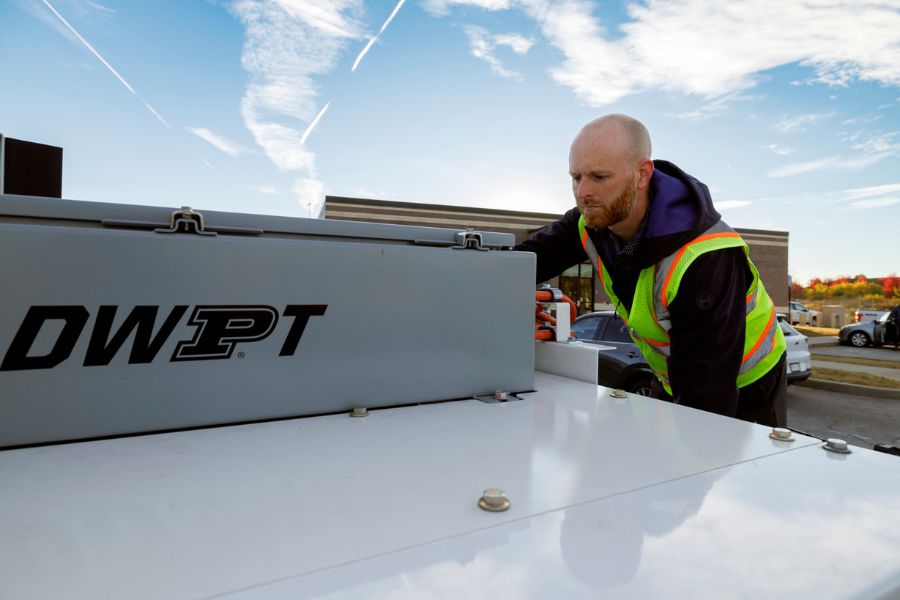
Source energy in this testbed is provided by a battery energy storage system. Energy is transferred to the transmitter coils encased in the pavement through inverters (to convert DC voltage to AC) housed in buried roadside vaults and conduits (for wiring). The transmitter coils generate magnetic fields that transfer energy to a vehicle passing above a corresponding transmitter.
Other wireless EV charging efforts also use transmitter and receiver coils, but they haven’t been designed for the higher power levels that heavy-duty trucks need. The Purdue team found a way to design coils that accommodate that wider power range.
Others have proposed multiple low-power receiver coils on the truck to charge from the road to meet the high-power demands. In the Purdue design, a single receiver coil assembly on the underside of the vehicle at proper clearance captures the energy, greatly simplifying the overall system. “While the technology works similar to a wireless phone charger, in that situation you’re only transmitting 15 watts of power,” said Aaron Brovont, project team member and research assistant professor in the Elmore Family School of Electrical and Computer Engineering. Brovont specializes in power and energy systems.
“We’re multiplying that power transmission by more than a factor of 10,000,” he said. “We also must maintain a ground clearance of at least eight inches, and the coils must be buried deep enough below the pavement surface that they’re not going to be damaged or any way exposed to regular traffic. It’s really about finding that sweet spot of what is the right amount of power.”
Trickle down effect
While accommodating the higher power needs of heavy-duty vehicles, the system is also built with the versatility to support the lower power needs of smaller vehicle classes. “This is a system designed to work for the heaviest class of trucks all the way down to passenger vehicles,” said Brovont.
Trucking contributes the most to U.S. gross domestic product compared to other modes of freight transportation; lowering costs for heavy-duty electric trucks could help attract more investment into electrifying highways, which all vehicle classes could then share. If electric heavy-duty trucks could charge or stay charged using highways, their batteries could be smaller and the trucks could carry more cargo, significantly reducing the costs of using EVs for freight transportation.
Electrified highways would also allow the batteries of passenger cars to be smaller.
“Two of the big barriers to electric vehicle adoption, at least to the public, are range anxiety — ‘Oh, my gosh, where am I going to charge the battery on this car?’ — and cost,” said John Haddock, project team member and professor in Purdue’s Lyles School of Civil and Construction Engineering. “A lot of that cost is driven by the size of the battery packs you need for ample range. With this system, you drive your vehicle down the road and the road would charge the battery.”
Tapping many talents
Haddock is a specialist in bituminous materials and mixture design, pavement design, non-destructive pavement testing, pavement materials and management, and pavement failure investigation — vital to understanding how to embed the charging system in the roadway.
Purdue assembled a project team from numerous spheres of expertise, and drew from skill sets and pools of knowledge within Purdue Engineering — crucial for a project that required technological innovations in electromagnetic design optimization, magnetic materials, power electronic components, specialty cables, pavement design and maintenance, integration with the power grid, communication between vehicle infrastructure, and other areas.
“Collaboration was vital for the success of the project; going outside your comfort zone and working across disciplines is the only way this could have been accomplished,” said Dionysios Aliprantis, professor of electrical and computer engineering and team member; he researches electromechanical energy conversion, electric machinery, power electronics and power systems analysis. “I love that. This should really be a model of how future projects should take place.”
In addition to the researchers and public sector collaboration with INDOT, the private sector stepped up to the plate. The team partnered with AECOM, White Construction, PC Krause and Associates, and others on developing and implementing parts of the system.
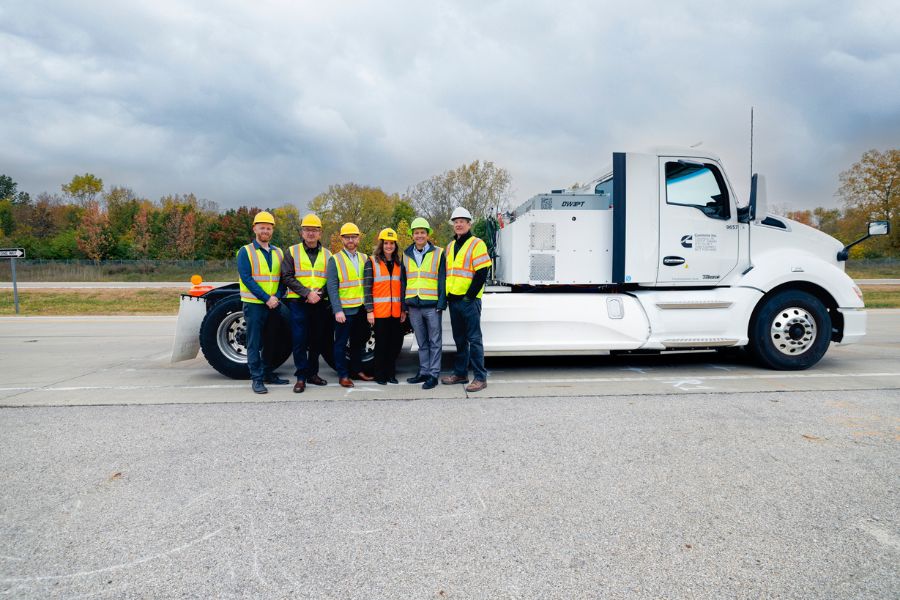
Purdue researchers demonstrated the wireless charging system using a Class 8 electric semi provided by Cummins. The company, a global power leader, is thinking long-term about the project, and possible roles as user, integrator and, perhaps, manufacturer of the technology as it scales. Ultimately, it would want to start bringing in fleet partners to kick the tires, to see if they might use and benefit from the capabilities the system offers.
“We’ve been involved in the project from Day One,” said John Kresse, chief technology engineer at Cummins. “We’ve learned how to integrate the system onto the truck, analyze what it would mean for our fleet operators, and understand how it will impact the powertrains that we will make in the future. The professors we’ve worked with have been wonderful. Sometimes university professors can be accused of being too theoretical, but this crew has got it down just right from a practicality standpoint.”
The DWPT system is involved with testing to help develop industry standards for the technology. Standards could encourage the commercial trucking industry to adopt the technology — a critical step for roadway operators and state departments of transportation when considering investments in infrastructure that will enable EVs to charge while driving.
The Purdue team received the Technology Innovation Award at the IEEE Power and Energy Society Innovation Showcase for their work on the DWPT system, recognizing the project’s potential to transform transportation electrification. The project also received the Innovative Project of the Year Award from Drive Clean Indiana.
Learning by doing
The benefits to researchers, the private sector and public are all well and good, but Purdue is also in the business of educating the next generation of our nation’s engineers to master their field and tailor research for the common good.
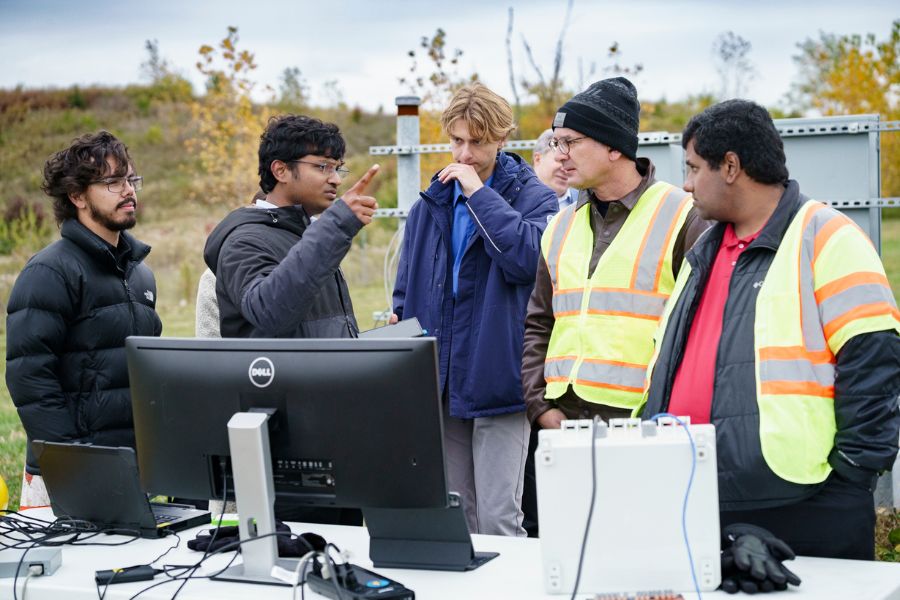
“This project is certainly a flagship example of a successful academic/public/private partnership, positioning Purdue and ASPIRE for long-term leadership in electrified transportation,” Gkritza said. “But it’s also been a remarkable ‘lab-to-life’ learning experience for our students — an opportunity to see how fundamental research can translate into real-world infrastructure.”
Students learned to work purposefully in a “charged” business environment, to advance their research into commercially applicable and viable real-world solutions quickly. “We had to navigate a lot of obstacles on a daily basis and find quick, practical solutions,” Aliprantis said. “Whenever we had a problem, we asked our students to resolve it by the end of the day.”
Student team members relished the opportunity to up their game. “This project has been amazing, much more of a professional project than normal, by virtue of working directly with companies like Cummins, PC Krause and Associates, and others to make this industry-grade,” said Isaac Abram, a second-year PhD student in electrical and computer engineering.
“Working on such powerful systems, you get to challenge yourself, question your engineering decisions, and then implement them. That is vitally important, as you progress from being a student learner to becoming a real engineer who can work out there in the field.”
A new model
The Purdue team is hoping, through the DWPT project, to usher in a new model for the new century. “This project takes major inventions and developments of the 20th century and brings them into a 21st century idea of a transportation system built around power electronics, computational technology, mechanical integration, civil/construction engineering, and sustainability and environmental engineering,” said Brovont.
It’s a new model for research, as well. “A lot of times, we do scale prototypes to prove out methodology and models, and then let industry take it further,” said Rob Swanson, a team member and Purdue research engineer specializing in motor and drive systems.
“Here we said, ‘No, we’re going to take this all the way ourselves. Let’s take our scale model all the way up to what is needed to do full power.’ Because if we can prove that academics can make it work in the lab and on a pilot roadway, it opens a lot of avenues for the rest of industry to take notice that this can be done.”
The researchers have disclosed their innovation to the Purdue Innovates Office of Technology Commercialization, which has applied for a patent on the intellectual property. The goal for commercialization is no less than prove-out and adoption on a worldwide scale.
“I think once people are educated about the benefits of the system — how it works, what it brings, how it revolutionizes transportation — then the market is going to drive this,” Aliprantis said. “I’m confident that it will become a reality within the next 10-15 years, even faster than we think it will. We’re confident it can be financially feasible and deployed at scale. It lowers total cost of ownership and will make the transportation system less expensive for everyone, both the public that pays for transportation services and fleet owners that transport the freight.”
This story was developed as part of "Victories & Heroes: Your Campaign for Purdue." Join us in elevating Purdue Engineering education and excellence. Click here to be a part of Purdue history.