
NIH director visits Purdue BME to view breakthroughs in brain and neurotechnology research
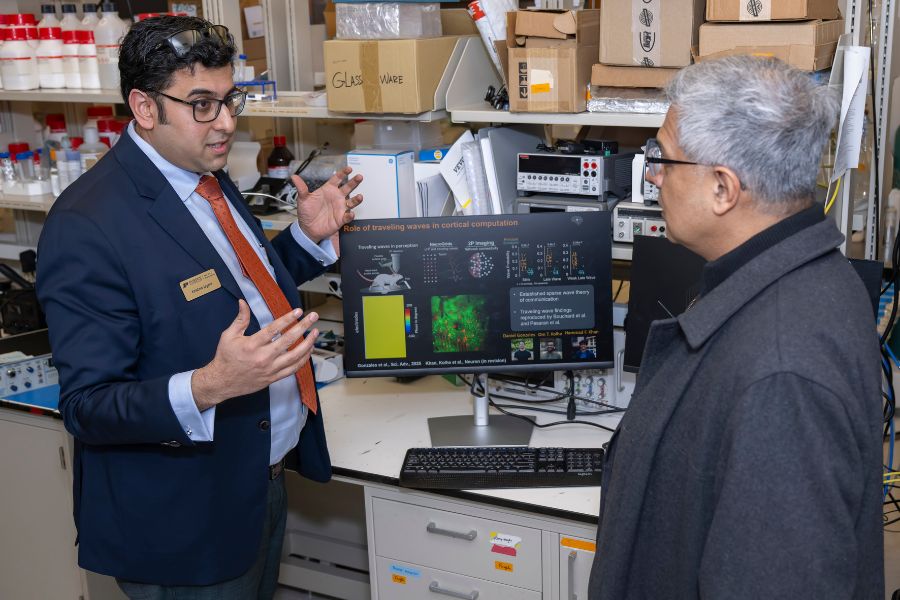
Dr. Jay Bhattacharya, director of the National Institutes of Health, visited the Purdue University College of Engineering on Wednesday (Feb. 18). As part of the visit he met with Krishna Jayant, the Leslie A. Geddes Assistant Professor in the Weldon School of Biomedical Engineering, and members of his research team. The discussion focused on investigations into the neural circuitry underlying cognition, including traveling waves in cortical processing, dendritic computation in pyramidal neurons, and biomarker-based studies of Parkinson’s disease and dementia.
Jayant’s lab develops and deploys advanced neurotechnology platforms to better understand brain function and disease. Supported by the NIH New Innovator Award and previously by the NIH National Institute of Biomedical Imaging and Bioengineering Trailblazer Award, the team has pioneered custom electrophysiological probes, enhanced two-photon imaging systems, optogenetic devices and electrophysiology platforms for freely moving subjects — all integrated with computational modeling.
These efforts align closely with priorities of the Brain Research Through Advancing Innovative Neurotechnologies Initiative, which emphasizes innovation in brain health, disease modeling and transformative technologies.
According to Jayant, Bhattacharya was highly intrigued by research in Jayant’s lab on traveling waves and the lab’s technical advances in imaging and neural manipulation tools.
“At Purdue BME, our lab fuses bold innovation with neuroscience frontiers — from pioneering imaging and electrophysiological tools and dissecting neural waves in cortical circuits to decoding dementia biomarkers — driving high-risk discoveries that NIH champions,” Jayant said. “Dr. Bhattacharya’s visit affirms this creative alchemy, propelling my team toward transformative careers and real-world brain health impact.”

Bhattacharya also met with Craig Goergen, associate head for clinical engagement in the Weldon School, to discuss the broader impact of NIH funding at Purdue.
“This support has helped expand Purdue’s research infrastructure and training programs, giving students and trainees meaningful opportunities to participate in federally supported projects that directly impact patient care and public health,” Goergen said. “The NIH has been instrumental in supporting Purdue’s translational research enterprise, especially in accelerating the development and clinical advancement of innovative medical devices.”
The visit underscored Purdue Engineering’s continued support from the NIH to advance high-impact research, train the next generation of biomedical innovators and translate discoveries into solutions that improve human health.