
Purdue, partners to launch AI medicine center in Indianapolis
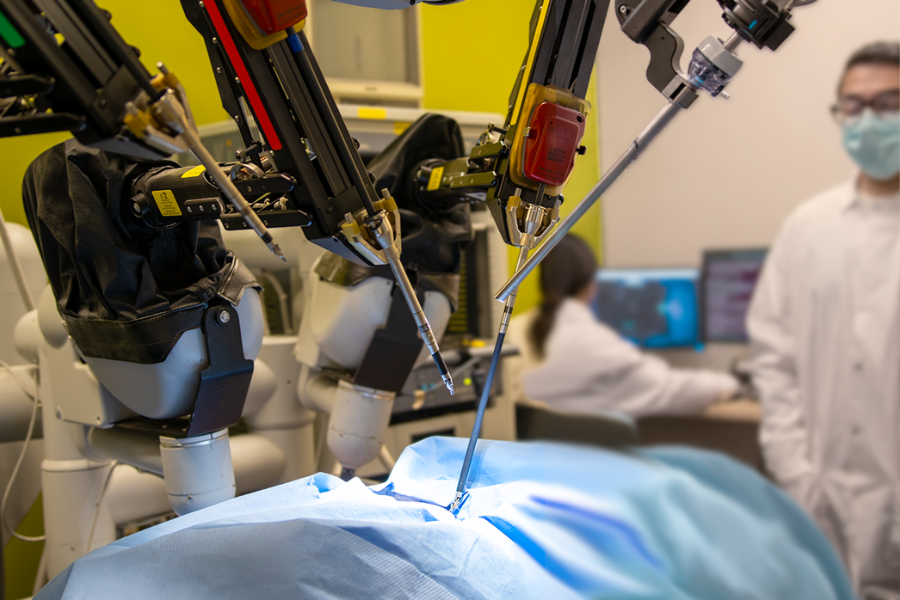
INDIANAPOLIS — Purdue University engineers and their collaborators will leverage artificial intelligence by launching the Center for AI and Robotic Excellence in Medicine (CARE) in Indianapolis.
CARE is a partnership between Purdue’s Edwardson School of Industrial Engineering, the Indiana Clinical and Translational Sciences Institute (CTSI), and the Indiana University School of Medicine.
The center aligns with Purdue’s One Health initiative, which involves research at the intersection of human, animal and plant health and well-being.
CARE mission and goals
Juan Wachs will serve as the center’s inaugural director. He is the James H. and Barbara H. Greene Professor in Industrial Engineering, a professor in the Weldon School of Biomedical Engineering, and an adjunct professor in the IU School of Medicine.
“CARE’s mission is to transform health care and medicine by promoting collaboration among those developing and applying cutting-edge AI technologies and robotics for medicine,” Wachs said.
CARE’s primary goals are:
- Lead pioneering research in AI and machine learning with a focus on addressing critical health care challenges by bringing focused and center-level extramural support to campus for such work
- Establish strong partnerships between researchers and clinicians at Purdue, IU, the IU School of Medicine and industry stakeholders
- Build the AI knowledge and skills to effectively allow clinicians to utilize AI in their practice from the bench to the bed and back
- Establish the first hub of combined expertise to address military and frontier medicine challenges
What they are saying
“Launching CARE in Indianapolis is another milestone that demonstrates Purdue’s leadership in machine learning,” said Arvind Raman, the John A. Edwardson Dean of the College of Engineering and the Robert V. Adams Professor in Mechanical Engineering. “We believe CARE’s impact will reach beyond Indianapolis and the state of Indiana, impacting lives around the nation and world.”
“At Purdue’s Edwardson School of Industrial Engineering, our expertise extends through operations research, AI and human factors, all of which CARE will amplify,” said Young-Jun Son, the James J. Solberg Head and Ransburg Professor of Industrial Engineering. “Launching CARE will amplify that expertise and strengthen world-class opportunities for our faculty and students in Indianapolis.”
“The launch of CARE amplifies the Weldon School of Biomedical Engineering’s strong momentum in Indianapolis at the intersection of AI, medicine and engineering, where our faculty, students and partners are translating innovation into real-world clinical impact for Indiana and beyond,” said Kevin Otto, the Dane A. Miller Head of Biomedical Engineering.
“Purdue’s considerable research arm extending to Indianapolis has created unique opportunities for impactful innovation,” said David Umulis, Purdue’s senior vice provost for Indianapolis. “The launch of CARE will spark life-changing discoveries at the intersection of our Boilermaker strengths in AI, engineering and robotics.”
“There is a dramatic need to bridge between Purdue’s strengths in AI, computing and engineering, and IU School of Medicine’s clinical expertise, domain expertise and therapies,” Wachs said. “The best form to accomplish this is through CARE.”
Introductory workshop
Purdue, Indiana CTSI and IU School of Medicine leaders held a Dec. 1 workshop called “Robotics & AI in Medicine” to introduce attendees to the key stakeholders who are establishing CARE.
“We connected experts from industry, government and academics and focused on outlining the innovations in AI, robotics and engineering to improve surgical performances,” Wachs said. “Some of the topics were embodied AI, field and frontier medicine, autonomous laboratories, and surgical simulations.
“The workshop was a unique opportunity to get AI scholars, government officials, industry stakeholders and clinicians in one place to brainstorm about the coming challenges in surgery and medicine and how to best be prepared to tackle them as a team,” he said.
About Purdue University
Purdue University is a public research university leading with excellence at scale. Ranked among top 10 public universities in the United States, Purdue discovers, disseminates and deploys knowledge with a quality and at a scale second to none. More than 106,000 students study at Purdue across multiple campuses, locations and modalities, including more than 57,000 at our main campus locations in West Lafayette and Indianapolis. Committed to affordability and accessibility, Purdue’s main campus has frozen tuition 14 years in a row. See how Purdue never stops in the persistent pursuit of the next giant leap — including its integrated, comprehensive Indianapolis urban expansion; the Mitch Daniels School of Business; Purdue Computes; and the One Health initiative — at https://www.purdue.edu/president/strategic-initiatives.
Media contact: Derek Schultz, dcschultz@purdue.edu