
Purdue Aerial Robotics Team places 13th in international UAV competition; third among US teams
After nine months of design, manufacturing, integration and testing, the Purdue Aerial Robotics Team (PART) traveled to southern Maryland to compete in the 2023 Student Unmanned Aerial Systems (SUAS) international competition that included 72 teams from 30 countries. This year's goal: To design an aircraft that simulates autonomous package delivery to customers. The Unmanned Aerial Vehicles (UAVs) had to avoid each other, travel to the customer, identify potential drop locations, and deliver the package to a safe location. Their vehicle was nicknamed “Guapo.”
The team, led by seniors Matthieu Opdyke (AAE) and Eric O'Keefe (ME), placed 13th overall in this year's event and 3rd among teams from the U.S. They were mentored by Shreyas Sundaram, Marie Gordon Associate Professor in the Elmore Family School of Electrical and Computer Engineering and co-director of the Institute for Control, Optimization and Networks (ICON), and Charles D'Onofrio, a master’s student in aeronautical and astronautical engineering.
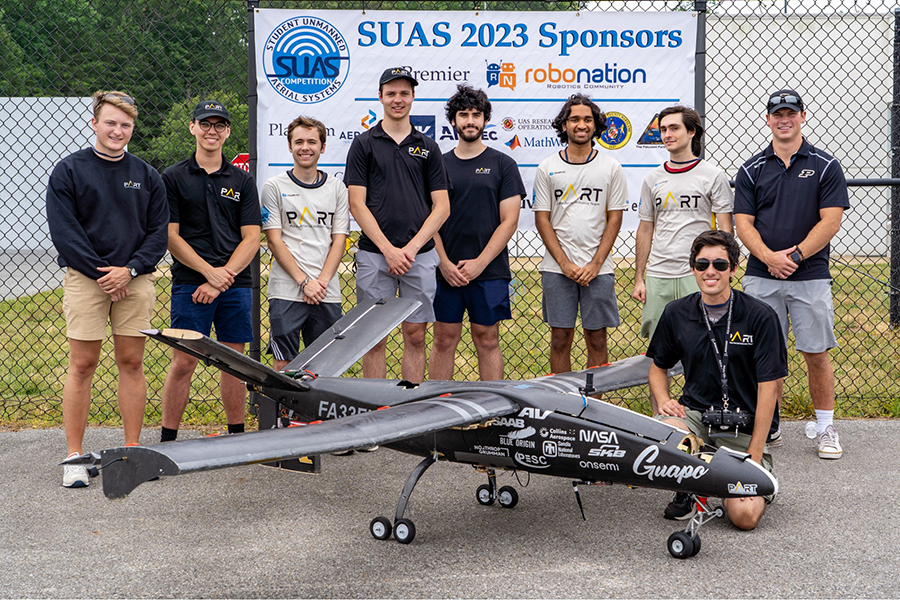
Over the past two years, the team structure has been reimagined. PART now maintains three branches: A competition team, R&D division, and Business Management Division (BMD). These three sub-sectors work in unison to achieve PART's mission to “mature students into principled industry leaders for their post-undergraduate careers by executing a comprehensive industry approach to interdisciplinary design, prototyping and systems engineering.”
To complete this task, PART harnessed the power of interdisciplinary engineering and agile development. With nine majors represented and approximately 50 undergraduate students making up their competition division, the PART students settled on a large-scale, fixed-wing UAV with a gross weight of 55 pounds, wingspan of 14 feet and a fuselage constructed entirely out of carbon composite materials.
PART executed an agile workflow with the leadership team meeting several times per week in a scrum-style “standup” to highlight progress, blockers and integration concerns. Additionally, PART held organization-wide “all-hands” meetings every Monday to brief members on logistical and technical updates.
The BMD also developed relationships with key industry partners, including Saab, NASA, AeroVironment and Sandia National Laboratories – all of whom will be critical in identifying talent, mentoring students and developing technical capabilities moving forward.
Opdyke has served as PART’s president since 2021. He said that PART’s recent endeavors demonstrate qualities that pushed them far beyond the scope of a classical university design team.
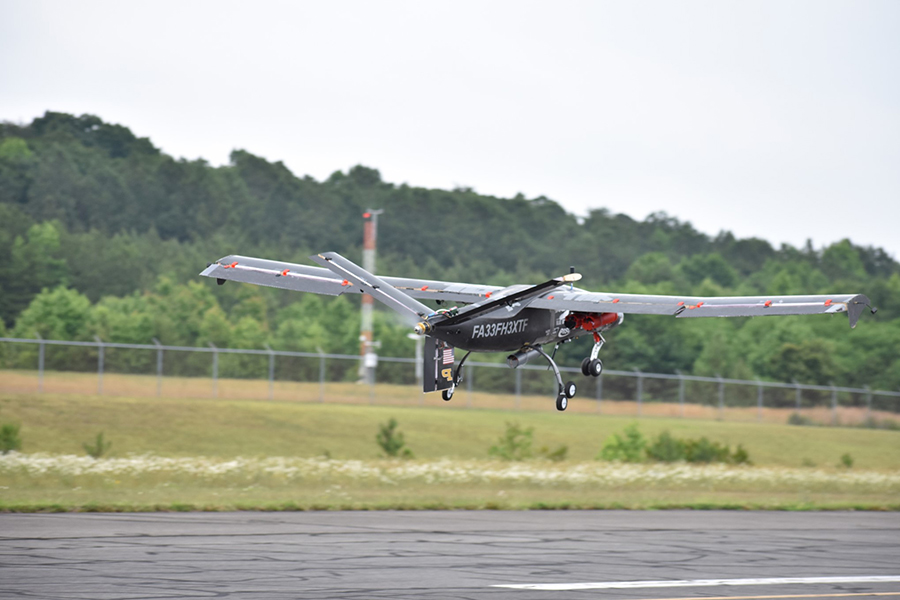
“The student team has grown to embody the ideals of a professional organization: from fielding a board of industry advisors, to engaging in bleeding-edge research and even implementing agile methodologies,” he said. “Purdue’s practical teaching approach infuses curiosity into the coursework; this translates to a strong desire to learn and experiment outside of the classroom. I found this critical in motivating me to discover and apply these engineering and management standards at an undergraduate level.” He will return to Purdue for his master’s in aeronautics and astronautics this fall.
“The team did an outstanding job of tackling a very challenging scenario for autonomous systems,” Sundaram said. “I was impressed by the comprehensive approach that they took to designing all aspects of their system, from the fuselage to the autonomous vision and planning algorithms that ran on board the aircraft. This team exemplifies the incredible caliber of students we have within Purdue Engineering and across campus.”