Purdue hosted IEEE international autonomous UAV competition
The 2022 Institute of Electrical and Electronics Engineers Autonomous Unmanned Aerial Vehicles (UAV) Competition was held April 9 at the Purdue UAS Research and Test Facility (PURT) at the Purdue Airport.
The competition was supported through a $1.8-million National Science Foundation grant, of which Purdue received half. Yung-Hsiang Lu, professor in the Elmore Family School of Electrical and Computer Engineering, is the PI for the NSF project, “Research Infrastructure for Real-Time Computer Vision and Decision Making via Mobile Robots.” Co-PIs from Purdue are: Shreyas Sundaram, the Marie Gordon Associate Professor in the Elmore Family School of Electrical and Computer Engineering; Shaoshuai Mou, associate professor, School of Aeronautics and Astronautics; Wei Zakharov, assistant professor, Libraries and School of Information Studies; James Goppert, managing director of PURT and lecturer in the School of Aeronautics and Astronautics; and John Mott, associate professor and head of the School of Aviation and Transportation Technology.
"This is the first competition of a project building a research infrastructure for autonomous robots, supported by a grant from the National Science Foundation," Lu said.
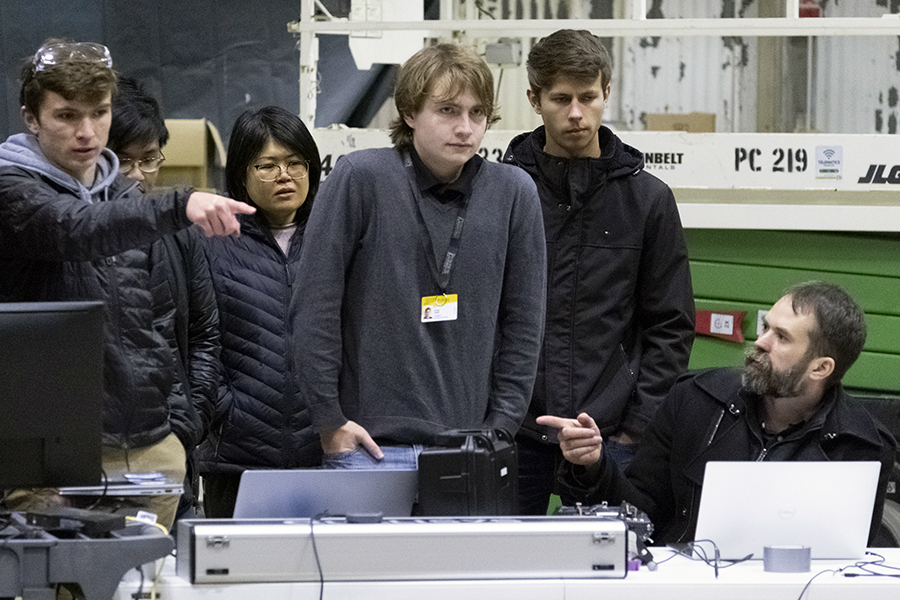
Goppert, who spent countless hours preparing for the event, closely monitored the competing teams’ progress throughout the day and kept spectators apprised of the drones’ movements on the course.
"This is the first time PURT hosted an international competition for autonomous UAV,” Goppert said. “We plan to organize several more competitions with increasing levels of difficulty in the next few years.”
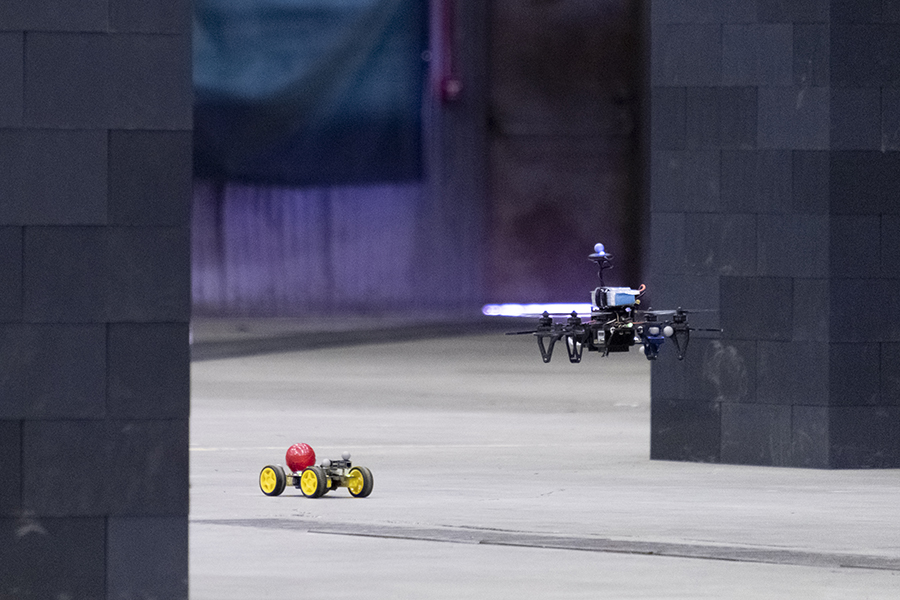
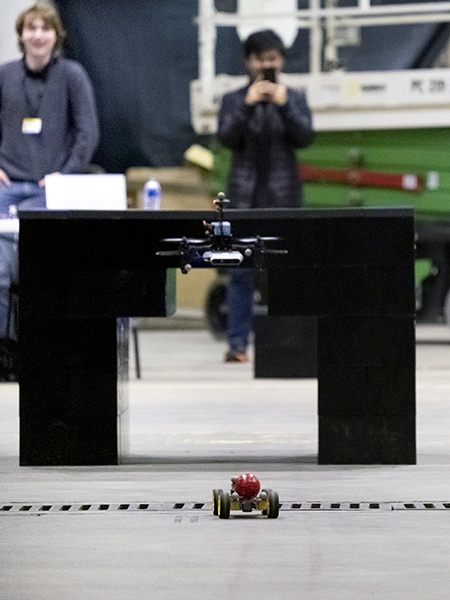
During the day’s contest, a UAV chased a ground rover autonomously without a human operator. The UAV had to avoid obstacles, including flying over a tunnel when the rover entered it. The competition included two stages. In the first, seven teams from China, Greece, India, Italy, Poland, Russia, South Korea and the United States submitted their solutions to be evaluated in a simulator. The teams from Russia, Italy and Poland were selected to enter the second stage when the solutions were loaded to the PX4 UAV and launched inside the 20,000-square-foot PURT, which houses the world's largest indoor motion-capture facility with the capability to measure the locations of UAS with millimeter precision.
"This competition is special because we integrated a virtual environment in the simulator and the physical environment in PURT," Sundaram said.
Zakharov agreed: “This competition will provide a benchmark for researchers to understand the potential and limitations of today's technologies.”
The event was aided by the volunteer efforts of 34 undergraduate and four graduate students in the College of Engineering, many of them part of the Air Force Research Laboratory — Unmanned Aerial System (AFRL-UAS) Vertically Integrated Projects program (VIP).
“They contributed by designing the competition, creating the simulator, writing the software controlling the rover and using PURT's motion capture system to calculate the scores," said Carla Zoltowski, director of VIP, a multidisciplinary research program for undergraduate students with graduate student mentors.
Undergraduate students "made a reference solution for all teams to study," said Qiang Qiu, assistant professor in the Elmore Family School of Electrical and Computer Engineering and the VIP undergraduate research team advisor.
Mott explained why Purdue was a natural choice to host the competition.
"Purdue University is uniquely equipped for research of autonomous aircrafts, including an airport, the first hypersonic quiet wind tunnel at a university and a research park, including industrial leaders like Rolls-Royce and Saab," he said.
Quetzalcoatlus of the V. A. Trapeznikov Institute of Control Sciences in Russia was the winning team. The team members’ solution successfully chased the ground rover while avoiding obstacles and tracked the rover while it was occluded inside the tunnel.
"It is very exciting to see our solution worked well in a difficult situation with many obstacles and a tunnel," said Alexander Abdulov, the leader of Quetzalcoatlus.
The two other finalists were the BioRobotics-SSSA Team from The BioRobotics Institute of Scuola Superiore Sant'Anna, Italy, and the High Flyers team from Silesian University of Technology Gliwice in Poland.