
Purdue engineering management students gain global experience through sustainability project in Costa Rica
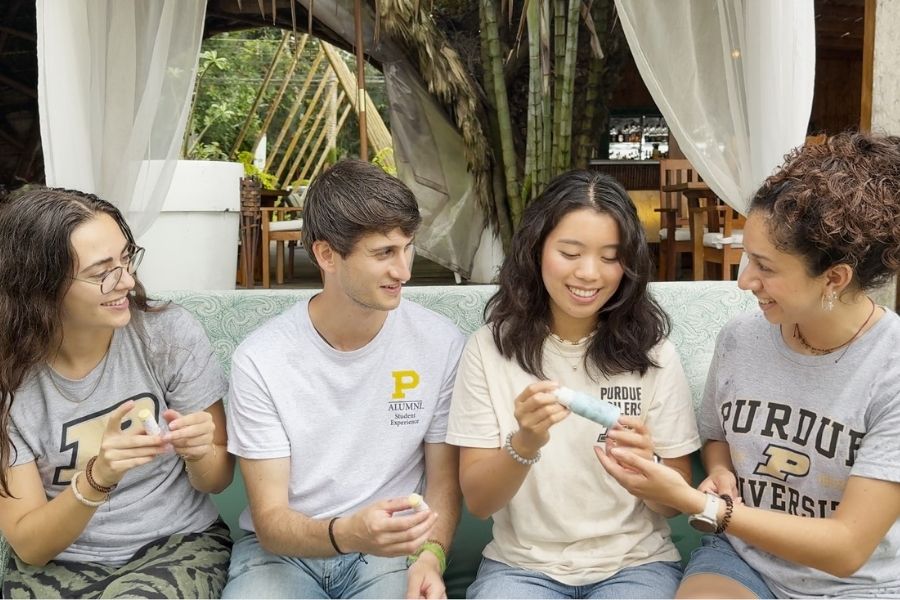
Students from Purdue University’s Master of Engineering Management (MEM) program are turning classroom knowledge into real-world impact through an international sustainability project in Costa Rica.
As part of the Social Impact Startup Academy (SISTAC) course, now in its fifth year, MEM students partnered with Sunspectra, a mission-driven startup focused on environmentally responsible sunscreen products. During Purdue’s October 2025 break, MEM Senior Director Eric VandeVoorde and four students traveled to Costa Rica to collaborate directly with the company and its partners.
For students Younji Kim, Duna Areny Molne, Nancy Tijerina Huerta and Mario Guadamillas Jaquete, the experience offered an immersive look at how engineering, business and sustainability intersect in practice. The team visited Sunspectra’s manufacturing site, worked alongside its leadership and explored Costa Rica’s broader innovation ecosystem through meetings with Impact Hub San José and the Inter-American Institute for Cooperation on Agriculture.
Founded by Mariola Urgelles, Sunspectra is developing sunscreen products made from agricultural waste — specifically papayas — creating a solution that supports both human health and environmental sustainability. By repurposing rejected papaya harvests, the company helps generate additional income for local farmers while reducing food waste and emissions. Its products also use marine-safe ingredients and environmentally conscious packaging to minimize ecological impact.
“Meeting Mariola was one of the most enriching parts of this experience,” said Areny. “Her dedication to building a business that creates value for both people and the environment — from sourcing imperfect papayas to investing in reef restoration and community education — felt like a masterclass in motion, reshaping how I understand sustainability in practice.”
Kim added that Sunspectra’s decision to manufacture locally stood out as a key differentiator, ensuring its environmental and social values are upheld throughout the supply chain.
“From the moment we arrived in Costa Rica, it was clear this is a country that doesn’t just talk about sustainability — it lives it,” said Kim. She noted that the country’s strong reliance on renewable energy and emphasis on local production reinforce Sunspectra’s mission and approach.
For Tijerina, the experience underscored the importance of integrating technical expertise with business insight. “Where technical and business perspectives meet is where the strongest outcomes are created,” she said. “This experience allowed me to better understand manufacturing processes, supply chain challenges, market research and the cultural considerations required for a growing business.”
Experiential opportunities like this are central to the MEM program, giving students the chance to apply their skills in global, real-world settings while working alongside innovative organizations.
“Experiences like this are exactly what we aim to deliver,” said VandeVoorde. “Students move beyond theory and engage directly with real challenges, gaining a deeper understanding of how engineering and management can drive meaningful, global impact.”