
More than a good boy: How Murphy is changing what well-being looks like in Purdue Engineering
It was midterms. Sydney Phillips, a junior in the School of Mechanical Engineering at Purdue University, was deep in equations at the Engineering Success Center when a beagle walked in.
"It honestly felt like perfect timing," she said. "Even just a few minutes with him helped me reset."
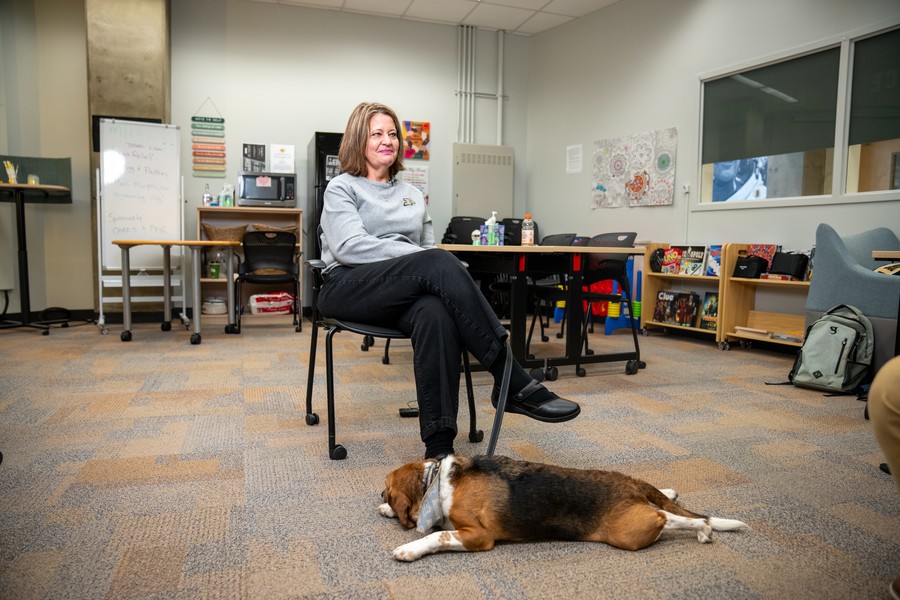
That beagle is Murphy, named by students after Edward Murphy, the aerospace engineer behind Murphy’s Law. He lives with Kristy Eaton, director of the Purdue Engineering’s Community, Assistance and Resources for Engineering Students (CARES), and visits campus regularly to do what research says therapy dogs do best: make people feel calmer, happier and less alone.
The name fits. Engineering is hard, and sometimes things get tough. The CARES Hub exists precisely for those moments, and Murphy has become one of its most effective tools.
A hub built for the whole student
Eaton came to Purdue Engineering almost two years ago, after more than three decades working in education and mental health. When she saw the position posted, she wasn’t looking for a new job.
"The world-renowned College of Engineering is interested in supporting their students’ mental health and well-being. How exciting is that?" she recalled thinking. She applied and got the job.
Located in Room 1261 of the Neil Armstrong Hall of Engineering, the CARES Hub is open ten hours a day, Monday through Thursday, and until 4 p.m. on Fridays, a closing time that is intentional. "We want to send the message to students: go out, it’s the weekend," Eaton said. "Don’t stay in the CARES Hub all Friday night and study."
The hub offers on-site therapy, Check-In & Chat hours, a peer mentoring program staffed by nationally certified engineering students, study space, educational workshops including Question Persuade Refer (QPR) suicide prevention training, snacks and regular social events. The programming responds directly to what Eaton hears from students again and again: that engineering life can feel isolating.
"We hear over and over again how isolated and lonely our engineering students are," she said. "So we create opportunities for them to meet people and become socially connected." The philosophy behind it all, as Eaton puts it, is simple: "”When we support student well-being in a community of care, our students are able to show-up, stay focused, and become more resilient to the challenges they will inevitably face in school and in life. We are building well-rounded Boilermaker engineers!’
A gift from across campus
Murphy’s origin story is a cross-college collaboration. After researching the evidence base for therapy dogs on university campuses, Eaton approached Purdue’s College of Veterinary Medicine (Vet Med). Studies consistently show that brief interactions with animals on campus reduce students’ perceived stress, lower cortisol levels and improve mood, and the data convinced her. Vet Med gifted Purdue Engineering a beagle puppy, and students did the rest, choosing the name Edward Murphy.
Sarah Schroeder, who facilitated Murphy’s placement from the Vet Med side, says his size and temperament made him an ideal fit. "Larger dogs can be intimidating to anyone uncomfortable around dogs," she explained. "Since Murphy is a medium-size dog, students have the option to sit with him on their lap or next to him. His gentle nature builds their confidence. His loving nature builds their trust."
Murphy is currently completing his therapy dog certification, a process Schroeder describes as helping him learn to manage comfort in new and unfamiliar environments. According to Eaton, he is the star of his training class, regularly used as the example dog by his trainer. The goal, once certified, is for Murphy to be a daily presence at the CARES Hub. .
Vet Med sees this kind of partnership as part of its mission. "The human-animal bond is a very special and common thread in our diverse society," Schroeder said. "We enjoy sharing this with other colleges on Purdue’s campus and will continue to do so wherever needed."
Permission to pause
Ask anyone who has spent time with Murphy and the reaction is strikingly consistent: shoulders drop, faces soften and for a few minutes, the pressure lifts.
Miriam Berry, a sophomore in the Lyles School of Civil and Construction Engineering who met Murphy during a Friday collaboration event last fall, remembers the exact moment. "He flopped right on his back and sprawled out so I could rub his belly," she said. "Definitely made me miss my own dog back home."
Now she knows to look for him on Friday mornings. "He’s always wagging when he spots me," Berry said. Her advice to fellow engineering students: "Even though Murphy will shed a lot on you, all of his love sheds off, too."
Phillips describes something similar: not a planned wellness routine, but a spontaneous reset. "You don’t have to plan a whole wellness routine," she said. "Sometimes just a few minutes with Murphy in the middle of a long study session can completely shift your mindset."
The impact extends beyond students. Terri Donald, an operations administrator with Purdue Engineering, describes the first time she encountered Murphy on a day when nothing was going right. She had closed her office door and dimmed the lights when she heard commotion in the hallway, with voices saying, "Oh, he’s so cute!" Then a flash of brown fur walked past her door.
"Just seeing their joy, and how naturally Murphy connected with them, helped me release the heaviness I had been holding," she said. "I found myself smiling without even realizing it."
Donald sees Murphy’s presence as especially meaningful for students navigating questions of belonging. "For many of our students, there can be an unspoken pressure to succeed, represent and push through challenges without always showing vulnerability," she said. "Having a space like the CARES Hub, and a presence like Murphy, offers permission to pause. Sometimes, belonging doesn’t start with words. It starts with feeling seen, safe and accepted. Murphy creates that environment without judgment."
The science behind the snuggles
What students feel intuitively, researchers have been documenting for years. Brief interactions with therapy dogs, as short as 10-20 minutes, have been shown in multiple studies to reduce perceived stress and anxiety, lower cortisol levels and improve mood. Emerging longitudinal research suggests that repeated access to therapy dogs over a semester can produce sustained well-being benefits over time.
Eaton knew this before Murphy ever set foot in Armstrong Hall. "Everything we do at CARES is evidence-based, including Murphy," she said. The survey data she’s gathered since backs it up. Student responses consistently surface two requests: more Murphy and more animals.
Murphy now draws the highest attendance of any CARES Hub social event. Engineering advisors from upstairs have been known to abandon their offices the moment word gets out he’s in the building. Even Dean Arvind Raman has taken time to visit with him.
Eaton has a theory for why. "Just like a therapist, it’s draining to be engaged all the time," she said of Murphy’s need for breaks after busy mornings. "That had to be explained to me by the vet behaviorist, and I’m like, ‘Well, that makes sense, because I’m a therapist and I know how it can consume my physical and mental energy. Murphy is no different.”
Murphy is, in this way, a fitting symbol for everything the CARES Hub is trying to model: Taking care of yourself is not a distraction from the work; it is the work. As Schroeder puts it simply: "Stress is so prevalent in everyone’s daily life. By having therapy dogs available, the immediate impact of that stress is lessened."
Visit engineering.purdue.edu/cares to learn more about upcoming Murphy visits, peer mentoring, therapy services and events.
This story was developed as part of "Victories & Heroes: Your Campaign for Purdue." Join us in elevating Purdue Engineering education and excellence. Click here to be a part of Purdue history.