
From Pamplona to the Cleanroom: Miqueleiz-Alonso engineers her own path at Purdue

When Nora Miqueleiz-Alonso left Pamplona, Spain, to study chemical engineering at Purdue, she was looking for a place that matched her ambition. She found it in the Elmore School of Electrical and Computer Engineering — a program known for rigorous academics, hands-on learning and a collaborative campus culture.
A first-generation college student expected to graduate in May 2027, Miqueleiz-Alonso chose Purdue for the strength of its engineering programs and the opportunities to grow both academically and personally. She was drawn to the combination of challenging coursework, supportive faculty and staff, and a vibrant community that encourages students to explore beyond the classroom.
Her interest in chemistry began in high school, when she started to see how central the discipline is to understanding the world. From materials to energy to biological systems, chemistry seemed to explain everything around her. That curiosity naturally evolved into chemical engineering — a field that integrates chemistry, biology and physics to design processes that transform raw materials into valuable products.
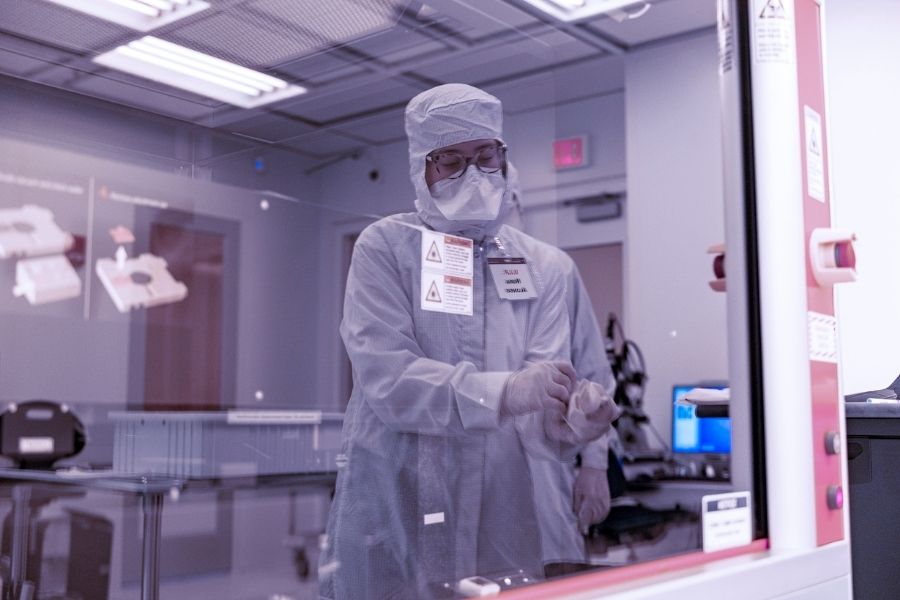
In summer 2024, Miqueleiz-Alonso expanded her interests through the Purdue Student Training, Awareness, and Readiness for Semiconductors (STARS) program that is focused on developing deep-tech skills in integrated circuit design, fabrication, packaging and semiconductor materials characterization. Much of her time was spent in Purdue’s cleanroom, working hands-on with nanofabrication tools. The experience introduced her to the semiconductor world, an area she had not previously explored, and sparked a new academic direction.
Eager to continue building her technical skills, Miqueleiz-Alonso joined VIP (Vertically Integrated Projects) at Birck Nanotechnology Center where students design and conduct experiments using advanced micro- and nanofabrication technologies in one of the largest and cleanest university cleanrooms in the country. As a member of the Statistical Process Control team, Miqueleiz-Alonso helped develop metal–insulator–metal transistors and focused on electrical characterization, including measuring electrical resistance. The team presented its findings at the Spring 2025 Undergraduate Research Conference and the Birck Symposium.
That momentum carried into a solo summer research project that blended engineering and art. She replicated the artwork of Indiana artist Ryan Lane at the nanoscale — a project that required significant experimentation and pushed the limits of several cleanroom fabrication tools. By carefully milling a silicon dioxide layer to varying thicknesses, she manipulated light interference effects to generate precise colors. Through a series of lithography steps and specialized etching techniques, she successfully recreated the patterns, designs and colors of the original artwork at a scale invisible to the naked eye.
As her interest in semiconductors deepened, Miqueleiz-Alonso explored pursuing a certificate or concentration in the field. Balancing those courses with the demands of chemical engineering proved challenging, as the curricula differ significantly. She also worked to gain recognition for her VIP coursework within her major, since multiple semesters of VIP do not currently fulfill senior design or other requirements in chemical engineering as they do in some other disciplines.
In conversations with David Janes, professor of electrical and computer engineering and co-director of the Semiconductor Degrees Program at Purdue, Miqueleiz-Alonso found encouragement to take initiative — not just for herself, but for future chemical engineering students interested in semiconductor research. The experience reinforced her belief that meaningful change often begins with student leadership.
Looking ahead, Miqueleiz-Alonso plans to pursue graduate studies and is strongly considering a PhD in semiconductors or nanofabrication. Working alongside doctoral students in the lab has shown her the creativity and independence that advanced research offers. She thrives in an environment where each day brings new questions, experiments and discoveries.
Her advice to other students reflects her own journey: If there isn’t a clear path to your goal, create one. By seeking opportunities, embracing challenges and stepping into unfamiliar fields, Miqueleiz-Alonso is not only building her future in engineering — she’s helping shape new possibilities for those who will follow.