
Purdue 1 patch designs tell the stories of the university's 2027 mission to space
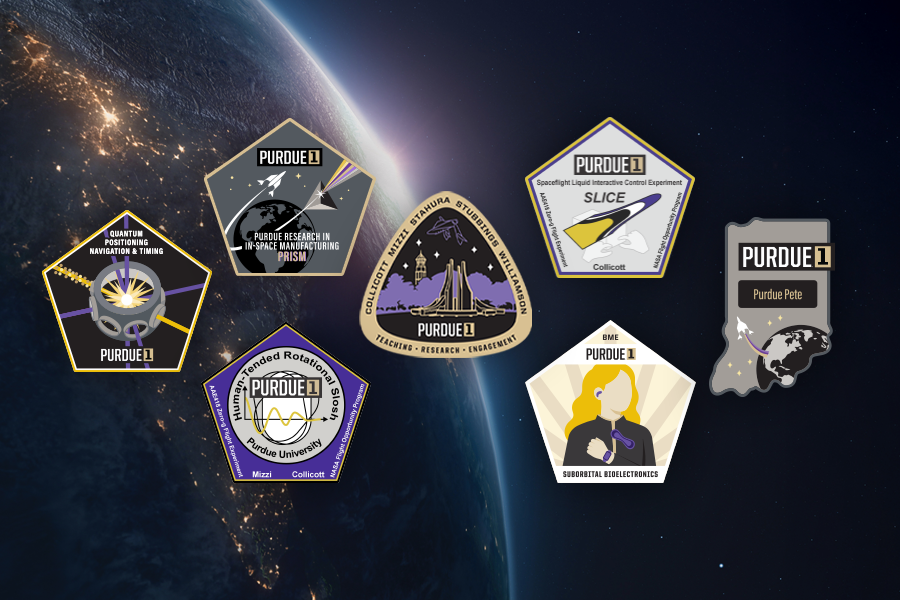
WEST LAFAYETTE, Ind. — The Purdue 1 spaceflight next year will carry research and innovation into a new frontier with mission patches highlighting the people, science and partnerships behind the university’s growing role in space exploration.
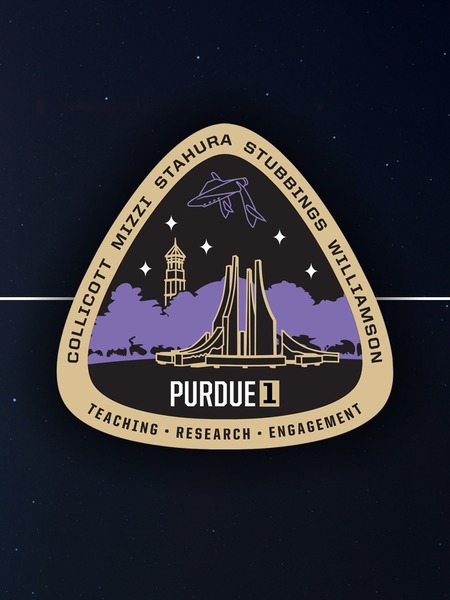
Representing a range of research projects and the collaborative work of students, faculty and industry partners, the patches that will adorn the five astronauts’ spacesuits offer a visual snapshot of the mission’s goals. Each design narrates how Purdue University’s expertise is helping push the boundaries of what is possible, from advancing emerging technologies to preparing for the challenges of future space missions. These patches illustrate the teamwork, curiosity and ingenuity required to turn ideas into experiments ready for flight.
“Human spaceflight has a long tradition of patches! A picture — or a patch — is worth a thousand words, as the saying goes,” said Beth Stubbings (formerly Moses), one of five astronauts on the all-Boilermaker mission aboard the Virgin Galactic spaceflight. With six suborbital spaceflights under her belt, she is the world’s most-flown female astronaut.
All of the patches incorporate some combination of the signature Purdue gold, black and gray hues and Virgin Galactic’s distinctive shade of purple. The overarching mission patch includes astronauts’ names and proudly boasts an image of Purdue’s iconic Engineering Fountain and Bell Tower. The five stars on the patch represent the five astronauts and the five onboard research projects.
The spaceship’s windows point downward to depict the crew looking down on campus. “We’re showing gratitude to Purdue, who made this mission possible,” said Abigail Mizzi, crew member and graduate student in the School of Aeronautics and Astronautics (AAE).
A total of seven patches were designed for the mission. Each crew member will wear the mission patch and at least one other that corresponds with their research or role while on the flight.

Vet astronaut will wear BME experiment
Stubbings, an AAE alumna who joined the Purdue Engineering faculty this fall as an associate professor of engineering practice, will test wearable technology on behalf of the Weldon School of Biomedical Engineering (BME). The patch she will wear displays the key items that will accompany her into space: medical sensors on her wrist and chest and a neuromodulator on the ear. The sensors will continuously monitor heart rhythm, gut rhythm, body temperature and other physiological characteristics to determine changes in nervous system physiology.
“These data can accelerate the development of personalized countermeasures, strengthen the evidence guiding fitness-to-fly decisions and establish thresholds for autonomous in-flight monitoring that trigger timely interventions and guide individualized recovery,” said Matthew Ward, a BME assistant professor who is leading the experiment. “The same approaches can be applied to longer orbital and exploration-class missions, where limited real-time ground access makes autonomous, automated health monitoring and management essential.”
The patch design features a stylized illustration of Stubbings, albeit without facial features so any girl or woman can imagine herself in Stubbings’ shoes.
“I was surprised to see myself on the patch. I’ve never been personally depicted on a space patch, and it’s humbling!” she said. The eye-catching design has the potential to resonate with youth pondering their future options. “I hope it inspires young girls to dive into science, engineering and aerospace.”
In addition to the Purdue 1 patches, Stubbings has requested to wear all six of her prior mission patches “in homage to my crewmates from those professional assignments.”
Any way you SLICE it
Crew member and AAE professor Steven Collicott has 30 years of experience flying zero-gravity experiments in various vehicles in air and space. Every spacecraft depends on liquids for fuel, drinking water for astronauts, coolants for electronics and fluids for medical systems.
“Being able to control when a liquid stays in one spot or moves off to another spot is important in spaceflight liquid systems, especially when the liquid wets the solid surface poorly, like water on many polymer surfaces. This is what we’re studying,” he said.
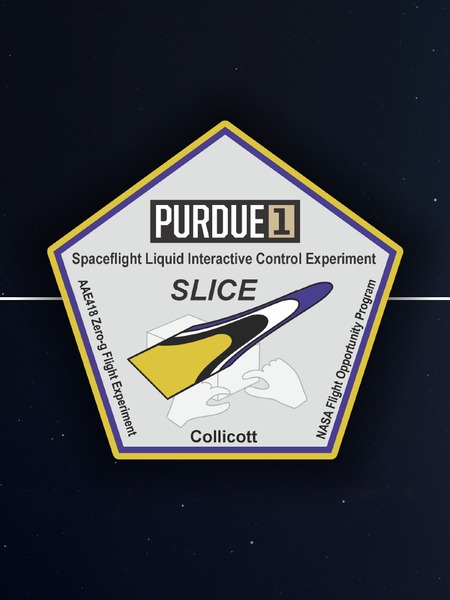
The catchy acronym for his Spaceflight Liquid Interactive Control Experiment (SLICE) is prominently shown on the patch.
“I learned some years back that if your experiment has a convenient name, then people can more easily talk about your work in our aerospace community,” Collicott said.
The hands on the patch Collicott will wear symbolize that he will tend to his own experiment. “The true expert, as I like to think, is flying to space with the experiment and operating the experiment in space, which is a historic advance in spaceflight research. I’ll be observing the experiment and choosing how to modify its operation in space to maximize the amount of useful data that we can acquire.”
The colored “tongues” illustrate the type of liquid flows that the experiment will create, he said. “Time increases from gold to black to white to purple.”
The patch also pays tribute to the many semesters of students in his AAE418 team-based zero-gravity class who have helped design and build experiment hardware for the flight.
“Years from now, I hope the patch reminds me of all the great people I got to work with on this task — my NASA sponsors, my many, many students in AAE418, our technical and administrative staff, department and college leadership, my crewmates, my colleagues and the Virgin Galactic team,” he said.
Research that will reach new heights
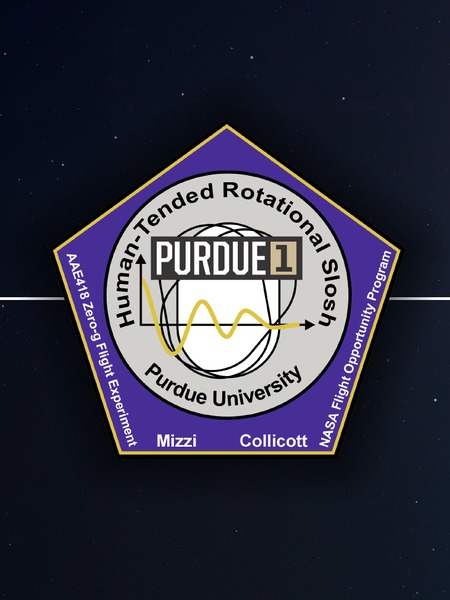
Collicott’s name is featured on another patch alongside that of fellow crew member and advisee Mizzi. She is preparing an experiment designed to learn how liquids in motion — depicted by the design’s gold waves — behave without gravity to slow them down or stabilize them. The white oval represents satellite propellant tanks that are pill-shaped, and the black-outlined ovals show the tanks rotating in flight. The project is the topic of her research thesis.
This fluid dynamic study carries significant implications because moving fluids can shift a spacecraft’s center of mass, affect stability and navigation, and complicate fuel delivery. The data collected will inform propellant systems, life-support systems in spacecraft and water delivery for plants.
Like Collicott’s patch, the one Mizzi will don salutes the NASA Flight Opportunity Program and work provided by AAE418 students.
The patches, Mizzi said, are evidence that aerospace is not a one-person sport. “It’s a team sport, and it takes a lot of people.” Mizzi anticipates that past and current students in AAE418 will connect to the patches. “Hopefully, a lot of them will relate to it and show it to other people with the pride of knowing they got to contribute to something bigger than themselves.”
Comparing Mizzi’s graduate research with her own, Stubbings marveled about how far aerospace has come in a short time.
“Think about it. When I was a Purdue grad student, I conducted materials research aboard NASA’s famous Vomit Comet, and now a Purdue grad student is about to conduct her fluids experiment in space. That’s amazing progress within just one generation,” Stubbings enthused.
Navigating beyond GPS
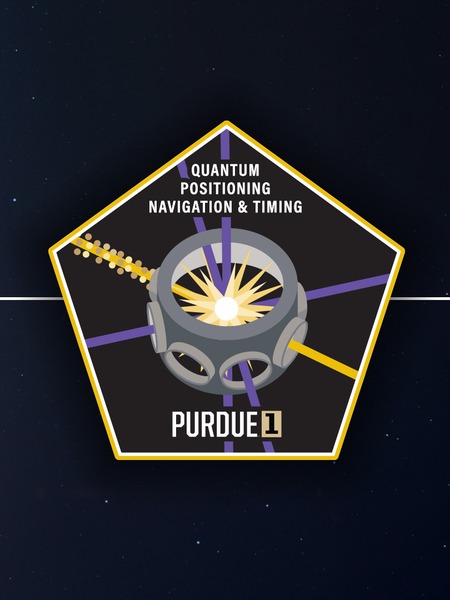
Shengwang Du’s research on quantum positioning, navigation and timing (Q-PNT) is featured on another Purdue 1 patch.
“For a researcher, seeing an idea move from the laboratory toward a spaceflight is already meaningful. Having that work represented on the mission patch gives it a visible place in Purdue’s story of space exploration,” said Du, the Scifres Family Professor in the Elmore Family School of Electrical and Computer Engineering and a professor of physics and astronomy in the College of Science. “To me, the recognition celebrates the collective effort of our students, faculty collaborators and our partner, Infleqtion.”
Du’s team uses laser light to cool atoms to temperatures very close to absolute zero, slowing their motion and allowing researchers to study and control them with remarkable precision. These atoms are the foundation for quantum technologies that could help answer the questions, “Where are we?” “How are we moving?” and “What time is it?”
The gray cylinder on the patch depicts a vacuum chamber with a warped magnetic field inside. The purple beams represent lasers, and the gold lines indicate that each beam serves a different function than a standard laser, Du explained.
“Our Purdue 1 experiment is an early step toward future quantum positioning, navigation and timekeeping systems that could support navigation when GPS is unavailable, including on missions beyond Earth,” Du said.
The project will shed light on how to make delicate laboratory technology work within the practical constraints of a spacecraft, Du explained. “Those lessons will help guide the development of future space-based quantum instruments.”
Manufacturing technology designed for space
Ajay Malshe, who has been investigating in-space manufacturing for many years, co-pioneered the concept “factories in space.” His Purdue Research in Space Manufacturing (PRISM) team has designed its Purdue 1 experiment as a compact, autonomous micro-lab for understanding the science and engineering required for manufacturing electronics and semiconductors in space.
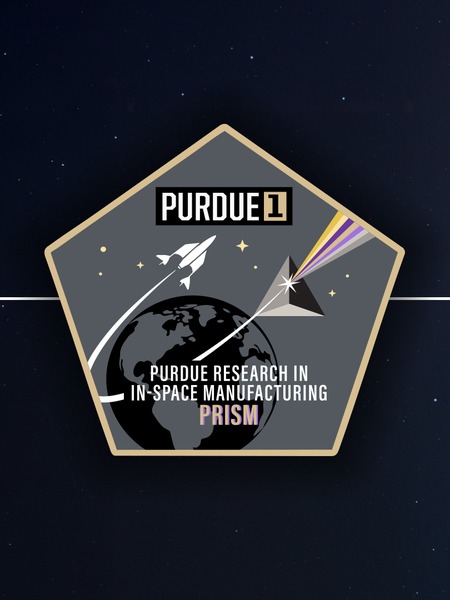
On the PRISM patch, the Earth represents its foundation in semiconductor and electronics innovation. The ascending spacecraft signifies the journey toward sustained space operations, and the prism dispersing light symbolizes the convergence of AI, edge computing, autonomous decision making and advanced manufacturing technologies, he said.
“Together, these elements capture PRISM’s mission to demonstrate AI-assisted autonomy and semiconductor and electronics manufacturing at the edge of space, enabling future space platforms to sense, decide, manufacture and adapt with increasing independence from Earth,” Malshe said.
Although the PRISM and Q-PNT patches won’t fly to space, there may be opportunities for identical stickers to fly on the experiment payloads.
Hoosier students invited to join the mission
To engage Indiana school children and build excitement for the spaceflight, the College of Engineering, Office of Engagement and Purdue Extension are collaborating on a statewide essay contest for fifth-graders.
The prompt, selected by popular alumni vote, asks young writers to outline their thoughts on how a personal interest or skill could contribute to the overall success of a future space mission.
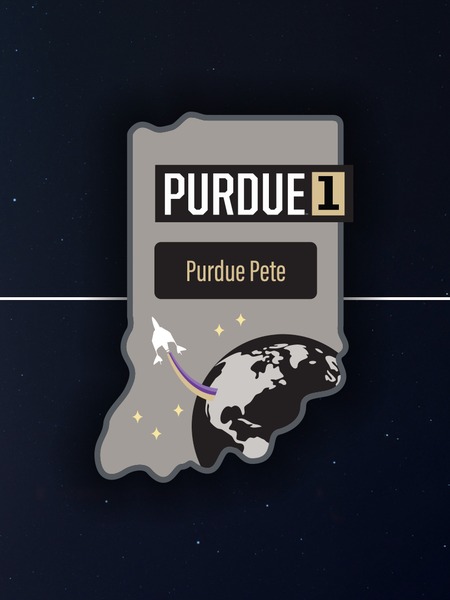
Organizers plan to select a winner from each of Indiana’s 92 counties in which eligible entries are received. Winners are expected to be announced in early spring 2027. Each county winner will receive a personalized Purdue 1 Indiana patch bearing the student’s name. If mission conditions permit, the section of the patch displaying the winners’ names will accompany the Purdue 1 crew on its suborbital flight.
Alumni Jason Williamson (BSCE ’97) and Florence Stahura (MS Chemistry ’92), who are leading engagement for the mission, round out the crew and will wear the Indiana-shaped patch on their suits. Signifying Purdue’s engagement with Indiana residents, the patch’s five stars represent the state’s fifth-graders, and like the mission patch, it features the five astronauts and five experiments. The Virgin Galactic spaceship is shown firing its rockets after release from the launch vehicle in Spaceport America, New Mexico.
“Flight patches are special, and we felt it would really sweeten the competition,” said Roberto Gallardo, vice president for engagement.
Every student across Indiana who responds to the Purdue 1 mission through their writing will have their essay as a tangible reminder of their connection to this historic moment, and the essay competition winners will receive the embroidered patch as an especially unique keepsake.
“It unleashes the precious imagination of children with the benefit of having a pretty cool patch to recognize those dreams,” Gallardo said.
Click here to preorder a Purdue 1 patch.
About Purdue University
Purdue University is a research institution ranked among the top 10 public universities in the United States. More than 111,000 students study at Purdue across multiple campuses, including more than 57,000 at our main campus locations in West Lafayette and Indianapolis. As a land-grant university committed to affordability and accessibility, Purdue’s main campus has frozen tuition 14 years in a row, enabling more students than ever to graduate debt-free.