
IE’s Johnson visits Capitol Hill to advocate for federal science and engineering funding
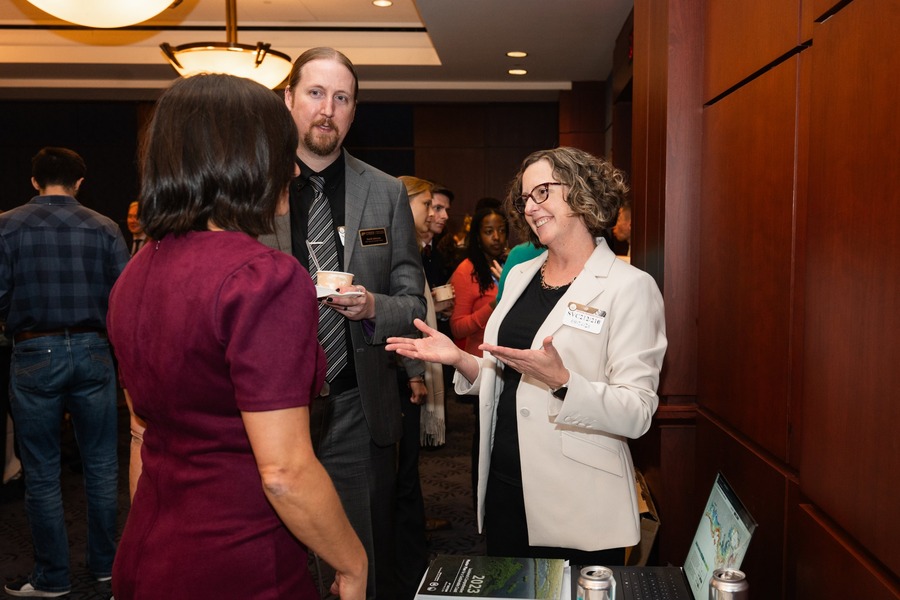
When coastal communities prepare for the next major storm, the decisions they make can affect lives, homes and billions of dollars in infrastructure. Purdue Engineering’s David R. Johnson is helping ensure those decisions are informed by science, and he recently took that message directly to Capitol Hill.
Johnson, the Ravi and Eleanor Talwar Rising Star Associate Professor in the Edwardson School of Industrial Engineering and associate professor of political science, traveled to Washington, D.C., on Sept. 24 to meet with congressional delegations and staff, and participate in the Coalition for National Science Funding’s Science Showcase. There, he highlighted how federally supported research is helping communities better understand and prepare for flooding and other natural hazards, drawing on his work developing the flood-risk model used in the $50 billion Louisiana Comprehensive Master Plan for a Sustainable Coast, which has been improved through his $500,000 National Science Foundation (NSF) CAREER award and other NSF support.
“NSF-funded research has dramatically improved our estimates of current and future flood risk,” said Johnson, who has been involved in the research since 2009 and currently co-leads the state’s Risk Analysis Team. “This has led to changes in the projects selected by the plan, the priorities for how quickly each one is needed, and a better understanding of what the state has accomplished since the plan was established after Hurricane Katrina struck in 2005.”
As an example of the plan’s impact, Johnson cites a 2025 study conducted to commemorate the 20th anniversary of Katrina. The amount of devastation that has been avoided by upgrades to New Orleans levees and floodwalls and other investments across the coast is “really striking,” he said.
“Hurricane Isaac in 2012 could have done even more damage than Katrina. Instead, Isaac was virtually a non-event that showed how well the new system is working,” Johnson said.
His leadership role in the NSF-funded Natural Hazards Engineering Research Infrastructure (NHERI) network is further evidence about the importance of federal investment in research and infrastructure to better prepare communities for natural hazards.
“I’ve been really inspired by researchers in the network who are dedicated to seeing their work implemented in building codes and standards that make the world safer. In some cases, that can take a decade or longer, and researchers don’t necessarily get a lot of credit for it, but seeing their passion is a great reminder of why we’re doing the research in the first place,” he said.
Most of the projects featured at the showcase in D.C. were technology demonstrations or products that originated with NSF funding.
“The event highlighted projects like one studying the sense of smell in locusts, with the goal of developing better chemical sensors for TSA and other security applications,” Johnson said.
His attendance, however, represented an important novelty.
“My work was the only example of how NSF funding has directly informed policy,” Johnson said.
In his testimony, he outlined to staffers from the House Appropriations Committee and the Committee on Space, Science and Technology that while basic research may take decades to be applied, sometimes it can immediately be put to use.
“Co-developing research questions with potential end-users has made my own proposals more competitive and can lead to a virtuous cycle where public funding develops new methods or technologies, private funding is used for implementation, and lessons learned from that transfer of technology lead to the next generation of research questions.”
In the end, Johnson wants policymakers to understand that a successful path from NSF-funded scientific research to beneficial technologies, tools and solutions is critically dependent on stewardship.
“It takes time to build partnerships between practitioners and academia, but it’s a symbiotic relationship that can make everyone’s outcomes better.”