
Award-winning Purdue Engineering research targets a persistent solid-state battery problem
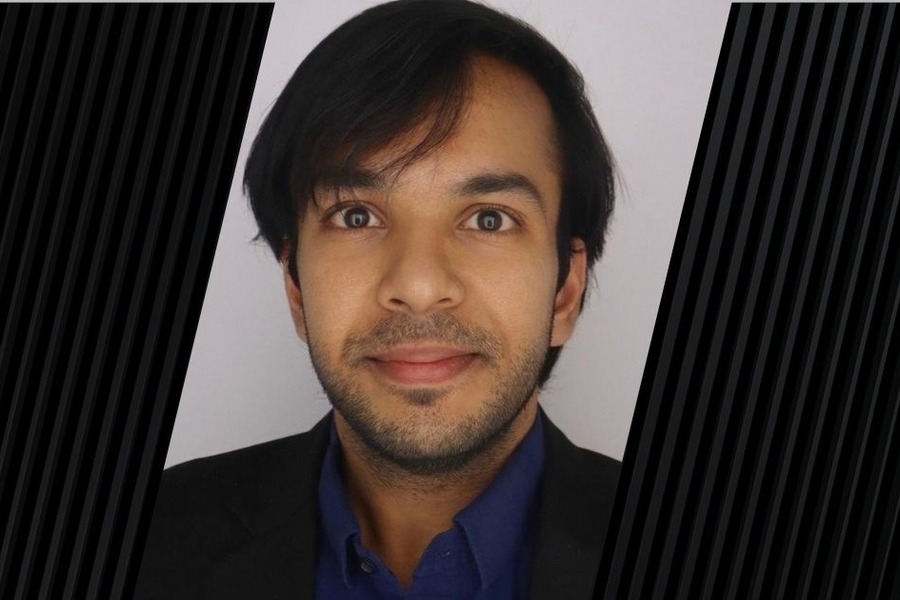
Aditya Singla, who completed his doctoral thesis under the supervision of Partha Mukherjee, a professor in the Purdue University School of Mechanical Engineering, won the 2026 edition of the Dimitris N. Chorafas Foundation awards. The honor recognizes outstanding doctoral research in the hard sciences in each partner university, including Purdue.
Singla’s thesis, “Mesoscale physics of interface instability in alkali metal electrodes,” is based on his research modeling defect formation at alkali metal electrode interfaces, including lithium and sodium metal.
A lot rides on solid-state batteries. Demand is surging, thanks to increasing renewable energy generation and electric vehicle use.
Because solid-state batteries have solid electrolytes, they eliminate much of the flammable liquid associated with conventional equivalents. They are therefore deemed safer and also have higher energy density, which means reduced battery size and weight, all desirable characteristics for electric vehicles.
Unfortunately, alkali metal anodes can develop voids and tiny needle-like deposits called dendrites. These defects can grow over repeated cycles and ultimately lead to short circuits and premature failure. The region to focus on is the very thin interface between the battery components such as the alkali metal anode and the electrolyte, where necessary electrochemical reactions take place — and also where the defects form.
Dendrites are not a new problem and have been extensively studied through lab experimentation. But the dizzying number of variables involved in dendrite formation and their many effects make a good fit for Singla’s approach: examination through computer modeling. Questions Singla was able to answer through simulations included: How will non-uniformity of the interface affect ion transport? Under what conditions are lithium filaments likely to grow? What external factors might affect defect formation?
Singla was also intrigued by the role of stress at the interface, especially in solid-state batteries. In conventional liquid-electrolyte batteries, there’s more room to maneuver, but in solid-state batteries, rigid solids pressing against each other lead to significant mechanical stresses. Evaluating the role of mechanics has become more urgent as the demand for solid state-batteries increases, Singla said.
The intriguing aspect of this research is that mechanical stress affects defect formation, which in turn affects mechanical stress. “Stopping dendrites is not just a chemical problem or a mechanical problem to address, it’s the various ways these physical processes interact and couple that determine what’s happening at the interface,” Singla said. These complex behaviors, especially at very small scales, lend themselves well to modeling studies.
Singla collaborated with lab-based researchers to validate his models. In turn, by using the model he was able to advise scientists on which experiments might yield the best insights.
He conducted his work at the FLEX Lab. Located in Discovery Park, FLEX is designed to adapt to the creative and innovative needs of Engineering professors and their students. Its wet-lab, dry-lab and open spaces enable teams to collaborate on interdisciplinary research and discovery that ranges from advanced manufacturing to imaging, and from information technology to medical devices.
The Dimitris N. Chorafas Foundation award especially recognizes research characterized by its high potential for practical application. Singla sees the value in such an outlook. “The processes that I’m studying might be occurring at the mesoscale but their effects are larger. Having safe, high energy density, cheaper energy storage systems is going to be essential for our future,” Singla said.