
Purdue AI Racing heads back to Laguna Seca, gears up for toughest challenge yet
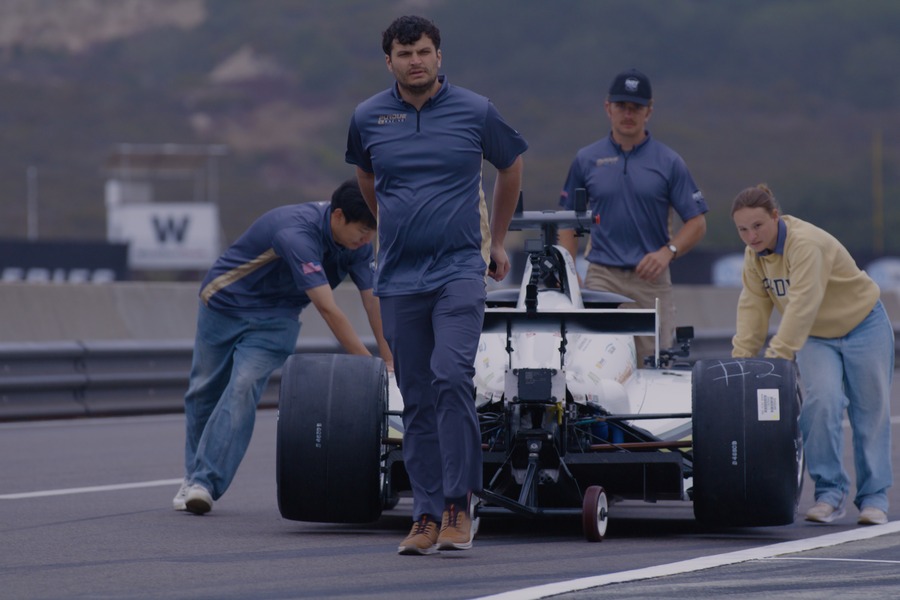
WEST LAFAYETTE, Ind. — The stakes and level of difficulty will be much higher when Purdue AI Racing (PAIR) returns to WeatherTech Raceway Laguna Seca in Monterey, California, on Sept. 3.
PAIR, one of nine university teams competing as part of the Indy Autonomous Challenge (IAC), will defend its sensational 2025 performance — a neck-and-neck second-place finish with recorded speeds of more than 143 mph with a best lap of 1:30.567, less than one second behind PoliMOVE’s 1:29.790.
This year, the event will include IAC’s signature autonomous passing competition, adapted to a road course for the first time. The format requires two autonomous racecars to alternate between attacking and defending roles across progressively more demanding performance rounds. This represents the next stage in the IAC’s progression toward complex multi-vehicle racing.
With an emphasis on autonomous overtaking, the competition will be significantly more challenging than in previous years, said Manuel Mar, senior operations manager for the team.
“Teams must safely manage following distance, account for blind spots, make braking decisions and execute passing maneuvers while navigating Laguna Seca’s complex layout,” Mar said.
Even without the new technical requirements, the world-renowned 2.238-mile course is known for its demanding 11 turns, including the famous “corkscrew” with its six-story drop in a mere 450 feet.
“To adapt to these difficulties, we have been putting many hours into simulation testing,” said Ashley Shaffer, a PhD student in the Elmore Family School of Electrical and Computer Engineering who joined the team in the fall of 2023. “We must account for braking for turns while trying to overtake an opponent, which complicates our overtaking strategy.”
In addition to preparing for new engineering specifications, the team has had to regroup after several experienced members graduated or moved on following the 2025 race.
“We had several key members who had each spent one to two years with the team, developing highly specialized technical knowledge in areas such as controls, perception and vehicle systems. While we recruited new students to strengthen the team, replacing that level of experience is not immediate. Instead, other members had to step into larger roles while new students underwent an accelerated learning process,” Mar explained.
Even though the team is young, Mar has been impressed with the progress made in only a year’s time.
“Rather than simply replacing those individuals, the entire team stepped up to ensure continuity. We supported the transition with extensive onboarding documentation, technical manuals, recorded meetings, training sessions and mentoring,” Mar said. “We also continue to stay in touch with several alumni who are always willing to provide advice when needed. It has been rewarding to see new members grow into their roles over the past year.”
Yuchen Song, a fourth-year PhD student in the School of Mechanical Engineering, is one of the veteran members, joining the team in the fall of 2023 after being recruited by his adviser.
“It was too exciting a project to turn down,” said Song, who is now the team lead. He develops the control algorithms and other software that enable the vehicle to run safely at high speeds near its limits. “This year, the challenge will be expanded to perception quality, prediction and precise planning and control.”
PAIR members have spent months readying for September. In May, the team practiced and collected data at Putnam Park Road Course in Greencastle, Indiana. They spent the last two weeks of July at Laguna Seca, where they practiced and completed rigorous safety-proving protocols and qualifications. They return to the track Aug. 22, this time sharing the track with the other teams as they prepare for the main event.
Sizing up the competition, Mar said last year’s first-place finisher, the Italian-based PoliMOVE, consistently has been one of the strongest opponents. At the same time, several teams, and the overall teams continues to improve, he added.
“It’s always difficult to predict the outcome because teams rarely reveal their full capabilities during testing. Everyone wants to avoid damaging the vehicle before competition,” Mar said. “We believe our team has prepared well and is in a strong position to compete.”
With PAIR’s impressive 2025 finish, the team’s goal is to demonstrate consistency and continue building on its progress.
“We want to compete at the highest level throughout the event and earn a place in the final round,” Mar said. “The team has worked extremely hard, and we’re excited for the opportunity to showcase that work on the track.”
PAIR is sponsored by Caterpillar, Gatik and Wabash.
The Sept. 3 race will kick off the Grand Prix of Monterey Weekend at Laguna Seca. Livestream coverage and broadcast links will be hosted directly on IAC Twitch and IAC media channels.
About Purdue University
Purdue University is a research institution ranked among the top 10 public universities in the United States. More than 106,000 students study at Purdue across multiple campuses, including more than 57,000 at our main campus locations in West Lafayette and Indianapolis. As a land-grant university committed to affordability and accessibility, Purdue’s main campus has frozen tuition 14 years in a row, enabling more students than ever to graduate debt-free.