
Purdue researcher Jay Gore awarded prestigious ASME Holley Medal for 'brilliance of the art'
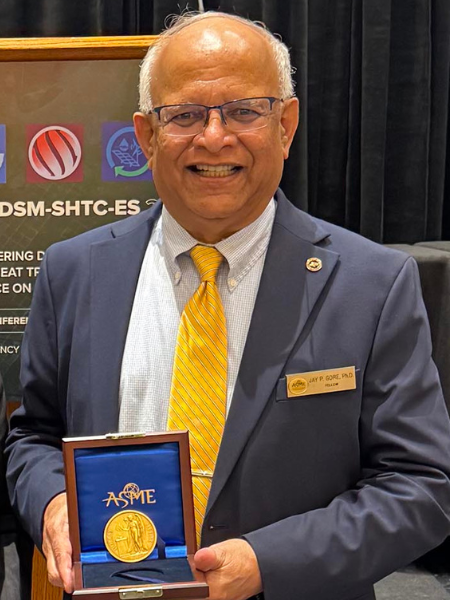
WEST LAFAYETTE, Ind. — Purdue Engineering is pleased to announce that Jay Gore, Reilly University Chair Professor in the School of Mechanical Engineering, has been awarded the highly prestigious 2026 Holley Medal by the American Society of Mechanical Engineers (ASME).
The medal is named after Alexander Lyman Holley, who chaired the first meeting of ASME founders in 1880. Holley, a mechanical engineer and inventor, is recognized for introducing (and then improving) the Bessemer process of steelmaking to the United States. The innovation made steelmaking cheaper and faster, enabling the cost-effective transformation of molten pig iron into steel in mass-production quantities to power American industrialization.
“It is overwhelming to receive the Holley Medal from the American Society of Mechanical Engineers,” said Gore, who also holds courtesy appointments in the School of Aeronautics and Astronautics and the Davidson School of Chemical Engineering at the Purdue University College of Engineering. “It’s especially gratifying remembering the list of past winners, among whom I now humbly take a place.”
Gore, in receiving the medal, was cited by ASME for his “lifelong discoveries and teaching in sustainable energy, gas turbines, internal combustion engines, and power plant efficiency; and for advancing fire safety using fundamentals of scientific engineering measurements and computations augmented with artificial intelligence.”
ASME doesn’t mince words in conveying the significance of the award, one of its oldest and most respected honors. Regarding its criteria, “It is an award for outstanding and unique act(s) of an engineering nature, accomplishing a noteworthy and timely public benefit.”
ASME goes on to say about the medal that, in choosing the recipient, “Attention shall be concentrated on the brilliance of the art — not on the individual. The achievement should be of such public importance as to be worthy of the gratitude of the nation and to call forth the admiration of engineers.”
The Holley Medal caps a long run of recognitions for Gore: Presidential Young Investigator Award (1991), U.S. Department of Energy (DOE) Advanced Gas Turbine Faculty Fellowship (1998), ASME Fellow (2006), American Institute of Aeronautics and Astronautics Fellow (2009), Jefferson Science and Technology Fellow (2010–11), and the ASME James Harry Potter Gold Medal (2025).
At Purdue, Gore was the founding director of the Energy Center in Purdue's Discovery Park, formerly served as Associate Dean of Engineering for Research and Entrepreneurship, and founded the Summer Undergraduate Research Fellowships (SURF) program.
His fundamental research areas span thermodynamics, fluid mechanics, and heat and mass transfer, with applications in fields such as biomedical, combustion, computational engineering, micro and nanotechnology, propulsion, sustainable energy and transportation. His research lab is concentrating its investigations on combustion and radiation heat transfer, with applications to pollution reduction, efficiency enhancements, fire safety and improving the fundamental understanding of various combustion phenomena.
Among the lab’s many current explorations is the use of AI to improve coal-burning power plants. Sponsored by the DOE, the researchers worked with a number of electric cooperatives and a national lab on a project to develop resources and tools that allow utilities to determine the cost of operating their large coal boilers at reduced capacity. The goal of the AI research was to create a data-driven model showing the best way to run the partial load boilers at peak efficiency; resulting software was provided to the 800 rural cooperatives that are members of the National Rural Electric Cooperative Association.
His life’s work is all in service to a sustainable future that embraces economic growth.
“The Holley Medal recognizes my connecting the higher frequency of natural disasters to the man-made increase in CO2 build up in the Earth's atmosphere, and for presenting pioneering ideas for recycling CO2 utilizing biomass and small nuclear reactors,” Gore said. “It’s also a recognition that the increased use of total and per capita energy is a good thing and needs to be met by increasing the exergy efficiencies of energy generation, distribution and utilization.”
About Purdue University
Purdue University is a research institution ranked among the top 10 public universities in the United States. More than 106,000 students study at Purdue across multiple campuses, including more than 57,000 at our main campus locations in West Lafayette and Indianapolis. As a land-grant university committed to affordability and accessibility, Purdue’s main campus has frozen tuition 14 years in a row, enabling more students than ever to graduate debt-free.