
Purdue engineers create wearable solution to optimize prosthetic fit, comfort
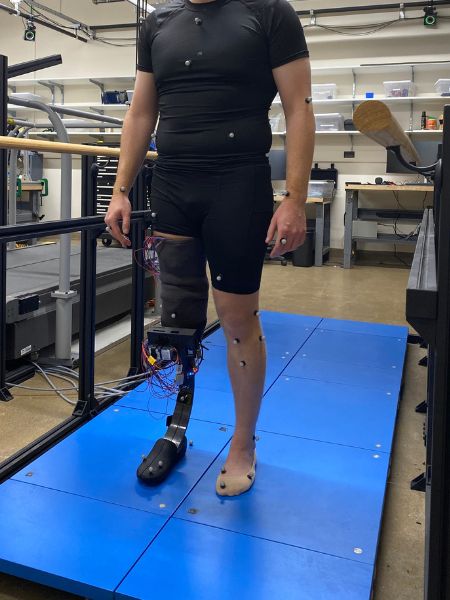
WEST LAFAYETTE, Ind. — Prosthetics are a fact of life today. It’s estimated that more than 50 million people globally — some 2 million of them in the United States — have lost a limb, and most of them could or already do benefit from the miracle of artificial limbs to restore mobility and lifestyle.
A big challenge with prosthetics is to ensure a proper fit where the residual limb inserts into the prosthetic socket. This interface must manage complex multidirectional forces during everyday activities: standing, walking, even altering one’s posture. Monitoring these forces in real time is vital to optimize socket fit and prevent secondary injuries.
Purdue University engineers with collaborators at the University of Notre Dame have developed a wearable solution, using embroidered, light-emitting textiles that integrate illumination and sensing, to detect both normal and shear forces at the limb-socket interface. Their findings have been published in a Science Advances paper titled “Embroidered textile sensors for real-time multiaxial force mapping in prosthetics.”
“This work represents a step forward in developing practical, wearable solutions for continuous biomechanical monitoring in lower-limb prosthetic users,” said corresponding author Chi Hwan Lee, a University Faculty Scholar and a professor in the Weldon School of Biomedical Engineering and the School of Mechanical Engineering.
The innovation overcame the drawbacks of existing strategies for sensing in-socket pressure and shear. “Optical-based systems rely on integrating signal processing and chip components within the socket — difficult to do in such a tight space,” Lee said. “Strain gauge-based transducers often require modification of socket geometry. Other solutions are limited to pressure sensing alone.”
The leap ahead would be a wearable, textile-based platform that satisfies the key requirements of flexibility, washability, multiaxial detection and compatibility with wireless systems.
“This called for novel materials and fabrication techniques,” said the paper’s first author, Tianhao Yu, a PhD candidate in mechanical engineering. “We met this challenge with a fully embroidered, multiaxial sensing system to detect forces at the limb-socket interface.”
Real-time monitoring
The system sensors are integrated with a Bluetooth-enabled data acquisition module and a textile-based electroluminescent display to enable real-time, close-loop feedback of pressure levels that are streamed and visually communicated via illuminated embroidered pixels.
A transtibial amputee individual — someone who has undergone a surgical amputation that removes the lower leg but preserves the knee joint — demonstrated the system’s capacity to monitor real-time pressure and shear during various daily functional tasks.
The system consists of a textile sheath embedded with a sensor array that is positioned inside the prosthetic socket and connected to the data acquisition module; the modular design enables plug-and-play functionality via snap button connections to the electronics. Pressure data is wirelessly transmitted to a portable device for digital mapping and feedback is displayed in real time via an embroidered textile display on the subject’s sleeve.
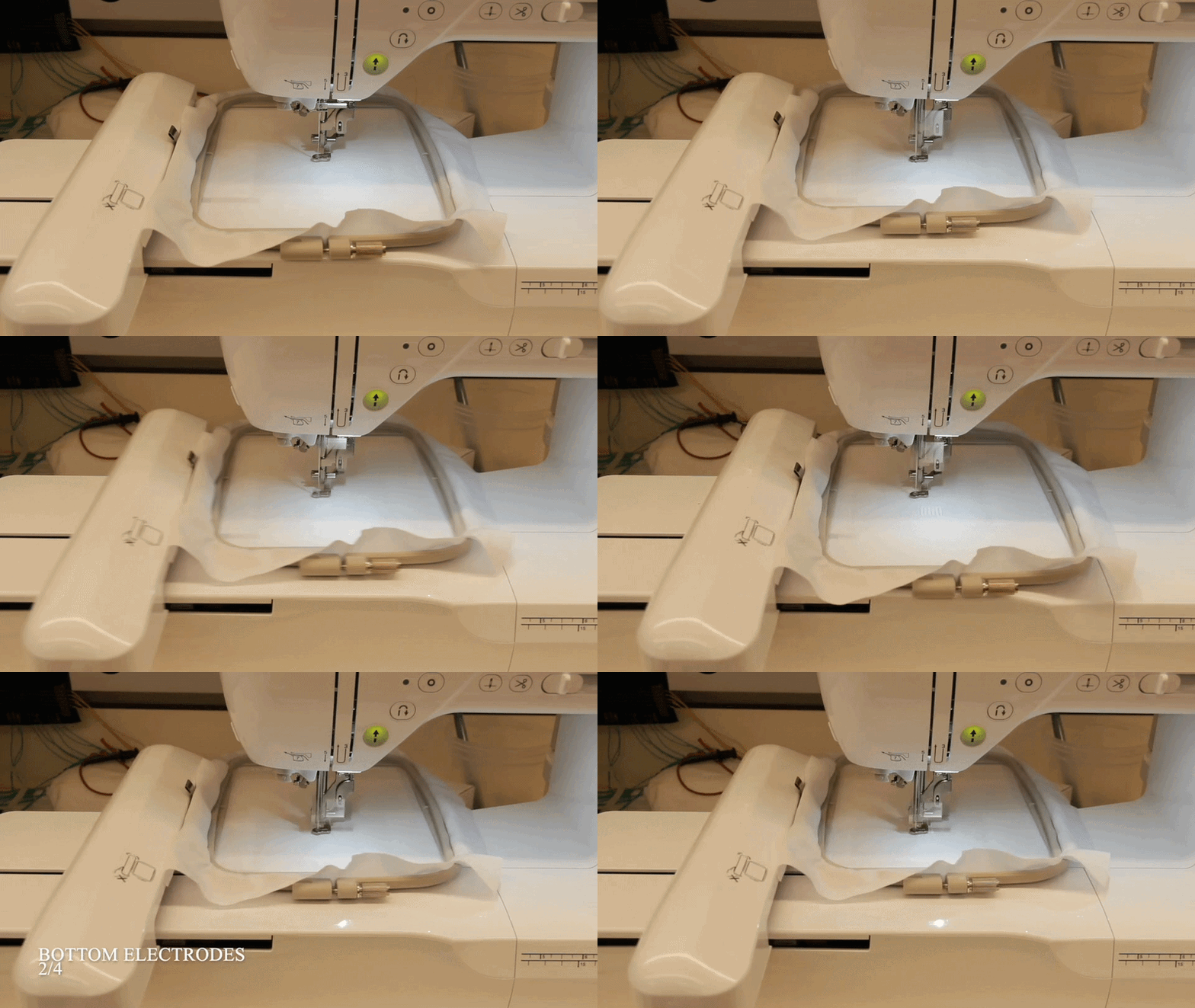
The researchers mated ionic gel-based electric double-layer capacitors with machine-embroidered electrodes in a quadrant system to best capture the measurements.
“The embroidered sensor forms a multilayered capacitive structure with a large common top electrode and four smaller bottom electrodes arranged in a quadrant configuration,” Lee said. “The sensor detects differential capacitance changes. Under normal compression, all four quadrants exhibit similar capacitance increases. Combined normal and shear loading induces asymmetric changes, revealing both the magnitude and direction of shear.”

Sewing things up
The sensing element is fabricated via machine embroidery by using a polyester top thread and a silver-plated conductive bobbin thread stitched into the substrate fabric. The sensor is integrated into the all-embroidered system so the microcontroller unit can process the capacitance signals and actuate the textile-based electroluminescent display.
The system’s ability to measure both normal and shear pressures is critical for practical wearable applications, especially when limb-socket interface forces vary dynamically during daily activities. The fabric architecture can be tailored in size, layout and electrode configuration for different socket shapes and sheath design. Sensitivity and working range can be tuned for customization across different users and loading conditions.
It’s wash and wear, too. The embroidered sensors were placed in a water-permeable protective sack and run through more than 30 full cycles of laundry (wash, rinse, spin, spin-dry), using a standard household washing machine and commercial liquid detergent.
Teaming for discovery
The cross-disciplinary research drew in multiple Purdue Engineering faculty, including Hyeonseo Joo from the Weldon School of Biomedical Engineering, Ziheng Wang from the School of Mechanical Engineering, and Yumin Dai from the School of Materials Engineering. External collaborators included Axel Gonzalez Cornejo and Edgar Bolivar-Nieto from Notre Dame’s Department of Aerospace and Mechanical Engineering. Funding was provided by the National Institute of Biomedical Imaging and Bioengineering at the National Institutes of Health, the Ministry of Trade, Industry, and Energy (MOTIE), Korea, under the “Global Industrial Technology Cooperation Center (GITCC) program supervised by the Korea Institute for Advancement of Technology (KIAT), and Purdue University’s University Faculty Scholar Endowment.
The wearable solution to optimize prosthetic fit and comfort aligns closely with Purdue's OneHealth initiative, which involves research at the intersection of human, animal, and plant health and well-being; it also maps with Purdue Computes, a strategic initiative to scale Purdue’s research and educational excellence in computing.
Most importantly, this development holds the promise of improved quality of life for those who have lost limbs and require prosthetic assistance to resume their everyday routines.
“The pressures of the prosthetic limb interface are very intricate and complex,” Yu said. “We want to deliver the most granular, most customizable data for patients to give them the best possible experience with their artificial limbs across their daily lives.”
Lee disclosed the innovation to the Purdue Innovates Office of Technology Commercialization. OTC will apply for a patent to protection the intellectual property.
About Purdue University
Purdue University is a research institution ranked among the top 10 public universities in the United States. More than 106,000 students study at Purdue across multiple campuses, including more than 57,000 at our main campus locations in West Lafayette and Indianapolis. As a land-grant university committed to affordability and accessibility, Purdue’s main campus has frozen tuition 14 years in a row, enabling more students than ever to graduate debt-free.
Media contact: Kayla Albert, wiles5@purdue.edu