
Purdue Engineering's Blue Sky competition winners aim to monitor early disease biomarkers and scale quantum computing
WEST LAFAYETTE, Ind. — “Blue sky” is a well-known expression for thinking out of the box. It’s apt naming for a Purdue Engineering initiative that supports high-risk, high-reward research ideas with the potential to address major societal challenges before they become mainstream research priorities.
Backed by philanthropic support from the Engineering Advisory Council (EAC) and funds from the College of Engineering, the program invests in visionary concepts that may not yet fit traditional funding opportunities, helping position faculty as national leaders in emerging areas of research.
“We wanted to create a program for our faculty to try out big and bold ideas, without the restrictions that come from standard grants.” says Nik Chawla, associate dean for research in the College of Engineering. The applications were reviewed by associate deans in engineering, followed by a blue ribbon panel of Purdue's Neil Armstrong Distinguished Visiting Professors. Finalists made a "Shark Tank”-style pitch to EAC members.
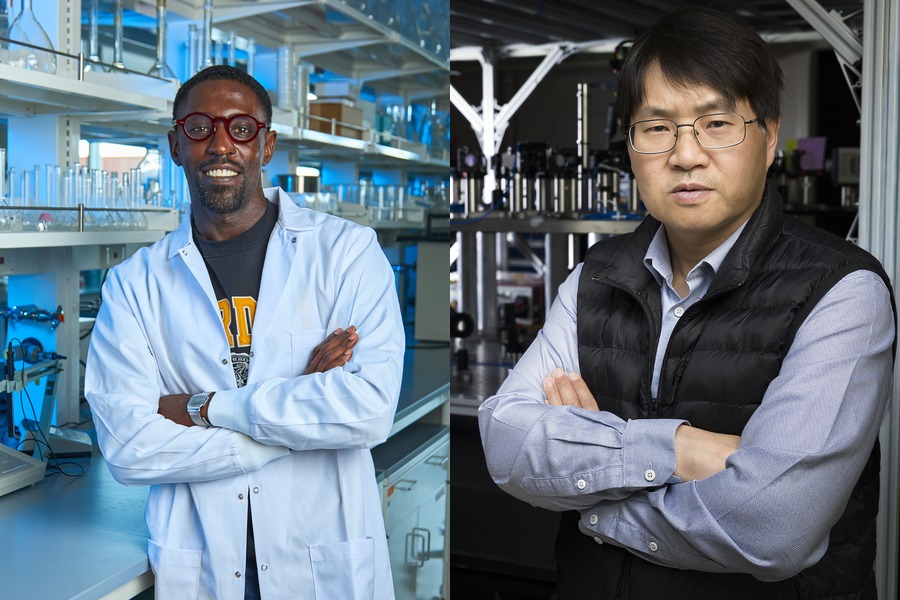
Purdue Engineering is pleased to announce the winners of the second annual Blue Sky competition: Leopold Green and Shenwang Du. Green is an assistant professor in the Weldon School of Biomedical Engineering; Du is the Scifres Family Professor of in the Elmore Family School of Electrical and Computer Engineering.
Green and his team aim to create a new generation of biosensors capable of continuously monitoring proteins and other disease biomarkers in real time.
Du is laying out a novel path toward scalable quantum computing: instead of a single monolithic machine, he proposes a fundamentally new architecture based on networked, interconnected quantum nodes operating as a distributed system.
Chips keep watch
Green’s project is titled “Sentinel Nanopore Arrays for Single-Amino-Acid-Resolved Proteomics and Real-Time Cancer Digital Twins.”
His “sentinel chips,” rather than relying on historical data like existing computational systems, will provide real-time sensing of biomarkers directly at the site of disease. He aims to build the first chip-scale proteomic “sentry,” a biological semiconductor. This semiconductor has a metal surface with nanoscale etching (including arrays of pores, 5-10 nanometer holes in the surface) that interacts with biological molecules such as ions, metabolites or even proteins for sensing.
Green will embed the sentinels into a digital twin framework to model cancer progression from primary tumor to distant metastases. The biological chips will continuously read cell-health indicators like cytokines, short peptide motifs, protease signatures and other metastasis-associated markers. The readings will populate the agent-based digital twins, where tumor, stromal and immune cells are encoded as interacting agents driven by measured molecular fields. Machine-learning inference will then translate the signals into probabilistic molecular identities for real-time tracing of tumor evolution and immune activation.
The project combines advanced biological semiconductor and nanopore technology, AI and digital twin models to detect the earliest signs of cancer progression and immune response. Timely detection could enable more personalized treatment strategies, accelerate therapeutic discovery and help predict and monitor disease faster than traditional diagnostic methods.
“Our framework enables continuously updated digital twins driven by real-time molecular telemetry,” Green said. “The commercial outcome would be a new class of deployable devices — such as a wearable patch — that merge the chemical programmability of DNA with the scalability, robustness and manufacturing pipeline of semiconductor electronics. The parallel software stack for cancer digital twins will leverage data for predictive modeling.”
Networked quantum computers
Du’s research impact, through the project he titled “S-QGPU: Shared Quantum Gate Processing Unit for Distributed Quantum Computing,” could be equally transformative.
The Purdue researcher seeks to transform the way quantum computers are built by enabling many small quantum processors to work together as a single, powerful system. Rather than relying on one massive quantum computer, the project will develop a shared processing architecture that connects distributed devices via a centralized quantum server, making quantum computing more scalable, cost-effective and accessible.
Du believes that future quantum systems may resemble the evolution of classical computing, from isolated computers to the internet and cloud computing. In his paradigm, compact “quantum laptops” containing 5-10 qubits can be interconnected through quantum networks to collectively perform computations that exceed the capability of any individual device.
In operation, remote quantum processors will convert their local qubits into photonic qubits and transmit them to a centralized quantum server, where hybrid photon-atom gate modules perform deterministic two-qubit quantum operations before returning the processed qubits to their originating nodes. This shared quantum server enables scalable distributed quantum computing, analogous to how cloud servers coordinate distributed traditional computing.
This approach could lay the foundation for distributed quantum cloud computing and position Purdue as a leader in next-generation quantum networking technologies, which is emerging as a direction of strategic importance in national quantum initiatives.
“If realized, our architecture could fundamentally reshape how large-scale quantum computing systems are built, through networking rather than monolithic hardware scaling,” said Du. “This would enable cost-efficient quantum infrastructure, enable interoperability across heterogeneous quantum technologies and support development of quantum cloud computing, where remote users access shared quantum resources through shared quantum networks.”
Forefront of Research
The Purdue competition awardees are tackling two of the most consequential domains in technology and society today. The ability to construct deployable devices that can identify and track disease biomarkers in real time can make the goal of early-stage disease detection a reality. The advances in quantum computing could amp up computational heft across all arenas of scientific and engineering research, further enabling the examination of multiple scenarios simultaneously at a speed that far eclipses the compute power of today’s existing platforms.
Most importantly, Blue Sky provides one more backdrop for innovation, for the most consequential research, to flourish at Purdue.
“To me, the Blue Sky award represents both an opportunity and a responsibility,” said Du. “It gives us the freedom to pursue bold ideas that are too early or too unconventional for most traditional funding programs. I am honored that Purdue Engineering recognized the potential of our vision for distributed quantum computing, and I hope this support will help open new directions in quantum science and engineering that ultimately benefit society.”
Added Green, “The Blue Sky award is transformative for my lab because it funds the integration unifying DNA nanotechnology, cell-free expression, semiconductor interfaces and computational digital twins into a single coherent platform. More broadly, this support is essential for early-stage engineering biology, because the highest-impact opportunities live at the interfaces: between materials science and molecular biology, between wet-lab experimentation and in silico modeling, between specific substance detection and true systems-level monitoring.”
About Purdue University
Purdue University is a public research university leading with excellence at scale. Ranked among top 10 public universities in the United States, Purdue discovers, disseminates and deploys knowledge with a quality and at a scale second to none. More than 106,000 students study at Purdue across multiple campuses, locations and modalities, including more than 57,000 at our main campus locations in West Lafayette and Indianapolis. Committed to affordability and accessibility, Purdue’s main campus has frozen tuition 14 years in a row. See how Purdue never stops in the persistent pursuit of the next giant leap — including its integrated, comprehensive Indianapolis urban expansion; the Mitch Daniels School of Business; Purdue Computes; and the One Health initiative — at https://www.purdue.edu/president/strategic-initiatives.