
Registration open for July 27 LyoHUB/FDA workshop addressing critical needs in pharmaceutical inspection and quality assurance
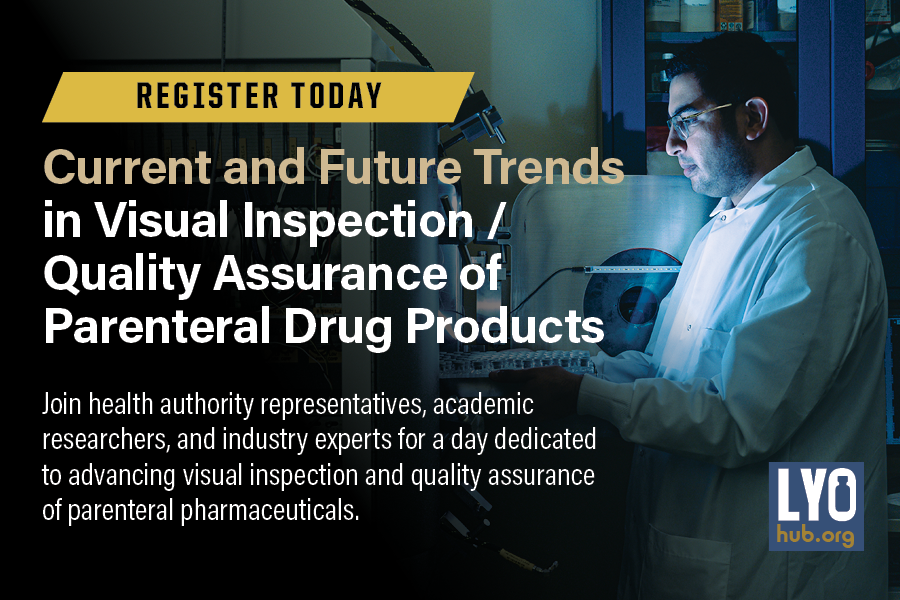
WEST LAFAYETTE, Ind. — Purdue University’s Advanced Lyophilization Technology Hub (LyoHUB) is working to advance the science and technology of lyophilization/freeze-drying, a preservation method that is vital to national security and public health due to its ability to ensure long-term stockpiling of lifesaving medicines without cold-chain refrigeration. Nearly 70% of antibiotics on the Essential Medicines List are supplied in lyophilized form.
In collaboration with the Food and Drug Administration (FDA) and 40+ industry partners, LyoHUB is hosting a workshop in the Washington, D.C., area to discuss safety measures for parenteral drug products that are lyophilized. The event is a direct response to a 2025 FDA-authored paper, “Recent Trends in Pharmaceutical Freeze-Drying and Control Strategies Observed in Human Drug Applications and Manufacturing Inspections.” The paper identified visual inspection programs as the single most common source of FDA Form 483 compliance observations across lyophilized parenteral operations, representing one of the three largest categories of compliance deficiencies across the industry. The workshop also addresses crucial needs identified the LyoHUB2040 Lyophilization and Freeze-Thaw Technology Roadmap for Pharma/Biotech Manufacturing.
Lyophilization, or freeze-drying, is a manufacturing process that removes water from a frozen product through sublimation under vacuum conditions. By preserving the product in a dry, stable state, lyophilization extends shelf life, improves storage and transportation, and helps maintain the potency and quality of temperature-sensitive materials such as biologics, vaccines and injectable pharmaceuticals.
Most lyophilized pharmaceutical products are parenterals — sterile drug products that are administered by injection or infusion rather than taken orally. Because many parenteral drugs contain ingredients that are unstable in liquid form, lyophilization provides a means to preserve these products until they are reconstituted and administered to patients.
With the demand for lyophilized injectables steadily rising, better manufacturing practices have become necessary to strengthen the supply chain. The highest level of integrity in lyophilization manufacturing is vital for optimal patient safety, and sterilization procedures that prevent degradation or contamination are critical.
This focused workshop will tackle the unique challenges of detecting particulates, identifying product defects and meeting regulatory compliance standards for lyophilized products. The event also will examine current and future trends in visual inspection and quality assurance of this class of pharmaceuticals and offer practical insights into current industry standards, regulatory expectations, and proven and novel approaches to reducing false reject rates.
The workshop is scheduled from 8 a.m. to 6 p.m. on Monday, July 27, at AstraZeneca, 1 Medimmune Way, Gaithersburg, Maryland. A networking reception sponsored by Purdue’s Young Institute for Advanced Manufacturing of Pharmaceuticals will follow. Also planned is a poster session highlighting the latest research in this area. The deadline to submit a poster is July 14.
LyoHUB, based at Birck Nanotechnology Center, is an industry-led consortium with 40+ member companies, including AstraZeneca, focused on advancing lyophilization technology for pharmaceuticals, vaccines and food products. Alina Alexeenko, the Reilly Professor in the School of Aeronautics and Astronautics and the Davidson School of Chemical Engineering, is the director and co-founder of LyoHUB. Eric Munson, the Dane O. Kildsig Chair in Industrial and Physical Pharmacy and head of the Department of Industrial and Molecular Pharmaceutics in the College of Pharmacy, serves as the scientific director of LyoHUB.
Serving on the workshop planning committee are: Alexeenko, Munson and Jennifer Gray, LyoHUB’s senior operations manager; Maxwell Korang-Yeboah and Steve Rhieu from the FDA/Center for Drug Evaluation and Research (CDER); and Sajal Patel from AstraZeneca.
Visit the registration page to see a full list of speakers. The deadline to register is July 20.
About Purdue University
Purdue University is a public research university leading with excellence at scale. Ranked among top 10 public universities in the United States, Purdue discovers, disseminates and deploys knowledge with a quality and at a scale second to none. More than 106,000 students study at Purdue across multiple campuses, locations and modalities, including more than 57,000 at our main campus locations in West Lafayette and Indianapolis. Committed to affordability and accessibility, Purdue’s main campus has frozen tuition 14 years in a row. See how Purdue never stops in the persistent pursuit of the next giant leap — including its integrated, comprehensive Indianapolis urban expansion; the Mitch Daniels School of Business; Purdue Computes; and the One Health initiative — at https://www.purdue.edu/president/strategic-initiatives.