
Purdue researchers invent wireless sensor to assess subsoil health in effort to cut costs and refine farming
A new smart platform invented by Purdue University researchers to wirelessly monitor subsoil health could change the landscape of agricultural sensing systems.
The invention addresses a critical need in agriculture nationwide: the efficient use of water, fertilizers and pesticides. Due to the variability of soil conditions across large fields, applying uniform amounts of these inputs can lead to significant waste, increasing costs for farmers and causing environmental harm if nutrient runoff reaches water systems.
“Our technology enables wide-area monitoring of subsoil conditions, helping farmers apply the right amount of inputs where and when they’re truly needed,” said Rahim Rahimi, an associate professor in Purdue’s School of Materials Engineering, who led development of the system. “This not only reduces environmental impact, but also improves crop yields and lowers operational costs, ultimately making food production more sustainable and affordable.”
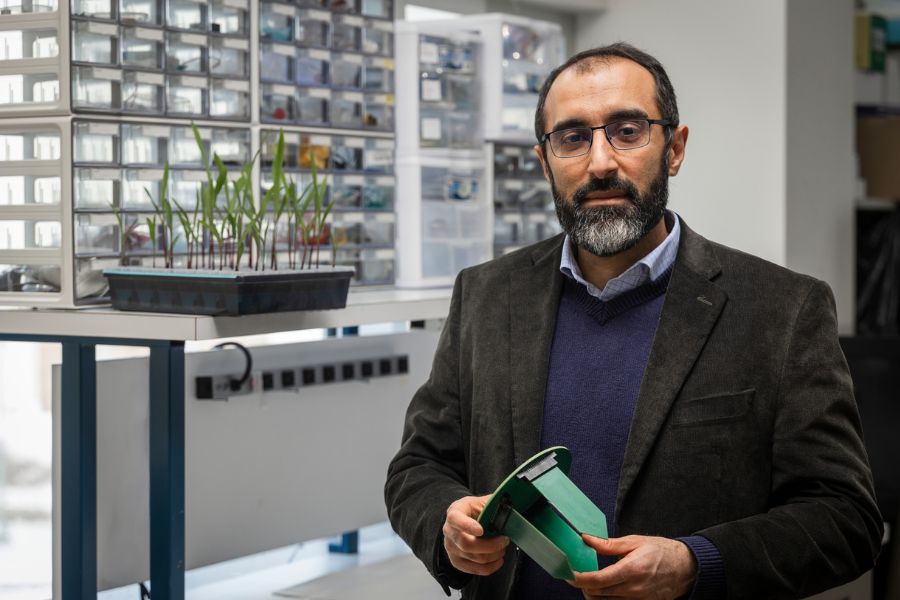
Called HARVEST — hybrid antenna for radio-frequency-enhanced volumetric water content and electrical-conductivity-based soil tracking — the invention is a wireless platform that eliminates the need for onboard electronics. The system employs nail-shaped sensing probes that are “physically and electrically coupled to a triple-ring antenna positioned above the ground, reducing signal loss while preserving sensitivity to subsurface changes,” Rahimi and his co-authors wrote in a paper published in Nature Communications.
By enabling wireless, passive and distributed monitoring of key parameters within the subsoil, the “smart nail” sensor overcomes traditional limitations and offers a new way to assess soil health.
While water and fertilizers are essential for crop growth, over-application wastes money and harms the environment, and under-application reduces yields. HARVEST embraces sustainable production by growing crops in a way that preserves natural resources, reduces pollution and ensures long-term agricultural viability.
The system can deliver deeper spatial and temporal insight into subsoil conditions, supporting data-driven agricultural management while reducing environmental impact. Subsoil refers to the soil depth at which roots access water and nutrients, or below the top 6 to 8 inches.
“Monitoring this zone is essential because changes in moisture and salinity here often dictate crop health and stress long before symptoms appear aboveground. Understanding these conditions allows for timely interventions, preventing yield loss and improving environmental stewardship,” Rahimi said.
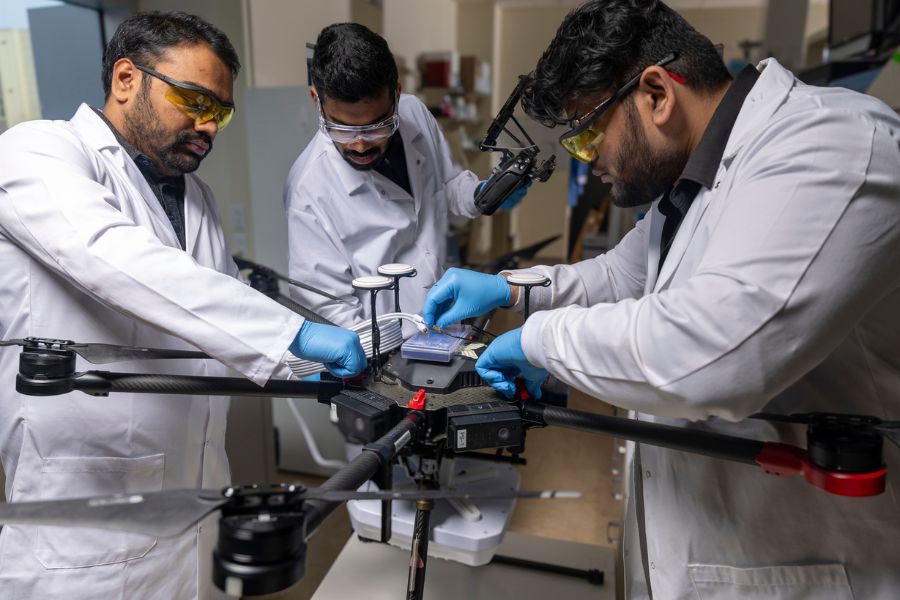
Most existing approaches for agricultural monitoring rely on surface-level sensing such as drone-based crop imaging or periodic soil sampling.
“While valuable, these methods are either slow, spatially limited or unable to capture real-time subsurface soil conditions at scale,” Rahimi said.
The HARVEST project was inspired by years of collaboration with agricultural scientists and farmers.
“We repeatedly heard the same challenge: Current soil-sensing tools are either too expensive or too limited in coverage. As a team of materials scientists and engineers, we saw an opportunity to apply advanced sensing and wireless communication technologies in a novel way that could address this unmet need,” Rahimi said.
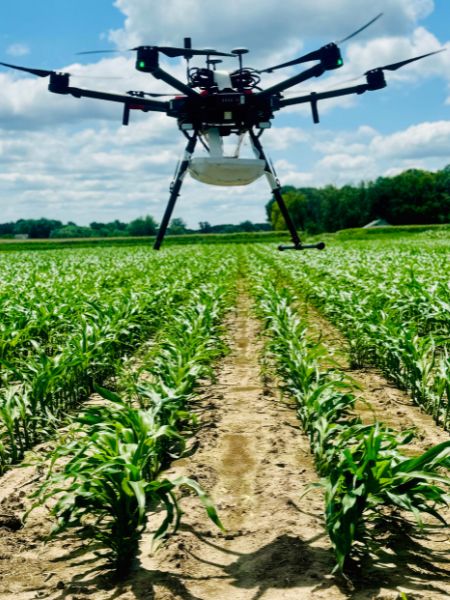
HARVEST technology — which was tested in a research cornfield at Purdue’s Agronomy Center for Research and Education throughout a full growing season — is designed to be scalable and cost-effective, making it accessible for both small, independent farmers and large commercial operations.
“By using commercially available materials and leveraging low-cost, unmanned aerial vehicle platforms, the system can be deployed in a wide variety of settings without requiring expensive infrastructure or specialized personnel,” Rahimi said.
Further, Rahimi said, this effort represents a strong example of interdisciplinary collaboration across materials engineering, electrical engineering and agricultural sciences, highlighting how Purdue researchers are developing technologies that are shaping the future of farming.
“Our hope is to see HARVEST sensors deployed at scale — across different crop types and farming systems — working in tandem with smart tractors, irrigation systems and decision-support software,” Rahimi said, adding that team members are excited about the potential for partnerships with agricultural equipment manufacturers and service providers to take this from a university prototype to a transformative tool in precision agriculture.
“Ultimately,” he said, “we envision HARVEST playing a key role in reducing unnecessary input use, lowering costs, protecting ecosystems and improving food security globally.”
Rahimi disclosed the innovations to the Purdue Innovates Office of Technology Commercialization, which has applied for patents to protect the intellectual property. Industry partners interested in developing or commercializing the work should contact Clayton Houck, Senior Licensing Associate, at cjhoukc@prf.org, about the track code 2026-RAHI-71311.
This work received funding support from the Wabash Heartland Innovation Network; Scalable Manufacturing of Aware and Responsive Thin Films; the National Institute of Diabetes and Digestive and Kidney Diseases program at the National Institutes of Health; and the National Institute of Food and Agriculture.