
Four Purdue Engineering faculty receive prestigious 2026 IEEE fellow designation
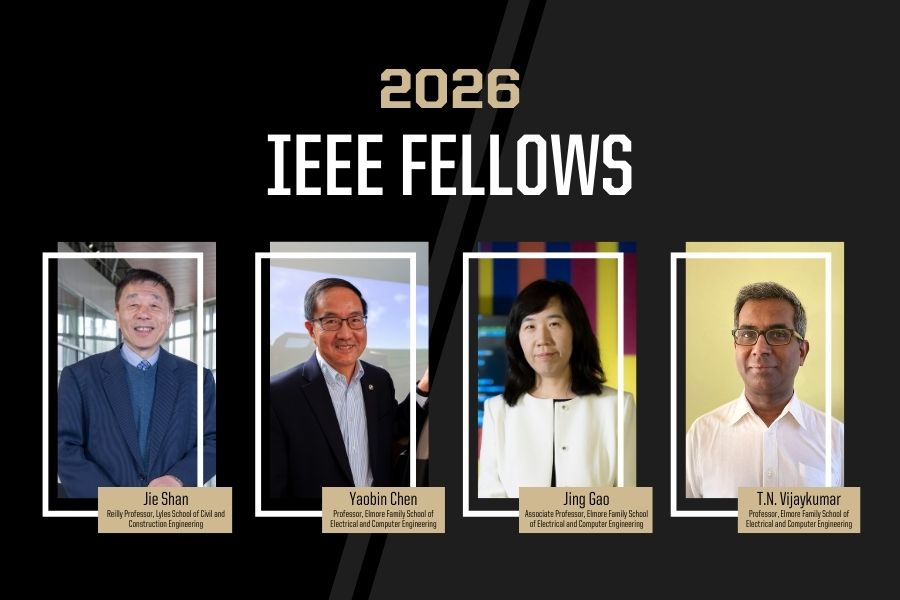
Four Purdue Engineering faculty have been named fellows of the Institute of Electrical and Electronics Engineers (IEEE) for 2026. The IEEE fellow distinction — awarded annually by IEEE, the world’s largest technical professional organization — is reserved for a select group of members whose exceptional contributions to engineering, science or technology have significantly advanced their fields. Fewer than 0.1% of IEEE’s voting members receive this honor each year, making it one of the organization’s most prestigious recognitions.
Jie Shan
Jie Shan, the Reilly Professor in the Lyles School of Civil and Construction Engineering, is being recognized for his contributions to advanced light detection and ranging (LiDAR) analytics and technologies.
Shan has built a distinguished career advancing innovative methods for processing and analyzing LiDAR and image data. His work has expanded the frontiers of geomatics engineering and enabled critical applications in high-precision mapping, 3D infrastructure modeling and autonomous systems.
As an internationally recognized expert in automatic 3D reconstruction from laser scanning and imagery, Shan has developed geometric, numerical and statistical techniques to tackle the challenges of unstructured spatial data. His contributions have led to more accurate surface and structural representations and have advanced large-scale topographic mapping, even under sparse measurement conditions.
“This is a tremendous honor and a humbling acknowledgement of our work over the years,” Shan said. “I am grateful for the recognition and the longstanding support of my colleagues, students and the broader professional community."
Yaobin Chen
The IEEE Board of Directors has elevated Yaobin Chen, professor in the Elmore Family School of Electrical and Computer Engineering (ECE) and director of the Transportation and Autonomous Systems Institute, to the grade of IEEE fellow in recognition of his pioneering contributions to automated vehicle safety and vehicle electrification.
Chen is widely recognized for research in advanced modeling, control, optimization and performance evaluation for automated driving and mobility systems to enhance safety for all road users.
His major contributions include developing an innovative methodology for modeling and evaluating vehicle-to-pedestrian/bicyclist automatic emergency braking (AEB) and road-departure mitigation (RDM) systems. He led the creation of the first large-scale naturalistic driving experiment in the U.S., along with novel vehicle-to-pedestrian/bicyclist interaction behavior models that serve as the foundation for standard crash scenarios and evaluation procedures for AEB and RDM systems.
Chen and his team also invented the world’s first advanced articulated pedestrian and bicyclist test targets with radar cross-sections that accurately replicate those of human beings, as well as the first surrogate road-edge objects designed for RDM system evaluation. These testing platforms, protocols and methodologies constitute a significant industry breakthrough, addressing long-standing gaps in validating and assessing emerging automated-vehicle (AV) safety technologies.
His research has contributed to the development of four Society of Automotive Engineers standards and has informed the National Highway and Traffic Safety Administration’s AV system validation guidelines. Several of his patents have been licensed for commercial use.
“Being elevated to IEEE fellow is a tremendous honor,” Chen said. “It represents not only recognition of my research accomplishments, but also the collaborative spirit of my students and colleagues at Purdue and our industry partners. This recognition motivates me to continue pursuing innovations that advance smart mobility and safety technologies.”
Jing Gao
Jing Gao, associate professor of ECE, has been elevated to IEEE fellow for her significant contributions to addressing the multifaceted challenges of big data analytics.
Gao has made influential advancements in overcoming key obstacles posed by big data — particularly the veracity challenge, which arises when data are inconsistent, inaccurate or unreliable. Her work also extends to developing innovative techniques that address the velocity, variety and volume dimensions of large-scale data.
Among her most notable achievements, Gao has pioneered the field of truth discovery, which seeks to automatically determine reliable information from vast collections of conflicting or uncertain data. She was the first to confront several of the field’s most difficult scenarios, demonstrating substantial performance gains across a range of truth discovery tasks.
Gao says in the future, she looks forward to tackling key challenges in AI-driven data analytics, contributing novel insights to the field, and delivering meaningful impact across the diverse domains that rely on these solutions.
“It is a great honor to be named an IEEE fellow, and I am truly grateful for this recognition from my peers,” Gao said. “This would not have been possible without the dedication of the remarkable students, collaborators and colleagues I’ve been fortunate to work alongside.”
T. N. Vijaykumar
T. N. Vijaykumar, professor of ECE, has been elevated to IEEE fellow in recognition of his contributions to an integrated microarchitecture–circuit approach for advancing low-power, high-performance computer architectures.
Vijaykumar’s research focuses on computer architecture, with emphasis previously on microarchitectures, high-performance microprocessors and simultaneously multithreaded processors when these topics were top research targets. He co-developed one of the first low-leakage schemes for the cache hierarchy and significant power-efficient techniques for the processor pipeline, which have been influential and widely cited in the circuit and architecture communities.
His other contributions include the first hardware soft-error recovery schemes for high-performance microprocessors; one of the first two software-programmable microfluidic architectures; and one of the most efficient hardware packet classifications in high-speed network routers. He has also made significant contributions to cache coherence that scales in both verification and performance, and memory dependence prediction. His current interests are in domain-specific architectures for prevalent software domains, such as bioinformatics, cloud computing and machine learning, secure speculative architectures, practical processing-in-memory architectures, quantum architectures, and formal verification of hardware memory consistency.
Vijaykumar is widely recognized for his sustained impact on the field. He is a recipient of the NSF CAREER Award in 1999; the first prize in the 2009 Burton D. Morgan Business Plan Competition for a business plan on commercializing programmable lab-on-a-chip technology; and an inductee into the Halls of Fame for the International Symposium on Computer Architecture and the International Symposium on Microarchitecture.
He expressed gratitude to his nominators, saying, “It is gratifying to be recognized for the low-power work I have done with my amazing colleagues and brilliant students over the decades.”