
Inside IoT4Ag: How ME's Dave Cappelleri Is Transforming Agriculture for Food, Energy, and Water Security
By 2050, the U.S. population is estimated to grow to 400 million and the world’s populace to 9.7 billion. That’s putting, and will continue to put, a tremendous strain on the vital resources needed to sustain that magnitude of people, particularly on the part of the agricultural sector.
Ag is a resource-hungry sector. Current agricultural practices account for 70% of global water use; energy use is one of the largest costs on a farm; and inefficient use of agrochemicals is altering Earth’s ecosystems. With finite arable land, water, and energy resources, ensuring food, energy, and water security will require new technologies to improve the efficiency of food production, create sustainable approaches to supply energy, and prevent water scarcity.
A number of reports highlight the opportunity for technological innovation to impact agricultural crop practices and production — and thus ensure a food-, energy-, and water-secure future for the health and prosperity of humanity.
The U.S. Department of Agriculture has stated that “… it is critical that productivity growth not rely on more cultivated land, water, or energy, but instead harness the power of innovation and technology.” According to the World Bank Group, “Digital technologies have the potential to improve efficiency, equity, nutrition and health, and sustainability in the food system.” And the USDA reported in 2019 that the total value of U.S. crop production exceeds $140 billion/year — precision agriculture is projected to increase that by an added $47 billion/year.
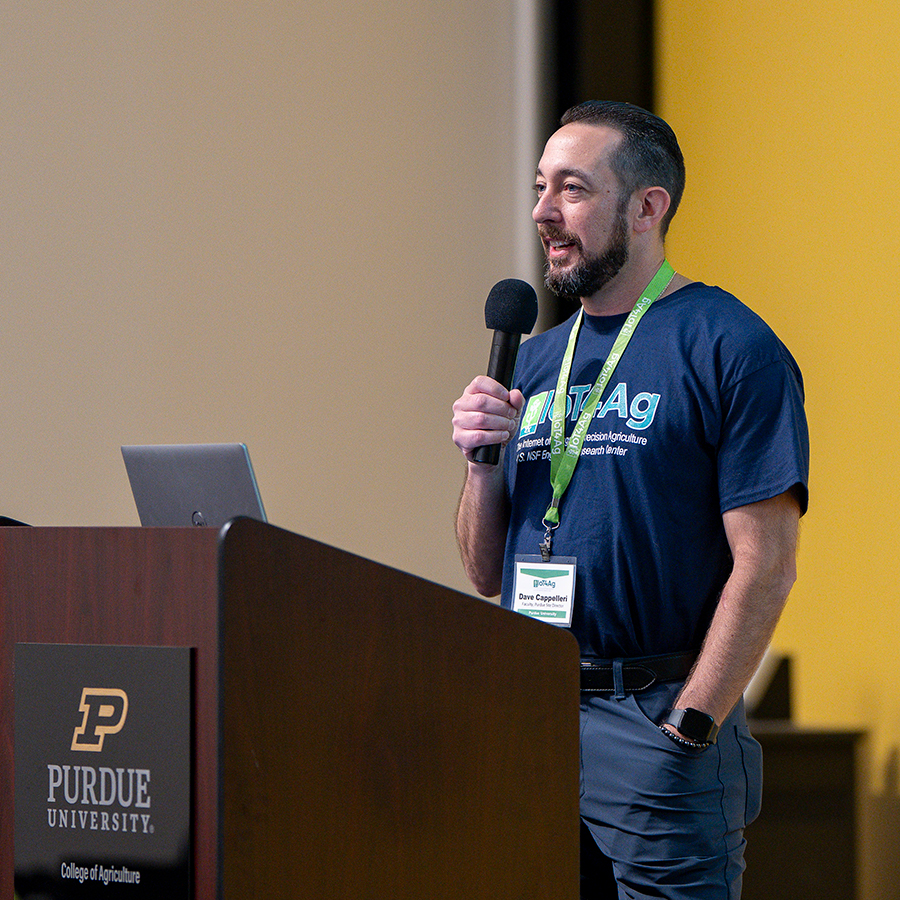
IoT4Ag is a keynote response to this need. IoT4Ag — The Internet of Things for Precision Agriculture — is a U.S. National Science Foundation-funded Engineering Research Center (ERC) that launched in 2020. It is comprised of university faculty and students, and partners from industry and government, dedicated to transforming agriculture.
IoT4Ag unites expertise in agronomy, agricultural engineering, communications, economics, environmental science, electrical and computer engineering, cyber systems, social science, and more to develop and deploy precision agriculture technologies to address the global grand challenges of food, energy, and water security. University partners include Purdue, the University of Pennsylvania, the University of California Merced, and the University of Florida.
Automating Crop Scouting
Agricultural crops are monitored primarily through the expensive, labor-intensive, and time-consuming process of crop scouting — manual sampling and documenting the state of the field. Precision agriculture involves the use of technology to acquire and analyze this data. However, currently technologies such as sensors are limited or non-existent to spatially, temporally, and compositionally monitor the state of the field. Data is coarse-grained and siloed in equipment. Communications infrastructure is limited or non-existent on the farm, and interventions are reactive and over-provisioned, increasing economic and environmental costs.
While the concept of precision agriculture has existed for 30 years, the exponential growth in information technology and data science and the reduction in their cost is now setting the stage for the next revolution in agricultural practices.
That’s where IoT4Ag comes in. IoT4Ag is creating novel, integrated systems that capture the microclimate and spatially, temporally, and compositionally map heterogeneous stresses for early detection and intervention to advance better outcomes in agricultural crop production. This NSF-funded Center creates IoT technologies to optimize practices for every plant, from sensors, robotics, and energy and communication devices to data-driven models constrained by plant physiology, soil, weather, management practices, and socio-economics.
IoT4Ag breakthrough technologies include multi-mode, low-cost, distributable, environmental and soil sensor technologies; autonomous aerial and ground-based robots; energy storage and delivery technologies for field-scale operation; Ag-specific communications; biophysically-constrained data-driven models for field analytics; and a Decision-Ag interface for field management and improved outcomes.
Agricultural Sensing Systems
The three primary research thrusts at the Center are agricultural sensors and systems, communication and energy systems, and agricultural response systems.
My research focuses on agricultural sensors and systems; specifically, ground-based agricultural robots as agricultural sensing systems. We are using ag-robots for in-row and under-canopy crop monitoring, sensing, and physical sampling. This is challenging for a number of reasons.
The robot needs to be small to fit between the typical 30” row spacing. It can’t rely on GPS-signals for autonomous navigation, since these signals are either weak or non-existent under crop canopies. While features exist in the field to help with localization and mapping, they all look the same, which greatly complicates the task. Physical sampling of crop leaves is also challenging because other leaves could be obstructing it; not only that, the system must determine the grasp pose of the flexible object and remove the leaf from the plant.
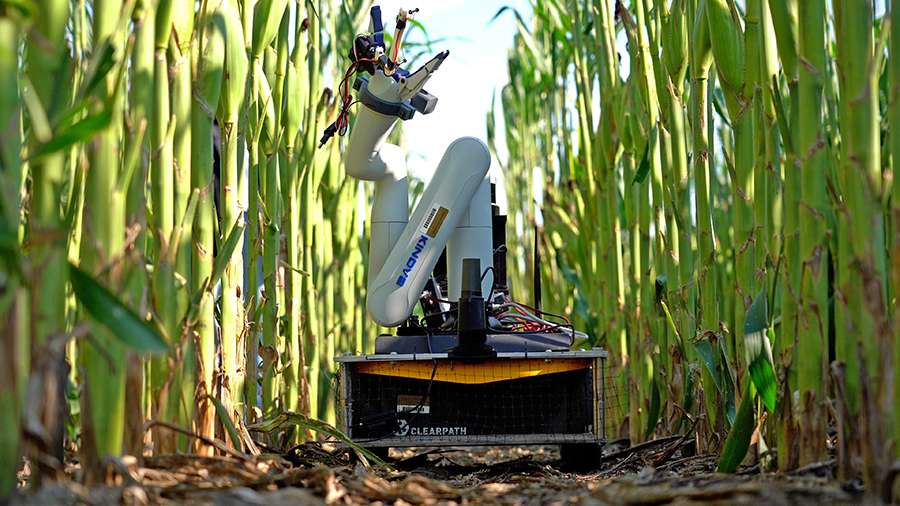
We have designed a custom agricultural robotic platform, sensor suite, and ag-specific algorithms to handle all these challenges. The Purdue Agricultural Robot, or P-AgBot platform, consists of an all-terrain Clearpath Robotics Jackal unmanned ground robot as the base, along with a Kinova Gen3 Lite six degrees-of-freedom robotic arm. The custom sensor suite contains an RGB camera, two LiDAR sensors, a wrist mounted RGB-D sensor, and an RTK GPS system.
We mount a custom nichrome wire end-effector attached to a servo motor to the end of the robotic arm for crop sampling. Embedded microcontrollers interface different sensors and electronics with the P-AgBot on-board computer. We also developed ag-specific algorithms for the bot. These include P-AgSLAM, for simultaneous localization and mapping in the crop rows; P-AgNAV, a LiDAR feature-based autonomous navigation algorithm; P-AgSAMPLE, a deep-learning leaf detection, pose estimation and grasp planning routine for physical sampling; and CROP-LO, a crop-row-optimized LiDAR odometry algorithm for autonomous navigation.
The sensor suite can measure and monitor crop attributes like crop height, corn ear height, and stalk diameter throughout the growing season. The P-AgBot platform can be configured with a custom drill and augur module and a sensor carrousel for planting buried soil sensors into the field; the auger can be swapped out for a vector network analyzer for reading the buried sensors throughout the growing season.
Physical AI in Ag
A lot of the work we do for IoT4Ag with the P-AgBot is an example of what is referred to now as physical AI. We are using AI algorithms for perception of the environment and then physically acting with the robotic platform in this space based on the information. We are also creating "big data” for training AI algorithms at Purdue’s Agronomy Center for Research & Education (ACRE) and creating simulations for the Sim2Real transfer of AI results to our physical platforms.
We’ve been testing the P-AgBot hardware and software in simulation, in the lab, and on the research farms at the ACRE facility for the past few years. This allows us to evaluate the technologies in real-world scenarios and collect data for algorithm training and refinement.
We also regularly interface with our Agricultural Systems Advisory Board (ASAB) about progress and direction. The ASAB consists of growers, agricultural agents, and members of grower associations who represent the voices of the end-user community. ASAB members provide our Center with a “boots on the ground” perspective regarding grower needs and priorities and potential barriers for technology adoption. We have patents currently under review on this technology that can be leveraged for future commercial applications.
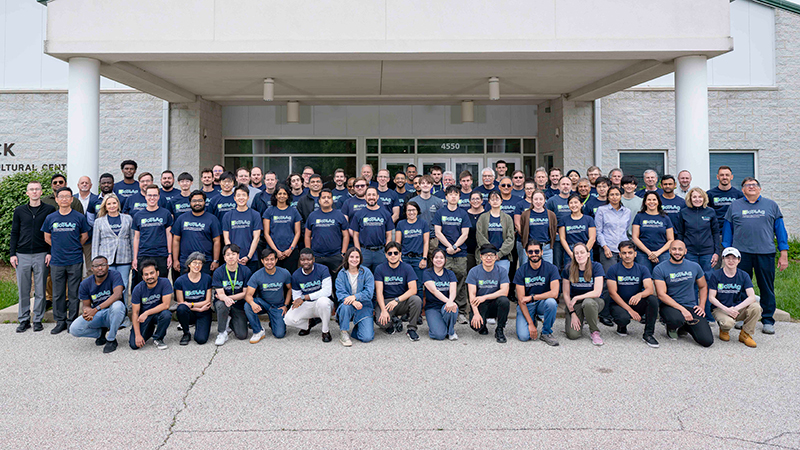
Multidisciplinary collaboration is vital at IoT4Ag. The center integrates expertise in agronomy, agricultural engineering, economics, environmental science, and the science and engineering of physical and cyber systems. The Purdue IoT4Ag team has faculty members from the Schools of Mechanical Engineering, Electrical and Computer Engineering, Civil Engineering and Construction, Agricultural and Biological Engineering, and Agronomy. The faculty at our IoT4Ag partner institutions Penn, Florida, and UC Merced are similarly interdisciplinary.
Within Purdue, we work closely with the Institute for Digital and Advanced Agricultural Systems (IDAAS), the Institute for Physical Artificial Intelligence (IPAI), and the Institute for Control, Optimization and Networks (ICON). In the private sector, we work with and get advice from the members of our Industrial Practitioner Advisory Board (IPAB).
Application Across Domains
Much of this research can carry over into other domains using the same core technologies. In general, we are interested in interacting with the environment in useful ways, and that environment can be agriculture, manufacturing, space, medicine, and so forth. We use different types of sensors for perception of each environment, algorithms for reasoning, and control actuators and robots to interact with it. We design new robots and robot configurations and/or sensor suites for differing interactions or applications.
For example, in the Multiscale Robotics and Automation Lab (MSRAL) that I direct, one focus we have is on agricultural robotics. We have also worked on space robotics applications, with similar but larger-scale mobile manipulation platforms for space habitat maintenance and repair.
We also work on small-scale robotics for biomedical and manufacturing applications. These robots typically measure at the mm- or microscale and are used for in vivo targeted drug delivery and diagnostics applications. We additionally work on designing new robotic micro-tools for minimally invasive surgery applications.
Instructing the Next Generation
There are many learning opportunities for Purdue students as part of IoT4Ag. All the Purdue IoT4Ag faculty support graduate students and/or post-docs working in the Center. There are undergraduate research opportunities during the semesters and summer months to work with each faculty on different aspects of their IoT4Ag projects; faculty have also sponsored/advised IoT4Ag-related engineering senior design projects. Most of these projects have hands-on components and are evaluated on the farm at the ACRE facility.
Looking ahead, we will continue to refine our algorithms for the P-AgBot, leveraging the latest advancements in AI. A new focus will be on fleet operations for the P-AgBot. For true farm-scale applications, we will need a team of P-AgBots to be deployed on the farm. We have developed a “mothership” architecture consisting of an autonomous IoT4Ag Polaris Ranger Utility Vehicle (UTV) and a robotic trailer that can transport a team of P-AgBots to a field and autonomously deploy them. We are now developing fleet operations algorithms for task assignment, task allocation, and resource management for efficient farm-scale operations.
The best-case impact of IoT4Ag is to realize our vision for sustainable, high-output precision agriculture. We can do this by creating and translating into practice IoT technologies for precision agriculture and by training a workforce to address the societal grand challenges of food, energy, and water security for decades to come.
These technologies, systems, and talent pool will then enable sustainable agricultural practices for more crop per every drop of water or Joule of energy, contributing to continual, year-by-year increases in the value of the U.S. crop market.
By David J. Cappelleri, Ph.D.
Assistant Vice President for Research Innovation, Office of Research
B.F.S. Schaefer Scholar & Professor, School of Mechanical Engineering
Professor, Weldon School of Biomedical Engineering (by Courtesy)
Purdue University