
Calestous Juma Engineering Fellows strengthen Purdue's research ties with Sub-Saharan Africa
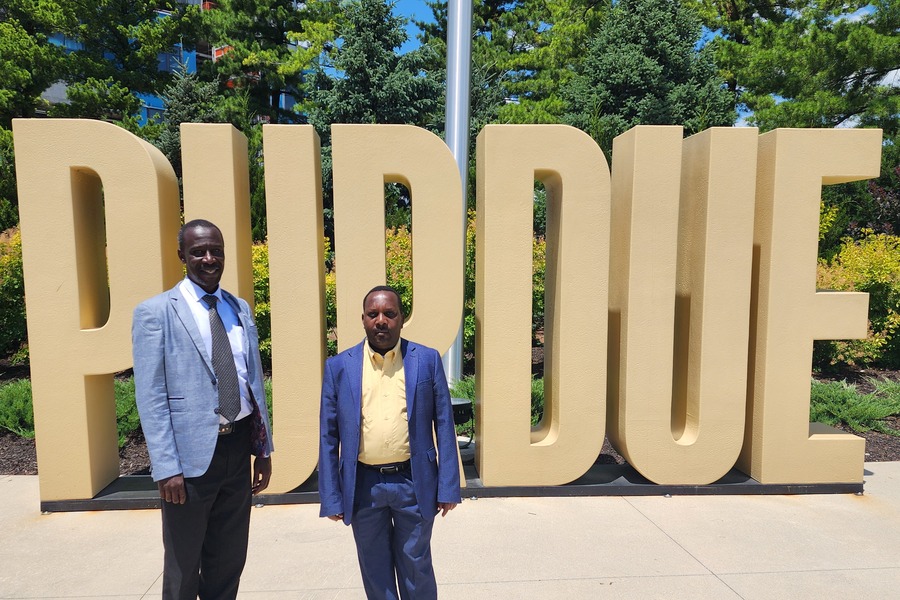
WEST LAFAYETTE, Ind. — Two visiting professors’ summer fellowships on the Purdue Engineering campus are contributing to two high-priority endeavors with sub-Saharan Africa: recruiting graduate students and advancing scholars working to harness science, technology and policy for sustainable development.
The inaugural Calestous Juma Engineering Fellows, hosted by Global Engineering Programs and Partnerships (GEPP), are Celestin Twizere and Eddy Odari. Both professors are conducting and sharing research within the Weldon School of Biomedical Engineering (BME).
Twizere is an associate professor of biomedical electronics, electromagnetism and telecommunication and director of the East Africa Regional Centre of Excellence in Biomedical Engineering and e-Health at the University of Rwanda. His background is in ground-penetrating radar, wireless communication and networks, electromagnetic radiation and propagation and smart antenna for mobile communication. His work includes strengthening research capacity and expertise in digital health, digitalizing the hospital patient trajectory, secondary use of electronic health records and e-mental healthcare architecture as an innovative solution to conventional treatment in Rwanda.
Alongside Young L. Kim, adjunct professor of biomedical engineering, Twizere is working on technology to detect anemia and malaria using a smartphone camera.
“This app will assist in the non-invasive diagnosis of malaria. My expertise is in user-centered design,” he said, adding that the technology will be used by teachers. To ensure that they are fully comfortable with navigating the app, he will fully include them in design and development.
Odari is a senior lecturer in the Department of Medical Microbiology at Jomo Kenyatta University of Agriculture and Technology (JKUAT). A medical virologist, his interests are in the development and evaluation of diagnostic assays, and he collaborates with researchers in the United States, Europe and Japan. He currently leads microbiology studies within the NeoInnovate Collaborative Consortium, bringing together three universities in the United States, JKUAT in Kenya and Amrita University in India.
Within Purdue BME, he is working with Tamara Kinzer-Ursem, the Marta E. Gross Professor of Biomedical Engineering, and Jacqueline Linnes, the Showalter Faculty Scholar Professor of Biomedical Engineering, continuing his research on low-cost disease detection devices to support community healthcare workers.
“I’ve been able to bring my expertise in biomedical and molecular diagnostics in optimizing critical conditions to improve validity of the assays developed by Tami and Jackie’s research groups,” Odari said. He further reiterates that his long-term collaboration with Kinzer-Ursem and Linnes has expanded his research networks, enhanced his technological abilities and improved his skills in attracting research grants.
Since arriving on campus in mid-June, Odari has been touched by the warm welcome he has received.
“Purdue is quite receptive to international scholars, and the environment for research and learning is just positively amazing,” Odari enthused. “GEPP is so efficient in responding to the scholars’ needs and very timely with information. Departments are always ready to offer support, making the transition very easy.”
Twizere, who finished his fellowship on June 26, departed with fresh perspectives and new direction.
“Collaborating with Purdue faculty, students and researchers has changed my way of conducting my teaching and research and my ability to supervise PhD and master’s students,” Twizere said. “On another note, I’m now confident in grant proposal writing, submission, funded project management following different guidelines and funding agency requirements.”
In Odari’s home country, the name Calestous Juma carries a lot of weight. When the Purdue fellowship was brought to his attention, he dove deeper into Juma’s achievements.
“His thirst for STEM, especially among the underserved populations in Africa, touched me greatly,” Odari said.
Juma was a Kenyan scientist who, at the time of his passing in 2017, was a professor of practice of international development at Harvard Kennedy School and director of the Belfer Center’s Science, Technology and Globalization Project.
In 2015, Juma left a lasting impression when he delivered the keynote speech at a GEPP event. His visit was facilitated by Kenneth Kobe, a founding board member for Purdue Polytechnic High Schools. He had met Juma decades earlier when Kobe was serving in the U.S. Peace Corps and was assigned as Juma’s teacher at Port Victoria Secondary School in Kenya.
Two years after Juma’s death, the Calestous Juma Legacy Foundation, a U.S. nonprofit with a Kenya-based legacy trust focused on community investment, was founded. This prompted conversations at Purdue about honoring his legacy. Arvind Raman, then the dean of the College of Engineering, and Kobe, who serves as the foundation’s treasurer, put their heads together and cultivated the fellowships in hopes of expanding research collaborations with sub-Saharan African universities and developing the next generation of engineers.
Twizere said he is eager to recommend Purdue to students pursuing graduate engineering programs.
“Purdue Engineering, with its 150+ years, conducive infrastructure and academic expertise, is the right place to learn, conduct research and build global connections,” Twizere said. “I learned that 30% of the students at Purdue are from other countries, resulting in the proper culture and confidence to handle and accommodate international students.”
About Purdue University
Purdue University is a research institution ranked among the top 10 public universities in the United States. More than 106,000 students study at Purdue across multiple campuses, including more than 57,000 at our main campus locations in West Lafayette and Indianapolis. As a land-grant university committed to affordability and accessibility, Purdue’s main campus has frozen tuition 14 years in a row, enabling more students than ever to graduate debt-free.