From clay to the cosmos: The making of the Neil Armstrong Space Prize
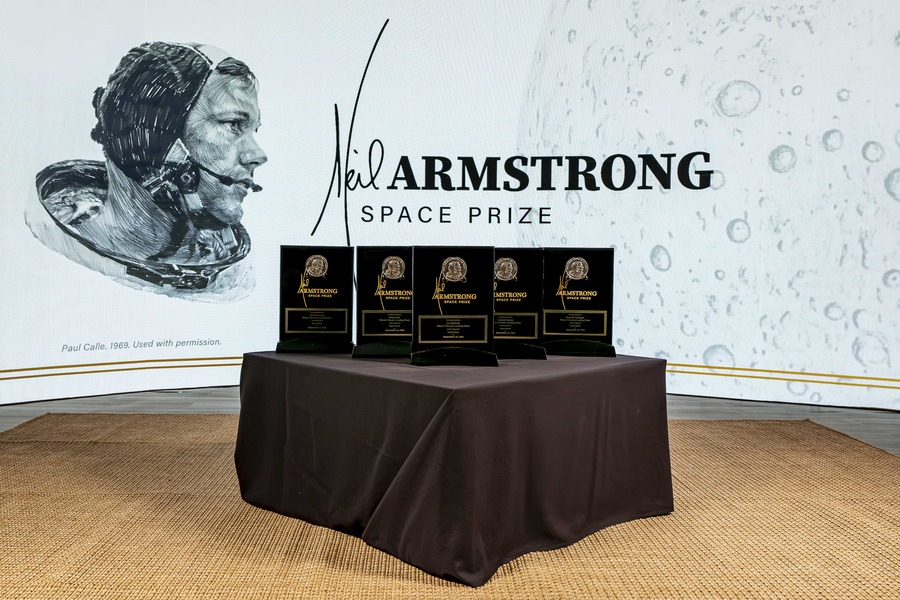
WEST LAFAYETTE, Ind. — When Purdue University set out to create its newest and most prestigious honor, the Neil Armstrong Space Prize, it needed a physical object worthy of the name. Not just a trophy, but a piece that could carry the weight of one of history's most consequential legacies. What followed was a year and a half of collaboration between artists, engineers and students, bridging clay and code, woodcraft and high-precision scanning, to produce a medallion unlike anything its makers had attempted before.
"Neil Armstrong is one of Purdue's most celebrated alumni, and this prize carries that legacy forward in a meaningful way," says Mark Lundstrom, the John A. Edwardson Dean of Purdue's College of Engineering. "Creating the medallion that bears his name brought together the brightest minds across disciplines, from artists and sculptors to engineers and students, to turn an ambitious vision into something real. Seeing it take shape, from concept to clay to precision manufacturing, right here on our campus, is a testament to what Purdue's College of Engineering is capable of."
The prize was conceived as Purdue's version of the Nobel Prize — a recognition, evaluated in the categories of Discovery, Innovation, and Human Achievement, for those whose contributions to space exploration are deemed most consequential for humanity in the preceding decade. The inaugural laureates, announced on April 21, were the Falcon 9 Booster Landing Team at SpaceX, honored for their groundbreaking work on the reusable two-stage rocket system. The recipients were honored at a ceremony in Washington, D.C., in September. Nominations for the next prize are open through November 1, 2026, at purdue.edu/space/prize. But before any award can be presented, it has to be made.

Phase 1: A vision takes shape
The process began not in a studio or a lab, but in a series of meetings. Bill Wolfe, a Hoosier sculptor and painter, brought in Wade Biggs, a designer and award-maker from West Terre Haute whose company Deer Ridge Woodcraft specializes in recognition pieces, to help translate a committee's ideas into a tangible form. The path was not straightforward.
"There were about 40 different layouts and thumbnails made per side," Biggs recalls. Early concepts were ambitious: one prototype featured a model of the Atlas V rocket, mounted on a wooden stand with a backdrop image from the James Webb Space Telescope. Then came what Biggs describes as a happy little accident, as Bob Ross might say. Simply placing the medallion on a high-gloss black piano finish, accented with a black ribbon, transformed the piece. "It gave it the dignity, elegance and distinction it deserves," he says.
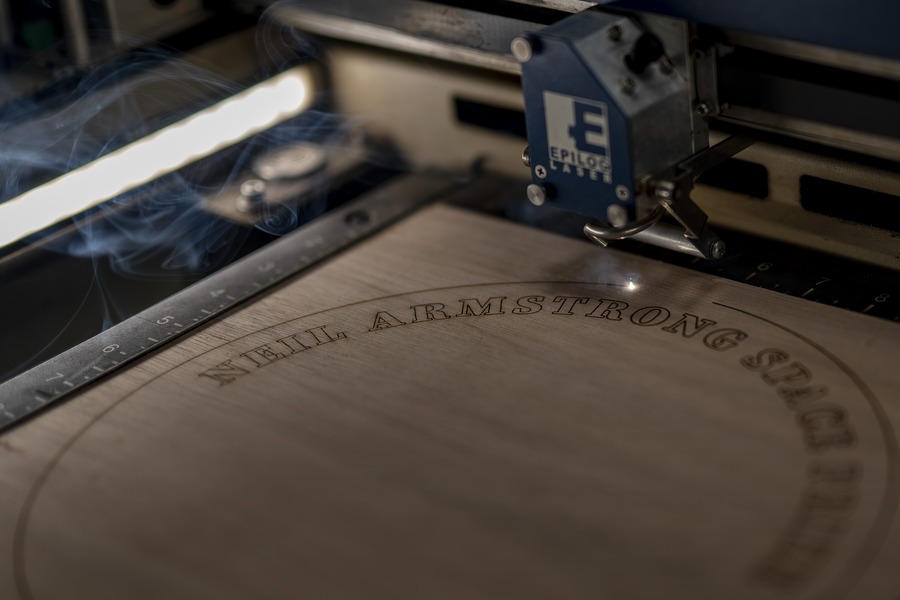
The medallion settled into a standard round shape, with Neil Armstrong's profile on the front and the famous Apollo 11 bootprint on the back. Biggs used computer renderings to identify the appropriate materials, then let a laser cutter handle the precision cutting of layered wood components, which were assembled and glued to create the shell. Then he handed the project to sculptor Bill Wolfe.
Phase 2: Sculpting a legacy
Wolfe was tasked with bringing Armstrong's likeness to life in clay. The starting point was a sketch by artist Paul Calle, whose detailed rendering of Armstrong in his spacesuit had captured something essential about the man. "The relief profile of Armstrong was developed from Paul Calle's sketch, which was so detailed that it facilitated the creation of the dimensional clay sculpture," Wolfe explains.
The back of the medallion presented its own challenge. The bootprint, that singular mark pressed into the lunar surface on July 20, 1969, is one of the most recognized images in human history, but translating it into a sculpted relief required judgment. "I had to take some liberties with sculpting that because of the shadows cast in the photo," Wolfe says.
For Wolfe, who grew up in the 1960s as NASA was first capturing the world's imagination, the project carried a personal weight. "I remember drawing the lunar module and putting the model kit together when I was about 15 years old," he says. "To be asked to be a part of developing this space award is quite an honor."

Phase 3: From clay to code
Once the clay mock-up was complete, it needed to become data. The ZEISS ScanBox, a precision photogrammetry system housed in the Build@Scale Lab in Dudley and Lambertus Hall, was used to capture a comprehensive 3D model of the medallion.
Kylea Hughes, who works with the ScanBox as a graduate student in the Purdue Polytechnic Institute’s School of Engineering Technology, describes how the process works: The clay piece is placed on a rotation table inside the ScanBox, where a FANUC robot arm equipped with two cameras and a blue-light projector captures images from dozens of angles. The software stitches those images together into a precise 3D model. The ScanBox can capture detail down to five microns, ensuring that every mark Wolfe's hands made in the clay would be preserved exactly.
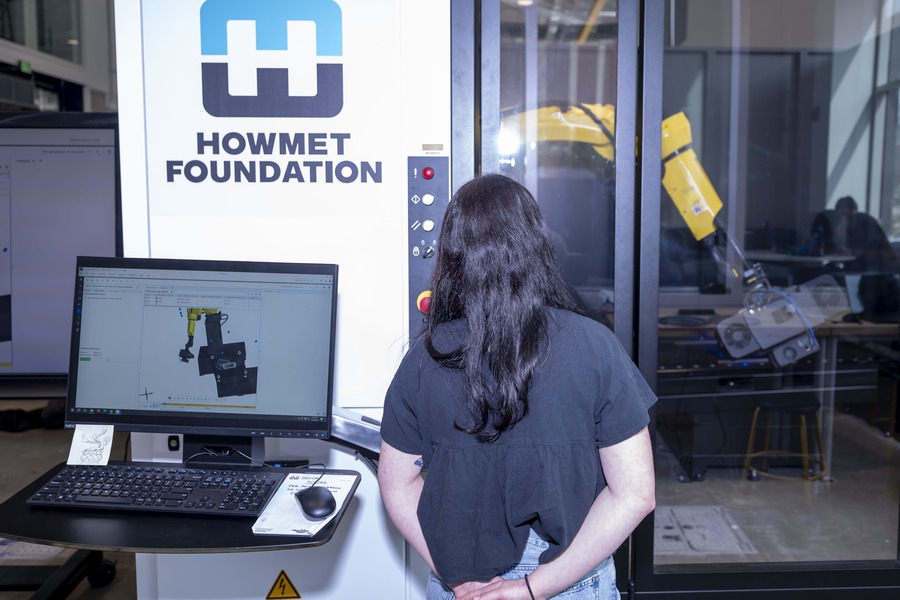
"This precision ensures that every mark the artist put into the clay is captured in the 3D model," Hughes explains. The project was a first for her team in one meaningful respect. "We're used to scanning manufactured parts like gears or turbine components," she says. "This was our first time scanning a piece of original artwork."
Paul McPherson, director of the Bechtel Innovation Design Center, oversaw the ScanBox operation and handled much of the scan refinement work, a painstaking process of converting the high-density mesh file into geometry that CAD and manufacturing software could use. "Such a project is only possible by pulling on the knowledge and expertise of individuals across multiple colleges," McPherson notes. "For Purdue to have such a deep background in the aerospace and space arena, it only makes sense that we figured out a way to make this medallion come to fruition."

Phase 4: Machining the final medallion
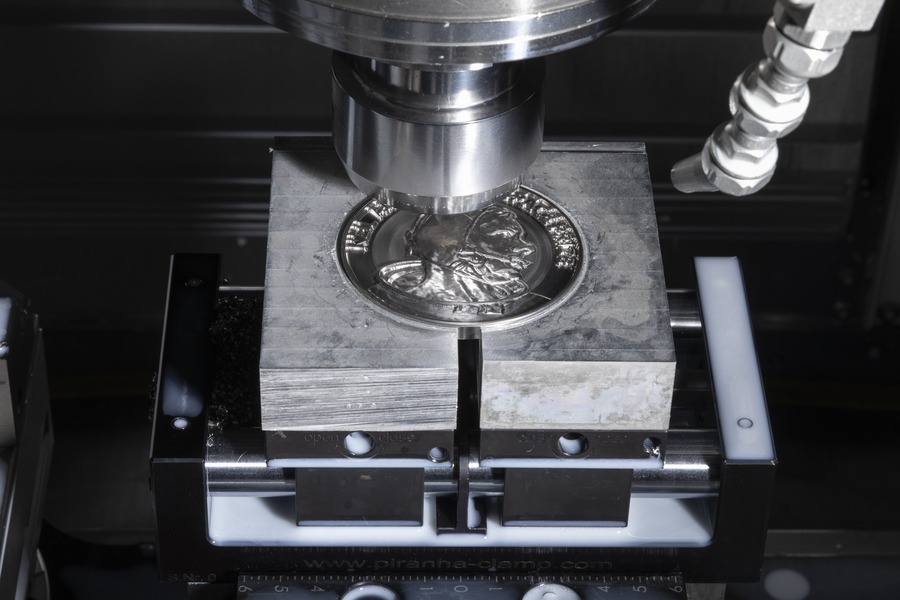
With the scan refined and the CAD model ready, the project moved to the Bechtel Innovation Design Center's metal shop and to Anirudh Pal, the lab's manager of technical services, who was responsible for setting up the CAM programming and running the CNC machining process.
The material chosen for the final medallion is Grade 5 titanium. The decision was deliberate. Gold was considered and ruled out as too expensive. Silver lacked established cutting data. Aluminum scratches too easily. Inconel is notoriously difficult to machine. "Titanium proved to be the sweet spot," Pal explains: exotic, aerospace-grade, affordable and supported by proven cutting parameters.
Each medallion takes approximately 25 hours of machine time to produce, a reality that shaped every decision Pal made. Machining runs overnight and unattended, which is outside standard procedure and required unusually comprehensive CAM programming and detailed setup documentation so multiple operators could hand off the process at different stages. Specialized tooling was sourced from two suppliers: Kennametal, a tooling sponsor, handled the bulk of the cutting tools, while a specialty 1/32-inch diameter end mill from Harvey Tool handled the finest surface detail. That tool, subjected to significant forces over long runs, has proven prone to breaking, a persistent challenge in the finishing stage.
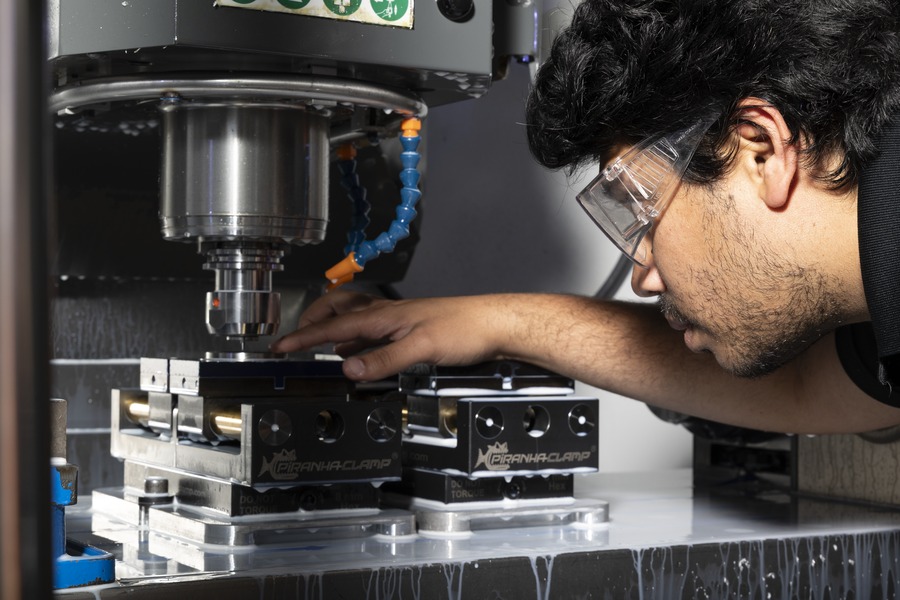
Pal is candid about what makes this project demanding. "I would not describe this part as particularly complex," he says. "The challenges stem more from the miniature tools, long run times and overnight machining cycles. A better word might be tedious." When a standard part fails, it typically happens within the first hour or two. When a run exceeds 20 hours, the cost of a mistake in time, materials and setup is exponentially higher.
As for the finished piece, Pal left something of the process visible in the final product. "I like to leave the machining marks visible on the part because they tell the recipient something about how it was made," he says. "When I look at everyday objects, I can often identify design decisions, manufacturing methods and the compromises that were made during production. It feels like a conversation with the people who created the object. I hope to preserve that element in the medallion in case one of the recipients notices it too."
A giant leap, handmade
There is something quietly fitting about the fact that the Neil Armstrong Space Prize, an award designed to recognize the most consequential achievements in space exploration, began with a farm boy's sketch pad and a sculptor's hands, and ended with a titanium medallion machined overnight in a university lab. Wade Biggs, who sat in an art class when the Challenger exploded and wondered whether humanity would ever truly reach beyond Earth again, found his answer in this commission.
"Despite setbacks and tragedies, the spirit of exploration has never disappeared," he reflects.
The piece passed through the hands of artists, woodworkers, sculptors, engineers and students, and carries within it — in the five-micron resolution of its scanned surface and the overnight hum of a CNC machine — every intentional mark made in service of honoring a man who once pressed his boot into the dust of another world and changed the course of human history.
"Every minute was worth it," Biggs says, "to honor a man who took humanity's first step into the unknown of space."
Author: Tasmiha Khan