
Purdue MEM students partner with EatCloud to expand food rescue through AI-powered WhatsApp solution
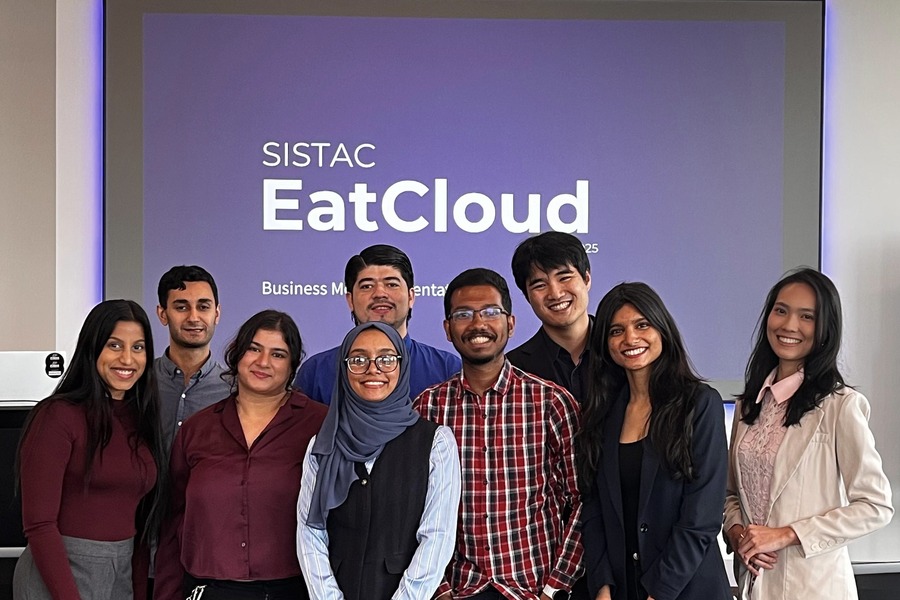
A team of students in Purdue University’s Master of Engineering Management (MEM) program partnered with Colombia-based social enterprise EatCloud to develop technology solutions aimed at reducing food waste while expanding access to food for communities in need.
EatCloud uses artificial intelligence and analytics to help food producers, retailers and distributors safely redistribute surplus food that is still fit for consumption. The platform provides full traceability of donated food while generating data on the economic, social and environmental impact of food rescue efforts, helping companies improve compliance and optimize sustainability initiatives.
As part of the collaboration, Purdue students explored how EatCloud could expand its network of food donors by engaging local farmers. Recognizing that WhatsApp is the most widely used messaging platform in Colombia, the WhatsApp Chatbot team designed a production-ready chatbot prototype that enables farmers to donate surplus crops quickly and easily. The chatbot can complete a donation in less than a minute at a cost of under 10 cents per transaction.
A second student team, ESG Impact KPI Mapping, focused on strengthening EatCloud's impact measurement and sustainability reporting capabilities. Team members José Sándigo and Pooja Bahuguna, a recent graduate, mapped the company’s existing operational data to globally recognized ESG reporting frameworks, identifying key metrics such as food rescued, meals delivered, waste diverted from landfills and carbon emissions avoided. The team also developed a dashboard prototype and implementation roadmap that will help EatCloud transform operational data into standardized, transparent impact reports for donors, partners and other stakeholders. Together, the ESG framework and the WhatsApp chatbot create an end-to-end process that improves both data collection and impact reporting.
Minsung Kim served as the team’s primary liaison with EatCloud, helping define the project’s scope, manage stakeholder expectations and ensure the technical solution aligned with the organization's business objectives.
“Our biggest challenge was overcoming the language barrier because none of us on the WhatsApp development team spoke Spanish,” Kim said. “By communicating proactively, using translation tools and working closely with the EatCloud team, we were able to develop a practical solution that supports both the organization’s mission and the farmers it hopes to serve.”
Kim said the project demonstrated how technology can solve real-world challenges while creating measurable social impact.
Fellow team member Oulaiphone Ouankhamchanh, a Fulbright Scholar from Laos, focused on project coordination, business model development and connecting the technical solution to EatCloud’s broader social mission.
“Our goal was to make food donation as simple and accessible as possible for local farmers,” Ouankhamchanh said. “This project showed how familiar technology like WhatsApp can remove barriers and help more people participate in reducing food waste and improving food access.”
Ouankhamchanh said the experience reinforced the value of practical innovation.
“Working with EatCloud reminded me that meaningful innovation doesn’t have to be complicated,” she said. “Sometimes the most effective solutions are the ones people can easily use in their everyday lives.”
Sándigo, a Fulbright Scholar from Nicaragua, said the ESG project demonstrated how engineering management can help organizations transform complex data into actionable business insights.
“Working with EatCloud to develop a more credible and standardized way to measure and communicate its impact showed me how engineering management can turn operational data into practical solutions that support better decision-making, stronger partnerships and business growth,” he said.
The students said Purdue’s MEM program is preparing them to combine technical expertise with business strategy and leadership. Kim credits the program with broadening his perspective beyond his undergraduate studies in public administration, while Ouankhamchanh said it has strengthened her ability to manage technology-driven projects focused on sustainability and community development.
“The EatCloud collaboration illustrates how interdisciplinary engineering and management education can produce scalable solutions that address global challenges such as food insecurity, sustainability and food waste,” said Eric VandeVoorde, senior director of MEM. “Their work demonstrates that technology, when paired with thoughtful management, can create lasting social and environmental impact.”