
Purdue MEM students teamed up with Kaaro Health to strengthen rural healthcare operations in Uganda
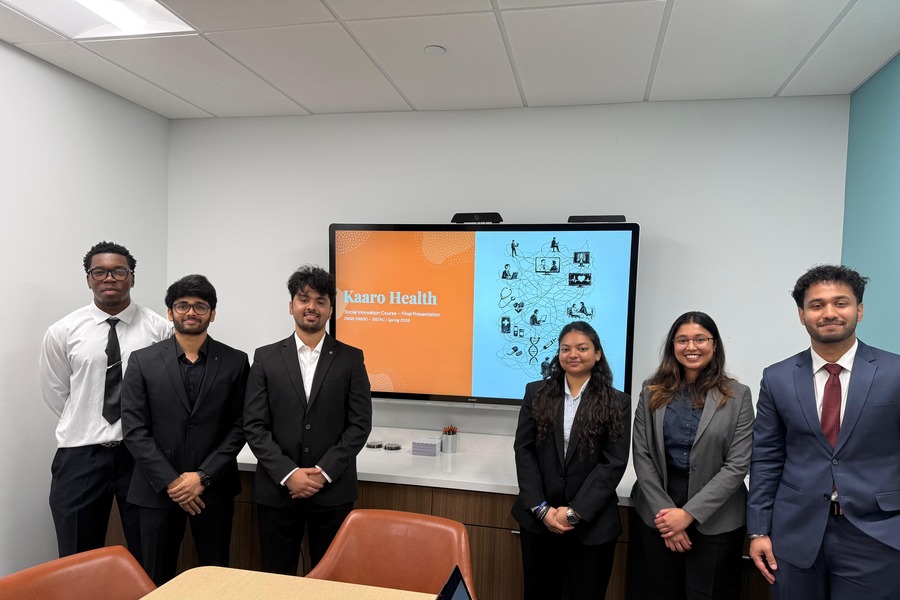
A team of Purdue University Master of Engineering Management (MEM) students partnered with Kaaro Health, a social enterprise that provides affordable healthcare to underserved rural communities in Uganda, to develop technology and operations solutions that support the organization’s continued growth.
Kaaro Health operates nurse-led container clinics, telemedicine services and medical logistics networks that expand access to healthcare in rural areas. The Purdue team was tasked with identifying ways to improve the organization’s operational efficiency and scalability while minimizing disruption to existing workflows.
Over the course of the semester, MEM students Neha Alagi and Greeshma Gala, together with Shrey Rastogi, Devadathan P K, and recent graduates Olan Sodunke and Siddartha Reddy Mudireddy, evaluated Kaaro Health’s business model, analyzed its supply chain and technology infrastructure, and developed recommendations for migrating clinic systems to the cloud. They also created a prototype inventory management dashboard designed to improve inventory visibility and streamline ordering across clinics, along with a phased implementation roadmap for future deployment.
Drawing on expertise in cloud architecture, data analytics, supply chain strategy, business modeling and user experience design, the students collaborated to deliver recommendations that were both practical and implementation ready.
“Our partnership focused on supporting Kaaro’s long-term goal of delivering healthcare more efficiently as it expands its clinic network,” Alagi said.
Through weekly meetings with Kaaro Health’s Head of Engineering, the team gained a detailed understanding of the organization’s day-to-day operations and identified opportunities for improvement. Using seven months of real order data, they developed a working inventory analytics dashboard that demonstrated the benefits of centralized supply chain visibility while replacing manual inventory tracking processes with a more scalable approach.
“Rather than proposing theoretical ideas, our work was designed to align with Kaaro’s current operations while providing a practical foundation for future digital transformation,” Gala said.
The project also challenged the students to rethink traditional technology solutions for resource-constrained environments. Reliable internet access, often assumed in standard cloud architectures, is not always available in rural Uganda. To address this, the team designed an offline-first system that allows nurses to record inventory and place orders without an internet connection, with data automatically synchronizing once connectivity is restored.
They also tackled the challenge of organizing operational data stored in WhatsApp message histories and paper records, transforming it into a structured database that could support meaningful analysis and future decision-making.
Rather than recommending a complete technology overhaul, the students worked closely with Kaaro Health through regular stakeholder meetings to refine their recommendations and develop a phased implementation strategy that integrates with existing workflows while allowing the organization to scale over time.
For Alagi, the project reflected exactly why she chose Purdue's MEM program.
She entered the program to complement her background in quantitative analytics and artificial intelligence with business strategy and leadership skills, gaining experience in communicating technical recommendations to non-technical stakeholders and designing solutions that organizations can successfully adopt.
“The Kaaro project was a direct application of that,” Alagi said. “Recommending a cloud migration wasn’t just an architecture decision. It required understanding Kaaro’s financial constraints, the nurses’ daily workflows, Uganda’s data regulations and what the organization needed to make a business case internally. That layered thinking is exactly what MEM trained me for.”
She said the experience also reshaped her perspective on engineering.
“Working with Kaaro Health was genuinely one of the most grounding experiences of the program,” Alagi said. “Designing within the realities of intermittent internet access, low-cost mobile devices and limited resources required us to build solutions that simply worked. Creating technology under those constraints felt more meaningful than many of the technical projects I’ve worked on.”
Gala said she selected the MEM program because it combines engineering, business and leadership, preparing graduates to bridge technical and strategic decision-making.
“Through the program, I strengthened my skills in product management, analytics, project management and stakeholder communication,” Gala said. “I plan to apply these skills by developing technology-driven products that solve real-world problems while balancing user needs, business objectives and technical feasibility.”
Reflecting on the collaboration, Gala said the partnership demonstrated the value of interdisciplinary problem-solving and reinforced how engineering management can create meaningful impact for mission-driven organizations. The team hopes its recommendations will continue to support Kaaro Health’s future digital transformation and expansion.
“Projects like this demonstrate the power of Purdue’s Master of Engineering Management Program that helps create meaningful impact beyond the classroom,” said Eric VandeVoorde, senior director of MEM. “By partnering with organizations such as Kaaro Health, our students apply technical expertise, business strategy and leadership skills to solve complex, real-world challenges. Just as importantly, they learn how to design practical, scalable solutions that improve lives while preparing to lead technology-driven organizations around the world.”