
Purdue MEM students team with Kenyan agritech startup to strengthen food security through business innovation
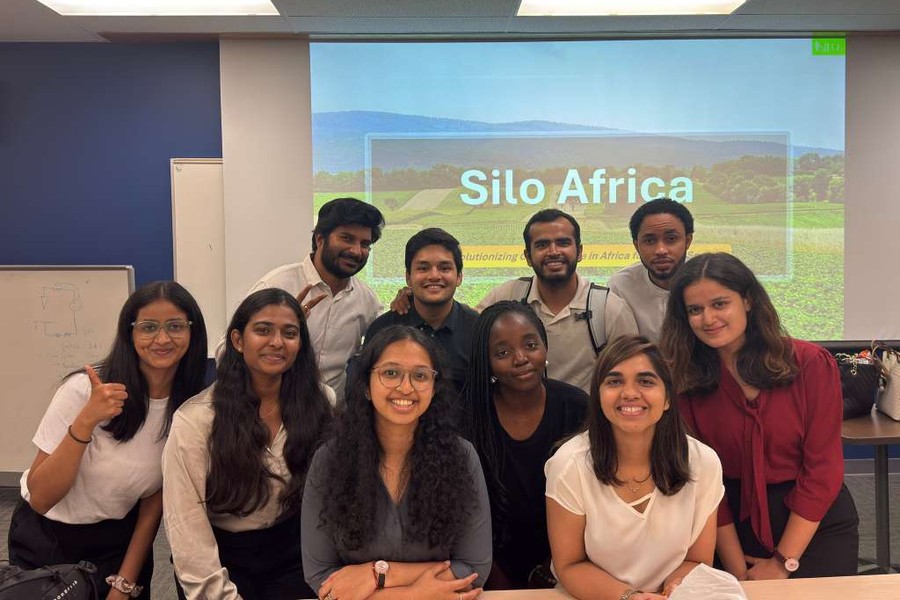
Graduate students in Purdue University’s Master of Engineering Management (MEM) program are partnering with a Kenyan startup to expand its impact on smallholder farmers by developing strategies to support long-term growth and improve food security.
Through Purdue’s Social Impact Startup Academy (SISTAC), supported by the Bayer Foundation, students partnered with Silo Africa, a Kenyan-based agritech company founded in 2022. Working directly with the company’s leadership team, students applied engineering management, business strategy and market analysis to develop recommendations that could help the startup scale its impact across East Africa.
Silo Africa provides digitized grain storage systems that monitor moisture, temperature and carbon dioxide levels, helping farmers protect harvested crops from spoilage and insect damage without relying on chemical insecticides. While the company’s technology addresses a critical challenge for smallholder farmers, its leadership asked Purdue students to explore strategies that could strengthen the business and create new opportunities for sustainable growth.
Over the course of the project, the student team developed recommendations to diversify Silo Africa's revenue beyond hardware sales, while also creating concepts for predictive analytics tools to help farmers and grain buyers make more informed decisions. This included evaluating subscription-based digital services and identifying potential product enhancements to build a more scalable business model. On the technical side, the team built an aflatoxin risk detection model paired with a dashboard that translates model output into grain health status and immediate action items, giving farmers and buyers a clear, real-time read on risk.
For Nishika Nakka, the experience demonstrated that successful innovation depends as much on understanding people as it does on developing technology.
“Working with Silo Africa taught me that successful innovation begins with understanding the people you're trying to help,” Nakka said. “Every recommendation we made had to be practical, accessible and grounded in the realities facing smallholder farmers. Seeing how classroom concepts translated into real business decisions made the experience incredibly rewarding.”
Throughout the semester, the team encountered challenges that extended well beyond traditional business analysis. One of the biggest hurdles was understanding a market and customer base that differed significantly from what they had previously experienced. Students immersed themselves in Kenya’s agricultural ecosystem, learning how smallholder farmers, commercial buyers and other stakeholders make decisions, what they value most and how those priorities shape technology adoption.
The team also had to evaluate a wide range of potential growth opportunities and determine which recommendations would provide the greatest value while remaining realistic for an early-stage startup. Working closely with Silo Africa’s founders and staff, students validated ideas through regular discussions that provided insight into customer needs, business priorities and the realities of operating in the Kenyan market. Those conversations helped the team continually refine its recommendations and ensure they reflected the company’s long-term goals.
Toluwani Oyeleke focused on developing a recurring revenue strategy centered on Silo Africa’s existing digital platforms, identifying opportunities to generate long-term customer value while supporting the company’s mission.
“This project showed me how technology and business strategy can work together to create lasting social impact,” Oyeleke said. “We weren't simply building a business model; we were helping create a path that could allow Silo Africa to reach more farmers and strengthen food security across the region.”
For Kirti Singh, the project reinforced that a good model as a business offering only matters if people can actually use it.
“The technical side was only half the job,” Singh said. “We had to make sure the model’s output turned into something a farmer or Silo Africa’s team could look at and immediately know what to do next with their stored grain. Rural Kenya also faces real last-mile connectivity constraints, so the dashboard had to stay simple and lightweight, nothing flashy, just something that works. In the end, it came down to giving people a clear read and a clear next step.”
Eric VandeVoorde, senior director of Purdue’s Master of Engineering Management program, said projects like the Silo Africa partnership provide students with opportunities to apply classroom concepts to complex global challenges while working directly with organizations making a measurable social impact.
“Projects like this demonstrate what makes the MEM program distinctive,” VandeVoorde said. “Our students learn how to combine engineering, business strategy and data analytics to solve complex challenges for organizations that are creating meaningful impact around the world. They leave with practical experience while delivering value to our partners.”
Through SISTAC, MEM students gain consulting experience while working with mission-driven organizations across the globe. For the Silo Africa team, the project provided firsthand experience collaborating across cultures, navigating an unfamiliar business environment and developing practical recommendations that could help strengthen food security while supporting the continued growth of an innovative Kenyan startup.
Kirti, came from a hardware engineering background into the MEM program. She chose MEM to build program management, product thinking, and cross-functional leadership on top of her technical depth.
"Silo Africa was a direct rehearsal for that," she said. "The project sharpened my ability to hear a room full of competing priorities and align them to what actually drives the product and program forward. That's what MEM gave me, not just frameworks, but the ability to turn all those voices into one clear path."