
Purdue MEM students join Ugandan social enterprise to chart path for sustainable growth
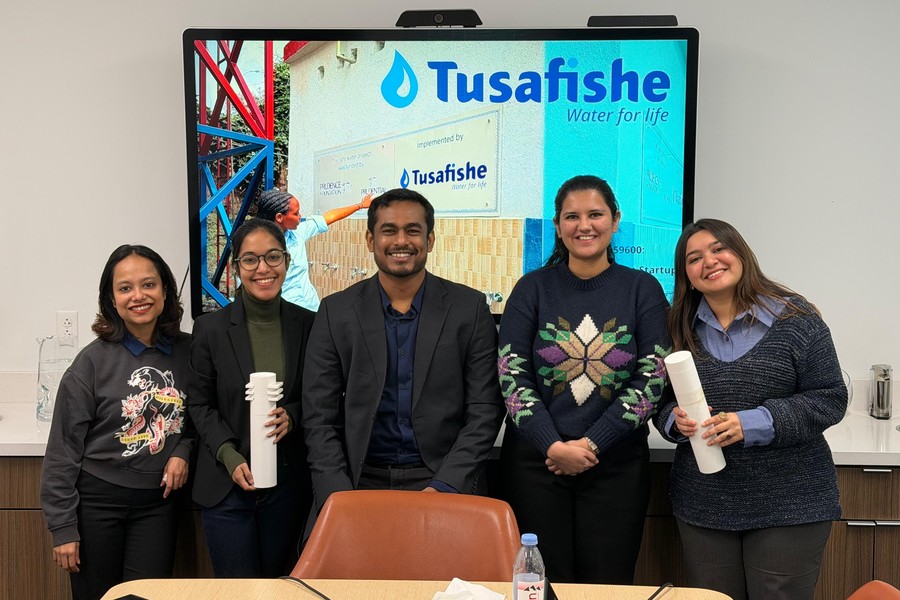
Graduate students in Purdue University's Master of Engineering Management (MEM) program are joining a Ugandan social enterprise to strengthen its ability to deliver clean water to underserved communities while building a foundation for long-term growth.
Through Purdue's Social Impact Startup Academy, two student consulting teams partnered with Tusafishe, a Uganda-based organization dedicated to reducing waterborne diseases and alleviating poverty by providing safe drinking water systems and community training. Led by founder Henry Othieno, Tusafishe develops affordable water purification technologies for rural schools and communities.
The partnership gave students the opportunity to address challenges commonly faced by growing social enterprises: how to expand operations, improve efficiency and create sustainable revenue streams while remaining responsive to local needs.
Building systems for growth
Ferdynan Joehanne Perez and Abishek Girish served on the Unified Digital Platform and Dashboard team, which examined ways Tusafishe could strengthen its operational infrastructure as it moves beyond pilot projects toward broader implementation.
Rather than focusing solely on technology development, the team evaluated systems that could support growth, including Internet of Things-enabled water kiosks, remote sensors, digital payment tracking, operational dashboards and potential opportunities tied to carbon credits. The students also conducted a product teardown to identify cost-saving opportunities and explored sourcing additional materials locally to support Tusafishe's existing circular economy approach to water filter production.
“A lot of their constraints are not the technology itself,” Perez said. “It's the operational backbone needed to grow as they add sites. We focused there.”
The team developed recommendations intended to help Tusafishe better monitor water usage, schedule maintenance, track financial performance and assess long-term sustainability. Throughout the project, students worked to ensure their recommendations aligned with the realities of operating in rural Ugandan communities.
Designing products for a changing market
MEM student Nikhilesh Solai served on the Revenue and New Product Integration team, which focused on helping Tusafishe remain adaptable and visible in an increasingly competitive market. Drawing on his mechanical engineering background and previous experience working on electrification programs at Caterpillar, Solai led product ideation sessions, developed 3D CAD models and oversaw rapid prototyping at Purdue's Bechtel Innovation Design Center. The team designed and tested filtration concepts, iterating from an insertable system using moringa seeds, gravel and microfiltration paper to an optimized three-stage stackable design with improved sealing that they recommended as a potential new product offering.
“We met with the Tusafishe team weekly to understand their business model and hear their perspective on how Ugandan customers view their products and how Tusafishe could better position itself in that market,” Solai said. “They were remarkably open with us about the realities of operating in Uganda, which gave us strong insight as we ran a full business model assessment across desirability, feasibility, adaptability and viability.”
Perez said through weekly sessions with Eric VandeVoorde, senior director of Purdue’s Professional Master’s Programs in Engineering, he learned that social innovation is not just about having the best technical answer.
“We talk a lot about culture, context and how people from different communities experience problems differently,” he said. “Before proposing a solution, we first have to listen and understand the people, the organization and the system around the problem.”
Learning leadership through global collaboration
Working across continents presented challenges. Team members navigated differences in culture, time zones and operating environments while remaining mindful that solutions successful in one region may not translate directly to another.
At first, it was easy to view the project through a technical lens, Perez said, but over time, they realized the bigger challenge was understanding the people and operating model around the technology. Who will maintain it? Who will pay for it? Will the community trust it? Is it repeatable and sustainable? Instead, the team focused on simple, sustainable and repeatable recommendations.
The experience reinforced why he chose Purdue's engineering management program.
“The Tusafishe project reminded me exactly why I chose MEM,” Perez said. “It gave me the chance to work on a real problem, with real constraints, for an organization serving a real community. It showed me that leadership is not just about having the best idea. It is about listening, understanding context, bringing people together and building something practical enough to last.”
For Solai, the project demonstrated how Purdue's MEM program combines technical depth with management and leadership skills.
“Pairing Purdue's engineering strength with the Mitch Daniels School of Business has shown me just how much engineering management comes down to human interaction,” Solai said. “Giving clear direction to sub teams and suppliers is as important as the technical work itself.”
Aritrika Roy came to the MEM program with nine years of experience in cross-functional leadership, AI tool development, cloud migration and process optimization, but wanted a stronger foundation in strategic decision-making, program management and systems thinking to complement her technical background. During a summer internship at Microsoft, she found herself applying MEM frameworks to scope minimum viable products, evaluate architecture tradeoffs and define meaningful success metrics.
“The biggest value of MEM has been learning how to apply structured thinking to real ambiguity,” Roy said. “Using those frameworks during my internship showed me how directly the coursework translates into technical and business decisions. That's the foundation I want to build on as I grow into a technical program or product management role in AI and security.”
For Girish, the project highlighted the importance of building organizational systems that can support meaningful growth.
“Working with Tusafishe taught me how much structure sits behind any organization that wants to grow,” Girish said. “Building that for them is the kind of engineering leadership I want to carry into my career.”
VandeVoorde said experiences like Tusafishe allow MEM students to see firsthand that engineering leadership requires more than designing a technical solution.
"It means understanding people, business models, cultural contexts and long-term sustainability,” he said. “By working with mission-driven organizations around the world, our students learn how to create solutions that are both innovative and practical enough to make a lasting impact."