
Scholarships, Purdue opportunities help first-generation student pursue engineering dream
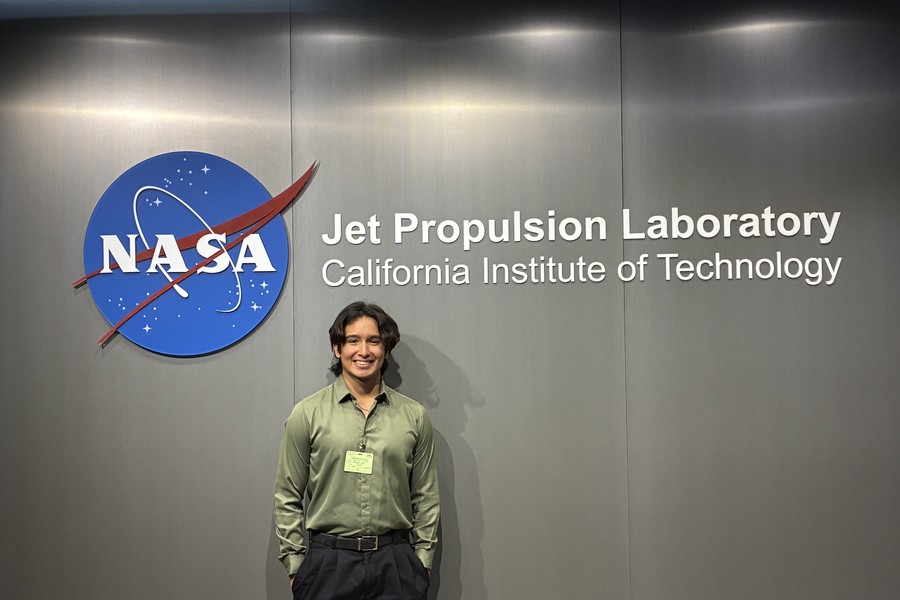
For Jorge Hernandez, attending Purdue University once seemed unlikely.
Growing up in Miami, Hernandez dreamed of becoming an engineer, but the cost of attending an out-of-state university appeared to put Purdue out of reach. As the son of Colombian and Cuban immigrants and a first-generation college student, he understood the financial sacrifices his family had already made to provide him and his sister with opportunities they never had.
Today, Hernandez is a senior in Purdue's Elmore Family School of Electrical and Computer Engineering and is expected to graduate in December 2026. Along the way, he has built a college experience filled with research, student organizations, internships, global experiences and career opportunities that he says exceeded anything he imagined.
His Purdue journey began when he was invited to campus shortly after he was admitted to engineering.
Hernandez and his mother drove from Miami to West Lafayette to attend a program designed to introduce prospective students to Purdue Engineering. During the visit, they learned about student organizations, research opportunities, study abroad programs, internships and Purdue's connections with leading employers.
Within days, Hernandez found himself envisioning a future he had not thought possible.
"I could only think about all the opportunities I would have at my fingertips to build a promising career," Hernandez said. "I had always dreamed of becoming an engineer, and suddenly I was being invited to a place where I could make that dream a reality."
Despite his enthusiasm, finances remained a significant concern.
Hernandez's parents immigrated to the United States seeking better opportunities for their family. Both spent years working in construction, enduring long days of physically demanding labor in South Florida's heat to provide for their children.
"They constantly reminded us to study hard and pursue higher education so we wouldn't have to face the same struggles they experienced," Hernandez said.
Then, during the spring semester of his senior year in high school, Hernandez received life-changing news.
While traveling with his family to Colombia to visit relatives, he opened an email from Purdue Engineering moments before a flight departed. He had been selected to receive two engineering scholarships that would cover nearly 90% of the cost of earning his bachelor's degree.
"I was in tears," Hernandez said. "I never imagined I would be given an opportunity like that to pursue something I had been passionate about for so long."
Determined to make the most of his Purdue experience, Hernandez immersed himself in campus opportunities from the beginning.
Before his first semester, he participated in the Engineering Academic Boot Camp, a five-week transition program run by Don and Liz Thompson MEP and Engineering Student Success that allows incoming students to take classes, connect with peers and learn more about engineering careers and companies.
As a freshman, Hernandez joined engineering organizations that aligned with his longtime interest in aerospace.
He spent a semester working on FlaC-Sat, a Purdue Vertically Integrated Projects team partnered with the Air Force Research Laboratory to design and prototype a 6U CubeSat satellite. Hernandez contributed to software architecture and embedded programming for collecting sensor data that could eventually be used onboard the satellite.
He also joined Purdue Orbital, where he helped develop communication protocols for rockets designed and built by students.
While aerospace engineering initially seemed like the obvious choice, Hernandez discovered a growing passion for programming and software during his first year.
"Coming to Purdue, I thought I would definitely become an aerospace engineer," Hernandez said. "But after taking programming courses and getting involved with software projects, I found myself torn between aerospace and computer engineering."
Resources available through Purdue's first-year engineering program, student organizations and major exploration events helped him navigate that decision. Ultimately, he chose computer engineering and has not looked back.
As a sophomore, Hernandez explored software security through research in Purdue's Trustworthy Software Ecosystem Lab under Santiago Torres-Arias, assistant professor of electrical and computer engineering.
His work focused on mapping the flow of script packages throughout the open-source software supply chain and evaluating potential malware exposure risks.
That same year brought one of the most transformative experiences of his undergraduate career.
Hernandez relocated to Rochester, Minnesota, to work as a software development intern at Mayo Clinic, where he discovered an interest in biomedical devices and the direct impact engineering can have on patient care.
During the internship, he developed a system designed to improve the functionality of a heart pump used during high-risk cardiovascular procedures. Working independently for more than four months, he incorporated variable-speed capabilities into an existing device that synchronized with a patient's electrocardiogram signal.
The technology has the potential to better mimic a patient's natural cardiac cycle during procedures such as heart transplants.
Throughout the internship, Hernandez collaborated with physicians and engineers, visited hospital procedure rooms and refined the device's interface to make it easier for clinicians to use.
At the conclusion of the internship, the prototype was evaluated during a live-animal test attended by physicians and engineers.
"I was nervous," Hernandez said. "But I knew I had put everything I had into the project, and seeing it work successfully was incredibly rewarding."
Following his internship, Hernandez expanded his global perspective through Purdue's Global Engineering Alliance for Research and Education, or GEARE, program.
Although he initially planned to study abroad in Spain, a presentation from another Hispanic student inspired him to choose Singapore instead.
Hernandez spent five months studying at Nanyang Technological University, gaining firsthand experience navigating a different culture and educational environment.
After returning to the United States, he completed another internship at Rincon Research Corporation in Centennial, Colorado, where he focused on digital signal processing and radio technologies. He also worked at NASA's Jet Propulsion Laboratory in California, supporting efforts related to the Deep Space Network, a global system of antennas that communicates with spacecraft operating beyond low Earth orbit.
As he prepares to graduate in December 2026, Hernandez remains grateful for the support he has received from Purdue and its donors.
Scholarships, he said, allowed him to fully participate in experiences that otherwise may not have been possible, including studying abroad through Purdue's Giant Leaps Study Abroad Scholarship and pursuing internships across the country.
"Purdue has opened so many doors for me," Hernandez said. "It allowed me to pursue opportunities I never imagined, and my biggest goal is to use what I've learned to build a successful career and eventually give back to my parents for everything they've sacrificed for me."